Quest for the Frozen Flame: Stripping it for Parts

I adore Paizo’s Adventure paths. They’re a huge timesaver for busy GMs, and not just those who want to run a long pre-written campaign! You can easily pull out interesting scenarios from the APs. After that, you can rub off a few serial numbers and slot them into your custom campaign with no one the wiser. I’ve written about this for other APs, and now it’s time for me to give Quest for the Frozen Flame the same treatment.

A bit of background

Frozen Flame is an awesome AP, but it’s not for everyone. It has a ton of wilderness exploration, and you’re deep in Book 2 before you see a town of any kind. The only bustling metropolis is in book 3, so if your group depends on friendly shops to gear up, they could be in trouble.

That said, having a bit of wilderness can be good for even the most city-bound campaign! It lets players experience something novel and test out skills that probably never get used if they get to retire to a comfortable bed every night. Frozen Flame has scores of scenarios that you can pick up and place in your own campaign with minimal fuss.

Book 1

The Hunt

This is a nice, small encounter for low-level players that encourages breaking out their skills, cooperating with each other, and planning ahead. Depending on how careful the players are, it could take up a good chunk of a session, and could be useful if you have players still figuring out PF2 rules.

Rockloom

This is another encounter that could take up a session or less of game time. The players are tasked with fixing a holy site, and doing so requires a combination of fighting, talking, and skill checks. This is a good encounter to teach new players that not everything needs to be hit with a stick in order to be dealt with.

Red Cat Cave

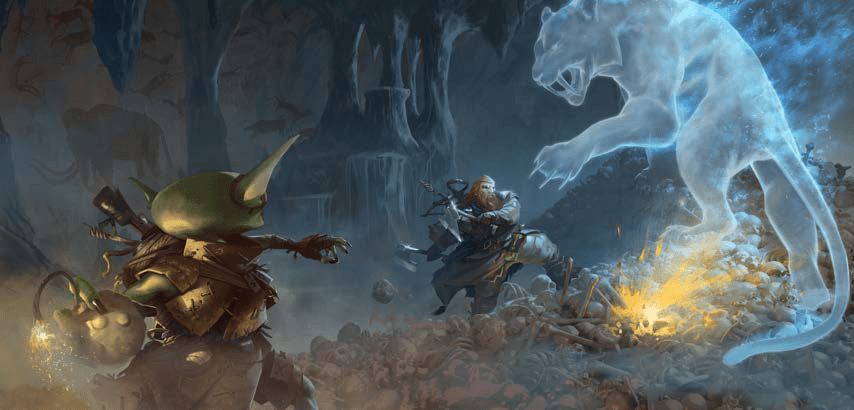
This is a small dungeon that could take a focused group one to two sessions. It’s another scenario that incorporates diverse encounters: Some are smackable, some are talkable, and there’s even a haunt! At the end, there’s a convenient place to do a data dump for your own encounter, since who knows what the Red Cat happens to know that the party could need?

Hex Maps

If you ask me for my opinion of Frozen Flame, one of the first things I’ll gush about are the hex maps. They’re honestly awesome, and made me want to do more hexploration. That said, the hex maps in this book are a bit sparse, but for good reason: The party in the book is being chased by another tribe who wants to wipe them out. There’s not a lot of time to chill out. If you use the book one hex maps, I’d recommend filling them out with campaign specific encounters. Alternatively, you could also leave them as is, but add your own pressure to the party. They could be chased, or they could also have a tight deadline to meet, like a celestial event (this works well if you still plan on using Red Cat Cave). Some other ideas: a meeting that needs to be intercepted, tracking another group that is slightly faster than you, or a natural disaster the group is trying to get ahead of.

Note: I recommend moving event K to a location in the path of the party, because it’s super easy to miss. Even my completionist crew missed it, and they rarely miss anything.
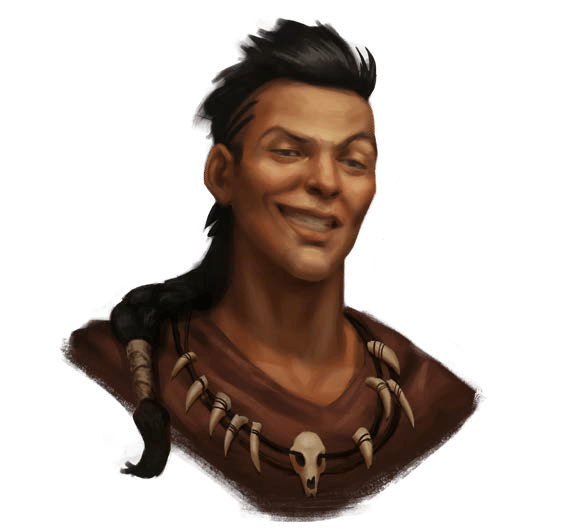
A smirking young man in tribal dress.
I mean, look at that face. Who wouldn’t go to the ends of the earth to punch it?

Pakano

Is your campaign missing a low-level villain that will make your players rage out every time they think he might be close? Well, here you go. I’ve run many games for my crew, and I’ve never had them hate an NPC as much as they hated this little turd.

Book 2

Calamity Caves

This is a big cave system that could take several sessions to finish. It also has a twist: Rather than just trying to find your way through it, you have to clear a path big enough for a following to go through. In the AP, this is your following, but it could also be a caravan that’s contracted the party to get them to a location on the other side. You could also ignore this twist if your players are completionists who won’t leave a single part of the map dark.

As for the encounters, they’re a diverse collection of social interactions, animal handling, quite a bit of fighting, and some traps. There are a few encounters that are specific to Frozen Flame, but you can drop in your own plots fairly easily. It should be noted that the PCs could leave the caves with some cute baby animals that will grow up to be rather fierce, so keep that in mind as they go forward.

Hex Maps

Seriously, this book has what I consider to be the gold standard for hex maps. Yes, it’s small, but most of the hexes have multiple locations to explore. Some of the events are even linked to each other, so it feels more like an actual ecosystem rather than a series of random tables taped together. It’s built for thorough exploration, and could easily take many sessions to complete.

The overall goal is to find the town Lubya and its Galacial palace, but this could be replaced with a custom set piece for your campaign. Some of the events might have to be tweaked, but as long as your custom plot includes a jerk BBEG, you can probably just change names.

Lubya

Lubya is a town in trouble that could be anywhere that’s isolated, keeping the citizens in place rather than running off to find a better life in a nearby metropolis. It’s being run (controlled) by an evil dragon and his lackey, and the citizens are wary of any offers of help, lest they be a test by the duo. The goal is to win the trust of the locals and free them from the despots.

This scenario involves a fair number of skill challenges, social encounters, as well as some fights. A group could easily take two or three sessions to finish it, excluding the Glacial Palace dungeon.

Glacial Palace

The Glacial Palace is a mini-dungeon that’s technically attached to Lubya, but it could be placed anywhere. It doesn’t even need to be somewhere cold, since the ice dragon within is the one keeping it kept up. It’s main occupants are an evil ice dragon and his lackey, as well as a collection of undead and dragon-type creatures. The only creatures that might need to be replaced if you move the scenario from the Crown of the World are the Zombie Mammoths, but it’s not like Big Undead are hard to find in Pathfinder 2e.

Though small, it’s still a challenge for the group due to limitations on movement, a few interesting battle maps, and creatures who have the home team advantage.

Book 3

Hillcross

Hillcross is a location where tribes gather to bask in a magical spring for a time. Though not strictly defined as a ‘town’, it acts as a level 8 settlement. Technically, it’s the size of a small town, but due to tribes moving in and out all the time (and coming in prepared to trade), it mechanically acts much bigger than its population.

If your party isn’t gathering a following, they can still use the various tribes to gather information or favors in a custom campaign. There’s also a battle for Hillcross that kicks off after the PCs have had a chance to settle in and schmooze a bit. The battle gives an enthusiastic group a chance to act like Big Damn Heroes, and this time for an audience!

Hex Map

While the hex map for this book isn’t as packed as Book 2’s, it’s still quite good! It comes with a number of random tables based on hex that can make it feel fuller than it is. It also includes several encounters that range between places of calm and peace to blood and guts, so it has something for every type of player. Due to the way it’s set up, with one entrance and one exit, it could placed between the party and their goal. Even if the party beelines for the exit, they’ll be forced across multiple terrains, so will still have fun.

Castle Grimgorge

Grimgorge is a sizable dungeon, set in an abandoned castle that’s been taken over by demons, the undead, and a very punchable worm. It offers more than a few challenges, even with a seasoned party. My group, who normally curb stomps end bosses, actually struggled with the worm and his witch, but in a way that felt rewarding. The fights aren’t unfair, but they do reward a party that coordinates with each other and plans ahead.

Note: Some of the fights mention a cursed item that the party acquires during the plot of Frozen Flame. You can ignore those mentions, for the most part. Even with the artifact in hand during our game, it didn’t change outcomes much, and can become a punishing artifact for a party that hasn’t bought into the overall goal of Frozen Flame.

Final thoughts

If playing all of Frozen Flame isn’t for you, I still argue that you can rip many of the scenarios out and use them in almost any campaign. After all, even the most city-bound group has to travel, and Golarion is filled with nearly empty roads and stretches of untamed wilderness that should be filled with adventure.

Quest for the Frozen Flame AP: Book 3 Summary and GM Experience

Every year, one of the talks at PaizoCon involves upcoming adventures. When they said they had an upcoming AP that involved megafauna, I squealed so loud I woke our dogs. Megafauna are awesome, especially if you can ride them, but in many campaigns, they’re simply not practical to keep around. If you’re wandering around the frozen tundra, though, they could actually be useful in most situations! I immediately started collecting players. As soon as I was able to read the first book, we got cracking, playing monthly sessions of 2-3 hours each.

Just over three years later, we finished book three, with the PCs having gone from minor players in a dying tribe to movers, shakers, and saviors of the great northern tundra.

Warning: I'll be gleefully spoiling the books past this point, so if you plan on playing in a Frozen Flame campaign, close this tab!

Summary of Book Three

From Paizo:

The Broken Tusks find sanctuary at last in the settlement of Hillcross, but invading frost giants quickly force the clan’s scouts to lead their mighty following’s defense against the siege and take on new titles. To put a stop to the slaughter, the newly named Mammoth Lords take the fight to their foes by riding their bestial mounts through the sucking muck of the Tamarnian Tar Forest. At the heart of these black woods, amid the ruins of a half-sunken crusaders’ castle, the heroes wield the sacred light of the Primordial Flame to defeat their ancient enemies once and for all.

The overall plot of book three revolves around not only keeping the Primordial Flame, but also removing its curse. The only lead they have in that department is to follow the path of the former Tusk who took it (Metuak), which is leading them towards Hillcross, a large, magically enchanted encampment used by the various tribes to rest and connect with each other.

The first chapter involves the Broken Tusks getting pulled into the politics and interpersonal dynamics of Hillcross. Besides having PC Glow, they also have a magical artifact that gains them a certain amount of attention. The quiet can’t last long, though, as Ivarsa and the Burning Mammoths finally track the crew down and begin an assault on Hillcross.

The PCs help repel the first assault, but realize they really need to continue on their quest. Leaving their tribe behind to help defend Hillcross, they make their way west into the Tamarnian Tar Forest, a land blighted by multiple evils. After some fighting (so much fighting) and meeting some allies, they finally make their way to the Metuak’s prison, Castle Grimgorge. There, they face down not only their tribe’s troubled past, but what remains of the Burning Mammoths.

How’d it go?

The players

My players continued to really enjoy this AP, getting into their roles as Big Damn Heroes every chance they could. They never missed a chance to recruit people to their following, and probably kept track of who they had better than I did. They also loved the final showdown with Pakano. I’ve run quite a few Adventure Paths, and never have my players hate anyone as much as they did Pakano. Some players might have cried foul for having to defeat an NPC twice, but mine relished the chance to put him down again.

No lie, their primary goal for going to Grimgorge was punching him in his stupid face again. Removing the curse was secondary.

Speed run

For this AP, I wanted to try a new way of speeding the AP up. While I have no issues with running APs as is, I also love playing around with them to see how tweaks can change how the content feels. In this case, I wanted to try doing a ‘speed run.’ Every time we started a new book, the players would be at the max level for that book. They wouldn’t level up again until the next book, when they would level up to the max for that book. So, for book one, they started at level three, for book two, they were level 8, and for book three, they were level 11.

I was delighted to see that my theory held. Combats early in the books sailed by, and became appropriate challenges by the end. They weren’t so powerful that everything was a cakewalk, but they did feel pretty darn powerful. One side-effect for this AP was that they didn’t hesitate to explore everything, since they had more time on their hands. A lower-level group would have had to rest more, meaning the time limit would have started bearing down on them, so they might have opted to skip swaths of the hexploration or some of the side-quests.

And yes, three years for three books seems like a long time, but we only played one two-hour session a month. According to my back-of-the-envelope math, that puts us at about the same rate as most APs. Had we been playing in non-speed mode, I have a feeling they would have skipped quite a bit to stay on track.

My thoughts

The biggest shock for me with this book was how hard the fight with Pakano and Ivarsa was. My players are ruthlessly competent, so they often curb-stomp boss fights. It proved to be a challenge, with PCs going down a few times. This was a good thing, though. The party hated Pakano with every fiber of their beings, so they relished a longer fight.

I really enjoyed running Hillcross and the politics there. It was a nice break from hexploration, and was a chance for the PCs to roleplay in a more open space.

Speaking of hexploration, while still good, it wasn’t as good as what was in Book 2. That’s not saying it was bad! Book 2 was Doublestuff Oreos, and Book 3 was original Oreos.

Finally, Book 3 is a great payoff for PCs who have invested in collecting a following. How many people they’ve gathered changes the outcome of the battle of Hillcross and how their tribe is viewed going forward.

Recommendations

ABP is still vital for this AP. Hillcross is he first major city the PCs run into, and they’re almost done with the AP at that point. If you don’t want to use ABP, make sure you have multiple crafters in the party and adequate downtime for them to get everyone geared up.

Also, by the time this book rolls around, you might have a group where every PC is mounted. Make sure everyone has read the rules on mounted combat, and that you’ve thought about how to potentially deal with mounts that can fly. This is important not only for battlemaps and how you represent them, but how they might skip encounters by going high. I’m a huge fan of players figuring out creative ways around problems, but I also like to be prepared.

The hexploration is set up differently in this book, with each hex requiring a different flat check and then a roll on another table. Set up a quick reference! I printed out all of the tables and taped them into my notebook so I wasn’t constantly paging back and forth in my PDF.

You also need to keep very careful track of lieutenants and following numbers. This changes the end of the book!

Finally, make the group consider who carries the Primordial Flame very carefully. It can’t be swapped around on a whim, and losing it sucks. While keeping hold of it isn’t that hard, generally, there are a few places in the AP where someone will attempt to take it. If the attempt succeeds, a PC could be in for a world of hurt for a while.

Who is this AP for?

As much as we all loved this AP, it won’t be for everyone. It’s one of those gems where some groups will dive into it, and others will fight it every step of the way. I would recommend it for groups where:

  • The players are into wilderness survival. Though the AP doesn’t force the issue often, a GM could easily build it into their hexploration.
  • Someone is really into crafting. Because there are almost no cities, the party will be reliant on crafting to gear up. This could be a player’s moment to shine!
  • The players enjoy finding non-violent solutions to encounters. This AP is rich with situations where a bit of roleplay can earn long-lasting rewards.
  • The players love exploration. Every book features a section with a hex map that could easily be expanded to add PC specific encounters along the way, if a GM wants.

So who isn’t it for?

  • Lone wolf groups. This AP assumes that the players will build a following over the three books. Failing to recruit (or even striking off on their own) can make some encounters more difficult and lead to a less satisfying ending overall.
  • Groups who prefer city adventures. There’s only two of them, and one of them, you’re sneaking around and not doing a lot of shopping or galivanting.
  • A group that is motivated by loot and gold, and not by causes. Seriously, there’s not a lot of loot in this adventure, and the reason for doing things boils down to “It’s the right thing to do” or “This will help the tribe.”

That said, I think it’s a fun AP for a group who is willing to go all-in on the premise, and has a gratifying dénouement for those who make it all of the way through.

Quest for the Frozen Flame AP: Book 2 Summary and GM Experience

A while ago, I posted about running Quest for the Frozen Flame, a Pathfinder 2e Adventure path. This past month, we finished book 2! In the interest of making the blog posts I wish existed, I wanted to do a rundown of the book from the GM perspective.

Warning! Past this point, there be unfettered spoilers for the Frozen Flame AP, including some for book 3. If you’re a player who hasn’t finished the AP yet, close this tab!

Book 2 Summary

Overall summary from Paizo:

In the brutal tundra of the Realm of the Mammoth Lords, only the hardiest folk have what it takes to withstand unsparing weather, track down big game, and fight back hostile followings. The Broken Tusk following has survived another winter, but a new year just began, and signs of danger foretell a year unlike any before.

This book opens with the tribe navigating a set of caves. The path behind them is blocked after the closing events of book one, so the only way forward is through them. The group is tasked with clearing a path to the exit for the tribe, which contains many vulnerable members who can’t fight or navigate traps.

No Paizo AP is complete without a dungeon, and I’m pleased to report that these caves were quite a bit of fun to navigate. They had a mix of fights, terrain, traps, and even social interactions that made them feel more alive than Diablo-style ‘kill all the things to proceed.’

The group eventually gets the tribe through, finding themselves in a valley that’s been ‘lost’ to Golarion for some time, and is being ruled over by a white dragon who wields the Primordial Flame. If you like hexploration, you will love this chapter. The goal here is to build your tribe’s number along with your reputation so that you have the manpower you’ll need to take back your tribe’s stolen artifact.

Finally, the players come to the glacial palace that houses the mad white dragon. A town at the foot of the palace, though, holds people badly in need of liberation. Depending on how much word has spread of your deeds, they may or may not help you with the final assault.

How’d it go?

The players seemed to enjoy this book quite a bit. They really got into the idea that they had to recruit new tribe members as well as spread their reputation throughout the land. Also, being a team of completionists, they were more than happy to clear a pretty sizable hex map. They also seemed to appreciate the mix of social and combat encounters, since we absolutely have some PCs who are more geared towards being faces than fighters.

Speed run update!

With this AP, I wanted to try an experiment with leveling. Rather than leveling up with XP or by milestones, when starting a new book, the players were asked to level for the max level for that book. So, for this book, they were level 7 throughout.

As predicted, this made the first half of the book fly by, with the end of the book feeling like it was an appropriate challenge. What was interesting here was that the book didn’t seem to take less time (at least, by the numbers), but I think the trade-off for this book was different. Rather than moving faster, the players were extremely thorough, tackling every last hook they ran into. If we were running this at a ‘standard’ speed, I could see it taking way longer than a normal Paizo book. That, or players would be more picky about what they explore. In theory, there is a time limit for them to escape the valley, but this didn’t come into play with them being higher level. Had they been a more appropriate level, I think they would have felt the crunch.

I still think this method works well for this particular AP, if you’re limited on time but don’t want to pull encounters.

My thoughts

I absolutely loved the hexploration for this book. If you’re planning some hexploration in your game, pick up this book and check out how they did it. Lots of the hexes connect to each other, plot-wise, and there’s a great mix of encounters, from curiosities to social to combats. The fact that there was a solid reason to explore was the cherry on top of the sundae.

Now, don’t get me wrong: The caves and the liberation of Lubya were awesome too, but the hexploration was really where the players got to lean into being Big Damn Heroes and forging their way. It’ll be the thing I probably think about when I think back on this book in the future.

My recommendations

Spreadsheet. Holy crap, you need something to track the reputation and following. Encounters will sometimes give rep, followers, or both, and it’s painful to go back and figure out how much the players have gained over the last few sessions. Make a spreadsheet and update it diligently.

Calendar. I didn’t need this, but if you’re running this at a normal pace, you need to keep track of days! I’d recommend adding it to the hex map, since that’s where most days will advance.

Show their progress. On the splash screen, I gave players an abstracted way of tracking their reputation. Fair warning, though: The needle won’t move much until they’re past the midway point of the hex map. I reminded them that they simply hadn’t encountered enough people to get the rumor mill started.

Screenshot of a splash page. There are two scraps of paper with notes on them.

First scrap: Broken Tusk Reputation: The Sutaki will follow the Broken Tusk to the ends of Golarion!

Second scrap: Followers gained: 122

Don’t rush! The players will know what direction their goal is in pretty early on, and will pinpoint the exact hex not long after. Encourage them to take their time and build up their reputation and following! That’s where all of the story is, and if they show up known with a small following, it could be painful.

Next book!

Not going to lie: I’ll miss the hexploration. There’s some, but it’s not nearly as robust as what Lost Mammoth Valley has. I still think the book will be fun, though, with lots of chances for the group to act like Big Damn Heroes of their now huge tribe.

Hillcross looks like it’ll need some careful management, but it’s been a while since I read the book. Time to go refresh myself, I guess.

The thing I’m most excited about? One last encounter with Pakano. Seriously, I’ve run a lot of Pathfinder, and I’ve never had players hate someone so thoroughly.

Quest for the Frozen Flame: Book 1

When Paizo announced that they were releasing an Adventure Path set in the Crown of the World, my first reaction was to squeal MIMMIFS and immediately recruit a group. Let’s just say I’m super into a campaign where mammoth races could potentially be a thing.

The group

Because people will ask, the group make-up was:

  • Human Gunslinger
  • Orc Monk
  • Human Alchemist
  • Orc Battle Oracle
  • Elf Fighter

We opted for monthly play because everyone involved tends to be busy, and bi-weekly slots are precious. Only one person was new to PF2, and everyone had significant experience with TTRPGs. Hell, a few of them had even played in a wilderness campaign before.

The set-up

I decided to run this game with Automatic Bonus Progression, because it takes the pressure off of me as a GM. It means I don’t have to worry about players getting runes at the right time in order to keep balance, and they can save their cash for more interesting options. 

I didn’t use Free Archetype because the AP didn’t explicitly recommend it, and none of the players were clamoring for it. 

Otherwise, I had no limits, outside of anything tagged Unique. If it’s printed by Paizo, it’s up for grabs. 

And… I decided to try something new.

Speed run!

I love the idea of running APs in non-traditional ways. While I still enjoy (and default to) running them as written, I’m drawn to the idea of mucking around with them. For this game, I pitched an idea to the players: SPEED RUN.

Rather than start at level one, players would start at the max level for that book. So, they start the game at level 3, at the start of book 2, they’ll be level 7, and at the start of the last book, they’ll be level 10. My hypothesis was that the players would blast through the first half of the book, but by the end, will be appropriately challenged. 

I wasn’t doing this just because I could. My biggest concern with the game was that we could only play once a month, and one player was in a drastically different time zone, so would be staying up until WTF o’clock to play with us. I wanted to keep things moving at a decent clip without taking two years to finish one book. I considered streamlining the AP, but this can be tricky: Sometimes, that innocuous encounter comes up again later, so if you skip it, you could end up having to frantically backfill content. 

I already spend enough time prepping. I don’t want to spend even more time re-writing. 

In the end, it played out just how I thought: Players raced through the first two chapters, but by the last chapter, were appropriately challenged. This does mean players don’t get a chance to get used to their classes over time, though, so I’d only recommend it for a group with some experience. 

So, how’d it go?

Warning: After this point, I will be spoiling with unfettered glee. Abandon all hope of a blind run, and that includes my players.

The book

In this AP, you play as members of the Broken Tusk tribe. The players are at the cusp of being accepted as official scouts, whether they’ve been with the tribe their entire life, or only the past few months. The main conflict is facing off with a rival tribe that they were once a part of, who have, quite frankly, lost their god-damn minds. 

When Paizo said that this was a wilderness campaign, they were not joking. There are no towns, encampments, other tribes, magic shops, ANYTHING you can trade with during book one. You do find treasure, but if your group is loot hungry, it won’t be enough to satisfy them. Yes, crafting is a thing, but you spend much of the AP literally on the run. There’s no downtime to speak of, unless you want to risk coming face to face with your rivals.

While there were lots of fights, there were also lots of opportunities to solve conflicts peacefully. Nearly every encounter included a chance to recruit members to your following (something that becomes important later), or to walk away without a fight. If you have players who are always looking to avoid coming to blows, they’ll have lots of chances to stretch their social skills. 

What’d the players think?

The players seemed super engaged with the plot, and quickly caught on that they were going to have to take the wilderness part of the story seriously. They also all agreed that without ABP, they would have been struggling.

Also, they hated, and I mean HATED, the personal antagonist. While the Burning Mammoths are the real danger, the face of them throughout the book is Pakano, a jerk from your tribe who defects to the enemy. Something about this NPC rubbed them the wrong way, and the normally peaceful PCs were thirsting for his blood. In fact, one told me that his eventual death didn’t feel bad enough

My thoughts

Personally, I think this is an awesome AP for anyone who’s up for the challenge of surviving in the wild and living communally. The only issue I had was that there was no motivation to explore, since you were being chased. Okay, the Burning Mammoths are way behind you and quite a bit slower, but the pressure is still on. One encounter was so far out of the way that I couldn’t imagine a group ever going that way, unless they were extremely cocky or obsessive completionists.

Even with ABP, loot is still very low, so if you have a hungry group, I’d recommend planting a traveling merchant somewhere, or establishing a crafter in the following who can provide certain items. You may even want to tweak the rules to make crafting on the run easier to do.

I didn’t push hard to get players to grow the tribe, since in this book, it’s not super important. They passed over a few encounters where they could have recruited someone, but this was mostly because they were focused on the task at hand. Having prepped book 2, though, I know I’m going to have to push them to get more people to join up. In fact, I’m going to put a rough counter on the start page so we can all keep track. 

My recommendations

  • Automatic Bonus Progression, in case you missed that
  • Figure out crafting and/or shopping 
  • Make sure players have their skills covered. There are lots of skill checks in this AP.
  • If no one is playing a healer, plan for that (or let the bodies hit the floor). Maybe a healer in the tribe, or a steady supply of discount healing potions?

Next book!

I just finished prepping Book 2, and I’m stoked. It has a small dungeon crawl (it’s Paizo, there always has to be at least one), and so many more opportunities for exploration and roleplay. If your players were annoyed by being chased, rest easy, because the Burning Mammoths are basically stuck behind an ice wall, giving players a chance to explore at their leisure.

(Image credit: Paizo, from the Player’s Guide)