
I run a lot of games. Like… a lot. I have a bi-weekly home game where we swap around who’s GMing, a bi-weekly stream, and a whole slew of monthly games. This wouldn’t be possible without three things:
- Pre-written adventures
- The ability to do remote games
- Lots of organization
Because I get asked, I figured there’s no harm in documenting how I prep Adventure Paths. Heck, maybe it’ll inspire someone who wants to GM but says they have no time to pick up an AP.
Caveats
I’ll say this up front: I am an over-prepper. I know my self too well. Improv-heavy games wreck havoc with my anxiety, and I find myself unable to really enjoy the act of GMing if I’m doing too much on the fly. I would much rather prepare for a fight that never happens than have to throw one at the last second. Not everyone needs this level of prep in their life! Take what works for you!
Also, I prefer this to homebrew campaigns. I’ve done several, and while fun, they require a LOT more work on my end to come together the way I want. I still do run homebrew, but the vast majority of what I’ll run is going to be pre-packaged.
Why do all this?
As I said before, I get super stressed if I feel under-prepared. I can generally hide it, but that doesn’t make it any less unpleasant to live through. If I’m prepared, I can chill out during the game, drinking my tea, secure in the knowledge that I’ve planned for most of the zigs and zags.
I also have small chunks of downtime in my day-to-day life, but a lack of large chunks of open time. I can sneak in 15 minute activities with no shuffling around, but one “Oh, by the way”, and my four hours of free-time on a Saturday morning are gone.
Finally, I love maps with walls and doors and lighting and music. I like a pretty VTT experience. You can’t really get that if you’re cramming.
Before prep!
I’m in the market for a new AP. What do I do before I start getting into it?
- I read the summaries for the chapters. I want to make sure the vibe matches what my group is looking for.
- I check the Paizo forums for that specific AP. They can be a treasure-trove of lessons-learned, suggestions, warnings, and re-drawn assets.
- I read the Player’s Guide. It’s tempting to skip this step, but there’s details in the guide that aren’t in the AP.
- I brow-beat my players into reading the Player’s Guide. Seriously, players who skip this often end up screwed over later because they selected a class that won’t work, or didn’t invest in a skill that comes up all the time.
Let’s talk prep!
I prep in three cycles: Reading, monsters, maps.
Reading
I don’t read the whole AP at once! I know some people do this, and good for them, but I prefer to work one chapter at a time. I would rather start playing sooner than put it off for a few months while I get through a whole slew of reading. I’ve found that as long as I’m two chapters ahead of the players, I generally have enough buffer to work with.
I also highlight a LOT. I use three colors: one for plot bits I don’t want to miss, one for DCs that aren’t already in a monster/hazard block, and one for treasure. My goal is to be able to find important details at a quick glance without turning my whole document yellow.
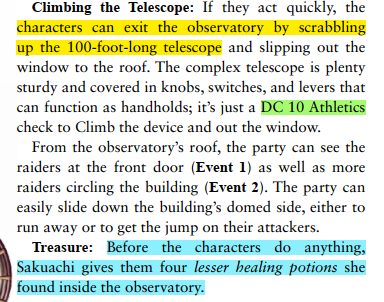
Now, if my chosen VTT has my adventure pre-loaded, awesome! I’m mostly done! This is 80% awesome, but it can lead to me being less familiar with the creatures than when I have to craft them by hand. Still, I’m not turning down the time saver.
Creatures and Hazards
After I read a chapter, I’ll go ahead and create all the creatures. How long this takes varies quite a bit. Some books, I can grab almost everything out of a bestiary. Others, nearly every creature is custom for that AP, so I have to create it by hand.
I could just roll everything by hand, but again, I like to actually relax during games. So, I fill out the NPC sheets for pretty much everything in the book. Because I’m working with 15 minute blocks of time, I try to focus on doing the same task over and over. So, I might work on filling out sheets during one session, while another, I work on getting the tokens set up (like I said, I love a pretty token).
For making tokens, I use Token Stamp. There are other tools, of course, but this one being browser based means it doesn’t matter which computer I’m on when I’m doing prep.
Maps!
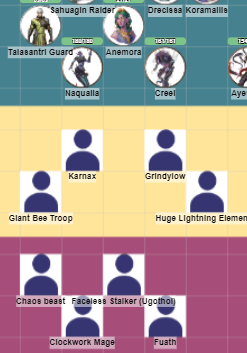
Maps are the last vital thing I set up. I have a blog post on extracting maps without giving yourself a stomach ache, and I still stand by that method. This is especially true since the automated tools I’ve used don’t seem to like grabbing maps from the interactive PDFs.
To be honest, this part of prep goes the fastest for me. Even with fancy lighting, I can get a map walled up in ten minutes, and since my creatures are made already, it takes only a few more minutes to populate them.
The other stuff
If I have F’s left to give, I’ll pick out some music for ambiance and fights, and maybe make a few handouts. If you like music, I strongly suggest making a few playlists that you can put on randomize and forget about until the situation changes. I like having one for fights, one for general ambience, and one for town.
When running my non-modern games, I use my VTT’s jukebox, which works perfectly fine. For modern games, though, I’m usually leaning on music that isn’t royalty-free, so I used Watch2Gether. And before you ask, no, those games aren’t streamed or uploaded. If they were, they’d get a strike before I had a chance to share a link out.
How long does this take?
I know that “It depends” isn’t a very satisfying answer, but… it depends. A chapter with lots of maps and custom creatures can take way more time than one that’s mostly roleplay and theater of the mind. Also, careful reading takes more time than quick reading.
Looking back over my notes, it looks like two weeks per chapter is a fair average. This seems like a lot of prep, but keep in mind that a chapter is three or four sessions for me, minimum. Since these games are monthly or, at worst, bi-weekly, that level of prep keeps me ahead of the game.
Because this is only 15 minutes at a time, I can generally prep two chapters every day without having to block out huge chunks of time. Because I stop once I’m well-enough ahead, I’ve found I can have around six games going at once without burning out. Really, the hard part is finding time to play!
What am I thinking about changing?
My day job involves coding in Python, so I’ve been diving more deeply about extracting text and images more quickly. I also want to learn more about talking to the Roll20 API (my VTT of choice) so I can create creatures and handouts more quickly. I will always pay for an AP if I’m running it, but Roll20 tends to pick and choose which they’ll import. I know other VTTs keep on top of this, but I’m not interested in switching platforms for reasons that could fill a whole other blog post.
This seems like… a lot.
I mean, it is. And it’s not necessary. I’m describing how I do it, but it’s hardly how everyone preps an AP. It’s not even how I did it when I first started running them.
With my first AP on a VTT, I didn’t use the system’s character sheets. I typed in every roll by hand, as did the players. I have friends who will skim over just enough to get the idea of what the story is and then vibe off of that. I have other friends who won’t put down a map until the players ask, and only toss down a token when it comes time to fight the thing. Heck, I have a GM where all the tokens are circles with letters in them.
While it’s a lot of work, this is the level of effort that lets me have the GMing experience I want to have: Chilling out with my coffee rather than frantically trying to understand what a block of text means, because this is the first time I’ve seen it.
At the end of the day, you do you, boo, as long as it gets us more games.


Do you strictly play online? I’ve only ever played in person and curious as to how much extra time is involved in online play.
LikeLike
These days, I play online, but I had a similar level of prep when my group was in-person. We used Roll20 since we already had our laptops on hand for our Hero Lab sheets.
Even further back, when I was still on paper maps, I did a ton of prep, drawing out everything beforehand. TBH, that took way more time because I’d have to clear a place to work, then do lots of back and forth, and then clean up so that the maps didn’t get kid crud on them.
LikeLike