
I want to start off things on the right foot: When it comes to tarot, I am at best a dilletante. I got into it back when I was in high school in the mid- to late-nineties, when there was a resurgence in interest in anything “New Age.” I had runestones, crystals, decks of all kinds, books on numerology, reading palms and tea leaves. I had pretty much everything but astrology.
Ya girl was woo as hell.
These days, I view most of those things as interesting, but tend to use them as tools in creative pursuits or self-reflection. If you’re a believer, trust me, I don’t mean any of what follows as any sort of insult, but you may want to skip the rest of this post.
For those of you who are still here, let’s talk about tarot and RPGs!
Tarot and planning
While most of the games I run are pre-written, I also run games that are completely homebrew plots. For these, I’ve found that using tarot as a kind of prompt has helped me come up with scenarios that I may not have reached for before because I’m a bit of a softie. Tarot cards are not soft.
The idea behind a tarot spread is that you lay out cards in a pre-determined pattern, with each position having a different question, and each card having a different meaning. If a card is reversed (upside down) the meaning is going to altered (usually worse, but not always). There’s a lot more that can go into it, but for our purposes, this is enough to work off of.
My favorite spread for this sort of planning is the Celtic Cross. I don’t use it quite like you might find in any guide, since we’re not looking to tell a fortune. We’re looking for inspiration. I don’t even try to use all of the cards. I use the ones that stick out to me as being potentially interesting for the game to pivot around.
Resources
You’ll need a few things to get started. Thankfully, they can all be found for free or cheap!
Cards: I love using physical cards (they’re just so pretty!), but you can find all sorts of apps and websites that will let you draw a random card. Just make sure, if you choose an app or a site, that the drawn cards are sometimes reversed.
A guide: There’s so many books, sites, and apps out there to tell you what all the cards mean. Hell, if you bought a deck, it’ll come with a little guide. The trick is finding a good one that hasn’t gone soft. Some modern guides try to put a positive spin on every card, and some even leave out the reverse meanings. We are not here to give your players a good time. We’re here for mayhem.
A quick way to see if a guide is soft? Look for their interpretation of The Tower. If you think “Hey, that doesn’t sound too bad,” put it back and keep looking. The Tower is pretty much always bad. I’ve linked some of my favorite resources at the end of this post.
The layout: The Celtic Cross
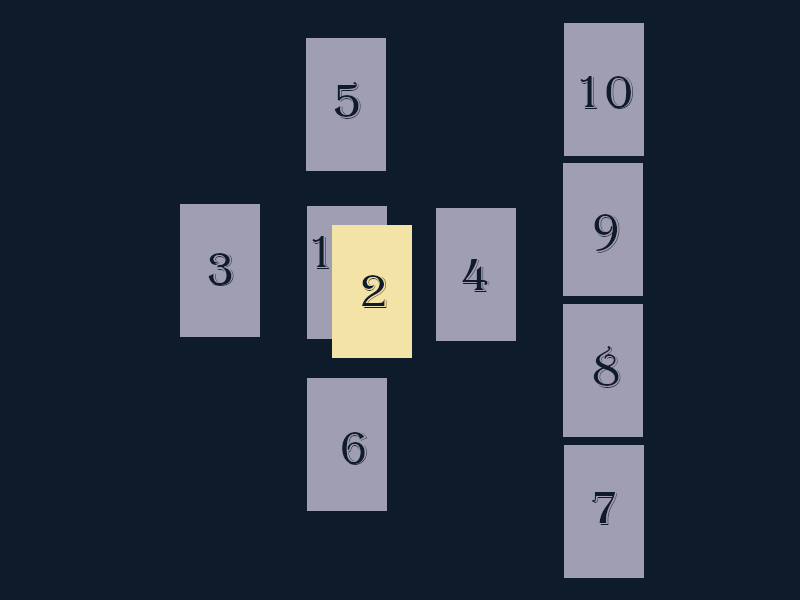
As I said before, I like using the Celtic Cross because it covers a lot of ground. You may get inspiration from an event you can introduce during the game, or it may remind you of an event in the past that you should drag up.
It’s a rather old layout (it’s first referenced around 1910, but it could be older? Or it could have been made up by the author. Tarot history can get wobbly), so you’ll find a ton of variations out there. This is what I came up with specifically for planning a game.
1: The current situation
This card is all about the status quo, or rather, a part of it. Is this aspect of ‘now’ something you can focus on? Maybe give players a moment to chill out in the present? Consider this card with the next card, which is…
2: An obstacle or challenge
This card covers the first card because it’s what is going to shake up the status quo. If the first card was a peaceful one, this could be what disrupts the calm. If the first card is gloomy and chaotic, this might be what makes it worse. In short, this card kicks the players in the pants.
3: The past
What happened in previous games, or before the game even started? Even if it’s the first session, a game has a past. The world existed before the PCs showed up (unless you’re playing a really out there system). This card might inspire you to bring this bit of history back for the players to deal with.
4: The future
What could be happening in the near future that you could drop hints about? This card deals with the immediate future. We’re talking weeks, not years. Unlike the second card, this is less a kick in the pants, and more a note that the players are scheduled to be kicked in the pants next month.
5: Current concerns
What are the players openly concerned about? A table of observant players are always worried about something. Someone finding that body. Losing position. That dragon finally showing up. This card might inspire you to press on something the PCs have openly worried about.
6: Secrets
Players also have things they tend to hide: A secret tryst, a worrisome bit of their backstory, a stolen trinket, a promise made behind closed doors, hidden feelings… What’s going on beneath the surface? This card might inspire you to drag that morsel into the light.
7: Advice
This one is pretty straightforward: What’s a piece of advice or a request that could be made of the PCs? I like working with this one because it can get the PCs moving in a completely different direction than they’re used to.
8: NPCs
Most games have a number of NPCs knocking around, doing their own thing. If this card reminds you of one of them (or a group!) maybe it’s time for them to come back and poke the PCs some.
9: Hopes / Fears
What are the players striving for, and what are they running from? If this card plays into your player’s deepest fears or furthest hope, now might be the time to play on those. After all, a fear isn’t worth anything if it never happens, and hope is for naught if it’s always just out of reach.
10: Outcome
Is this something you could hint at happening (especially in conjunction with one of the other cards)? If it’s good, you can use it as a carrot. If it’s bad, it’s what should be avoided. This card should not be taken as a given, since it’s only one of many possible outcomes. Players still need to work towards this if it’s positive, or against it if it’s a negative outcome.
Reading time!
Once you have your cards laid out, write down all of the positions and meanings, then start looking for things to jump out at you. I never use the whole reading, but rather pick a few cards that give me an interesting direction to move in. Maybe they’re evocative… but maybe they just remind me of something I’d been meaning to return to from a previous game.
I do recommend resisting the urge to do another layout if the current one doesn’t appeal to you. When you do that, it’s often because you’re looking for something safe, and that’s not why we’re here. We’re here to shake things up. So spend some time pairing up different cards/interpretations to see what might take your story forward in the most interesting way.
A sample layout
I tend to use this layout the most with my VTM games, since those tend to be less tightly plotted. Vampires have a tendency to make their own problems, so it’s often wiser to just set up a situation and see how kind the dice are to them that evening. This is the layout I drew for them:
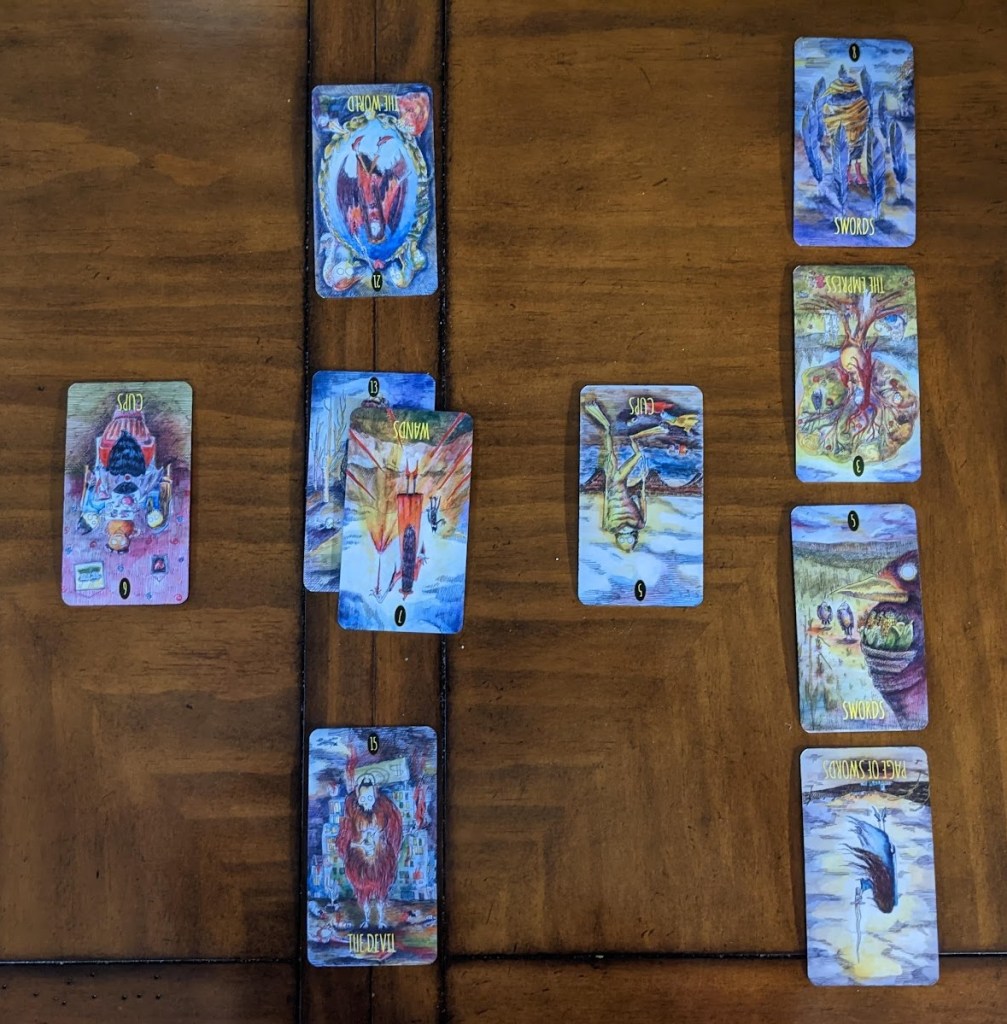
First, I did a quick and dirty reading, which was just me writing down the cards, positions, and some of the meanings that stood out to me.
| Position | Card | Meaning | Interpretation |
| Situation | Death | Endings, change, transitions | I tend to run games in arcs. Could the game be ready for the next arc? |
| Obstacle | 7 of Wands, Reversed | Exhaustion, giving up, overwhelmed | Has someone been pushed to the brink recently? Could we get them there? |
| Past | 6 of Cups, Reversed | Living in the past… | Maybe an older vampire… One who’s been mentioned before? |
| Future | 5 of Cups, Reversed | Personal setbacks, moving on | Once again, maybe the players are meant to be moving on to a new arc… |
| Current concerns | The World, Reversed | Seeking personal closure | Are there any personal plots that the players want to see wrapped up? |
| Secrets | The Devil | Addiction, restriction, sexuality | Maybe poke the players’ baser natures, which they spend a lot of time repressing |
| Advice | Page of Swords | New ideas…. | Someone could prod them to go in a new direction? |
| NPCs | 5 of Swords | Conflict, winning at all costs | Could that old vampire be looking to win at any cost? |
| Hopes / Fears | The Empress, Reversed | Dependence on others | Absolutely something the group fears. Play on that. |
| Outcome | 8 of Swords | Imprisonment, negative thoughts | So the stick rather than the carrot: Something to work against, since the group tends towards being hopeful |
After writing down all the meanings, I realized that I probably should kick off the next arc, which I’d been putting off. So many of the cards pointed towards change, decisions, and showdowns. In the end, it worked out perfectly: A (very, very) old Kindred showing up in town came looking for a place to settle (conquer), which kicked the crew into high gear. They were forced to band together and make some big decisions. Not only did they have to decide what to do with the old guy, but they had to decide what they, as a group, stood for.
Sure, I could have read the cards differently, but this methodology is all about inspiration and letting a mix of chance and context take you to new, interesting places.
Favorite Resources
One would think I’d have a ton of books about tarot cards, but when it comes to interpretation, I tend to prefer apps and websites.
Biddy Tarot: I use this site for card meanings, but also potential layouts. For quick readings, I love their list of three card layouts. They also have a great run-down of the Celtic Cross spread.
If I’m on the go, I use the app from Labyrinthos. It has a good database, and you can do a layout on your phone (and yes, it has reversed cards!).
The book that inspired me to use tarot for game planning was Corrine Kenner’s Tarot for Writers. A great book with some alternative layouts that are geared towards plot rather than traditional readings.
If I’m at my desk, I use this absolutely baller Google sheet (via Reddit) by u/adlist for looking up meanings, grabbed from various sources.
Physical cards: 100% optional, but if you decide to get a deck, make sure you get one with the traditional cards. That means 78 cards, major and minor arcana. There’s some decks out there that have their own system, which is fine, but I find that traditional cards Rider Waite set to be the most varied. Llewellyn Publications makes some super nice sets, and tend to be my go-to.
An alter cloth: Even if you’re not into new age, there’s a very good reason to get a piece of cloth to read on: It protects your cards. You don’t need anything fancy! I’ve used t-shirts and dishtowels when I’m not sure if my my table is perfectly oil-free.
 Katie Plays Games
Philip K. Dick cast I Ching to write _The Man in the High Castle_, so why not Tarot for DMing? Except that he was writing the whole book by himself, so as a result of all the random decisions, the story feels disjointed at times. But I think you’re looking for something far less detailed, right? Basically, a springboard that you and your players can use to flesh out a story, so I can see this working well.
LikeLike