
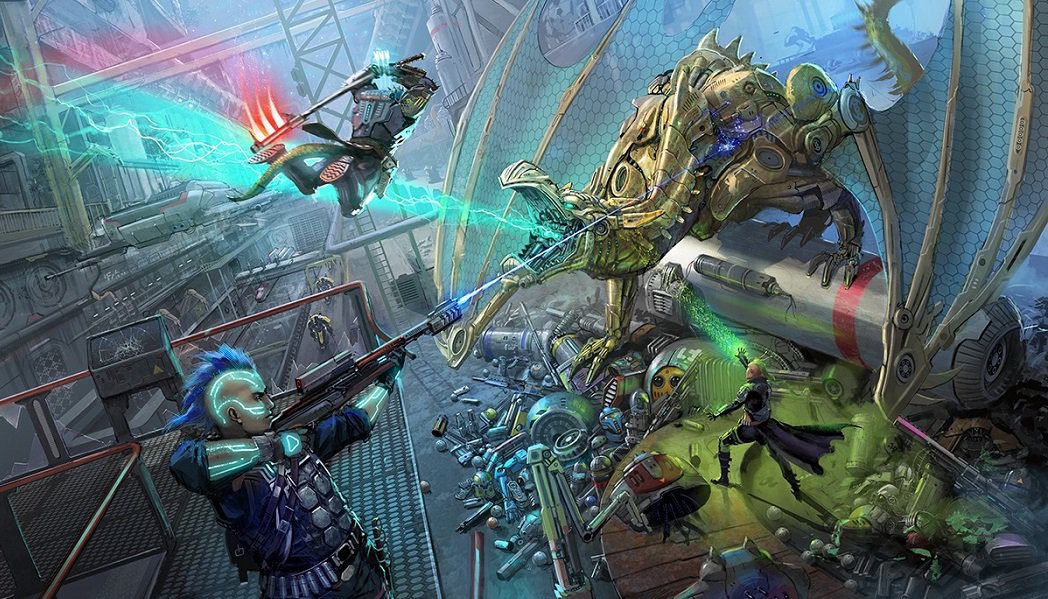
Next month, Starfinder Enhanced drops, which looks like it will be the last book for Starfinder 1e. Starfinder 2e is on the horizon, with the playtest dropping in August 2024. I just started getting into Starfinder, which has led to some people asking me if I will hold off until 2e drops. Isn’t it a waste of time to get into a system that’s ending?
Nope! Because, in my opinion, this is the BEST time to get into a new system. I even have some experience in this, as one of the people still playing Pathfinder 1e when 2e came out. I found advantages to staying in both ecosystems.
History
I’m a long-time Pathfinder 1e player. I jumped on the Paizo bandwagon when D&D 4e happened (they were still 3.5), and when they released a completely new system, my group immediately adopted it. While I’ve played in other systems, most of my regular games have been PF1e.
When 2e came out, I was invited to co-run a West Marches game, with the only restriction being that it had to be in Pathfinder 2e. This led to me playing both systems simultaneously, which is something that, four years later, I still do. My home game is mostly 1e, and the other games that have popped up are mostly 2e.
Benefits of playing a ‘complete’ system
When 2e came out, I had some people wonder if they should even bother with 1e. I encouraged them to give it at least a look, especially given that all of the rules are online. Here are some of the reasons I gave them:
It’s a content wonderland. A system that’s complete has an incredible amount of content: Classes, feats, spells, items, lore, and even adventures! Third parties have added to the pile for years, giving you incredible depths to plumb. For any idea you have, there’ll be enough material to bring it to life.
Time also has the benefit of answering all the questions. Find a rule that seems vaguely worded? Chances are good that someone had the same question five years ago, posted about it, and the matter was settled, sometimes by a Paizo dev. While playing PF1, it was rare for us to find an issue that hadn’t been settled several times, sometimes even in an errata.
And those questions? They’re asked and answered by a stable community. Even if you’re not someone who dips your toes into the social side of your hobby, there are benefits to a system with a robust group of people supporting it. They answer questions and create content for the games, like redrawn maps, character art, web-based tools, and many shared spreadsheets. And hey, if you want to be social, there will always be people looking for games, so you have a ready population of people who are already down to roll.
There are also stable tools for older systems. The roughest time with a new tool is when changes are fast and furious in the first few months. With a complete system, most bugs have been ironed out, and no new content is coming down the pike to throw the codebase into disarray.
Finally, this one is timely, but the Humble Bundles that come out will be so good during the transition. If you want to grab the books (and it’s not like books go bad), the next year or so will be the best time to grab them. There were at least two PF1 bundles during the 2e transition, and it was a wild amount of content for under $50. I know Starfinder has already had one bundle, and I expect there to be more.
Benefits of playing an ’emerging’ system
There are a lot of upsides to playing a complete system, but what about a new one? Should you bother jumping on the bandwagon early or wait? I don’t regret playing PF2 from the second the Core Rulebook dropped, and I’ll probably play SF2e as it comes out as well.
The most obvious benefit? It’s new! New things are exciting, and getting caught up in the hype train is fun. There’ll be tons of streams and videos combing over every arcane detail, and it’s fun to chill with your friends and go over the freshly-dropped PDFs. Excitement, for it’s own sake, can be a good thing!
Also, excitement means a new crop of players coming in. There’s nothing like a fresh start to a system to pull in a player who was getting bored with their current TTRPG. I’m always looking for new people to game with, and it’s fun to get people who aren’t in my current bubbles.
It’s also less to take in all at once. I’ve been in a game where I was dumped into a huge system, and I spent most of it floundering unless I had someone experienced to hold my hand. It takes time for me to get my head around how a system works, and I know I’m not alone in that. Only one book means you can dive in deeply without the ever-present worry of the OTHER twenty books you need to look through.
Also, because releases are staggered, you have time to get used to all the options! Those of us who were there at the start of Pathfinder 2e had six months between the first two books (the Core Rulebook and the first Bestiary) and the Advanced Player’s Guide. That is a LOT of time to get familiar with the base rules, understand how feats interact, and figure out which spells work best with which styles. This gave us a solid knowledge base to work off of with later releases.
But wait!
Won’t I get confused?! Look, I won’t lie: Getting rules mixed up happens. It happens less often than you’d think, though. I run both PF1 and PF2 every month with players in both games, and we might see someone get tripped up once every other session. Even then, it’s easy to shrug off, fix whatever plan they had, and move on with the game.
How do I choose?! I mean, I just kept playing both, but I get that not everyone has free time or a large pool of people to pull from. If I had any suggestion, it would be to look at the APs that interest you and play that system since conversion can be a lot of work. If you’re not playing an Adventure Path and not leaning one way or another, I’d veer toward the older system. A system that’s been around for a while has so much history. That history saved my first AP-based campaign! It’s also helped answer off-the-cuff questions during a session in seconds because someone else posted about that exact thing five years ago.
Whichever way you go, though, you’re sure to have a good time, and I can’t wait to see more people diving into Starfinder 1e and 2e, myself included.
 Katie Plays Games