Quest for the Frozen Flame AP: Book 2 Summary and GM Experience

A while ago, I posted about running Quest for the Frozen Flame, a Pathfinder 2e Adventure path. This past month, we finished book 2! In the interest of making the blog posts I wish existed, I wanted to do a rundown of the book from the GM perspective.

Warning! Past this point, there be unfettered spoilers for the Frozen Flame AP, including some for book 3. If you’re a player who hasn’t finished the AP yet, close this tab!

Book 2 Summary

Overall summary from Paizo:

In the brutal tundra of the Realm of the Mammoth Lords, only the hardiest folk have what it takes to withstand unsparing weather, track down big game, and fight back hostile followings. The Broken Tusk following has survived another winter, but a new year just began, and signs of danger foretell a year unlike any before.

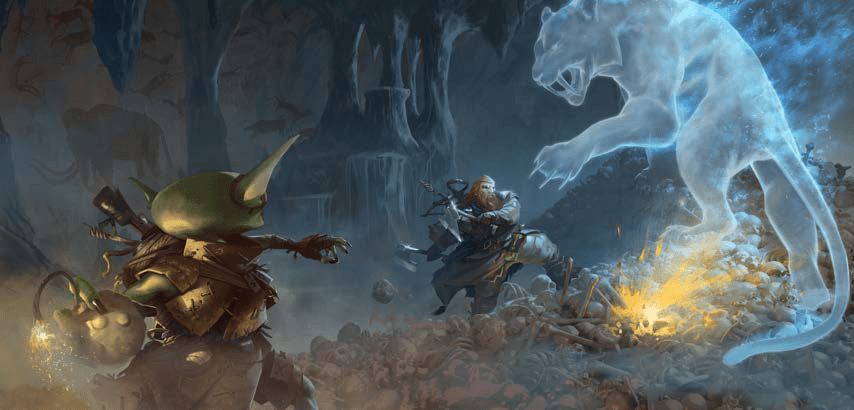
This book opens with the tribe navigating a set of caves. The path behind them is blocked after the closing events of book one, so the only way forward is through them. The group is tasked with clearing a path to the exit for the tribe, which contains many vulnerable members who can’t fight or navigate traps.

No Paizo AP is complete without a dungeon, and I’m pleased to report that these caves were quite a bit of fun to navigate. They had a mix of fights, terrain, traps, and even social interactions that made them feel more alive than Diablo-style ‘kill all the things to proceed.’

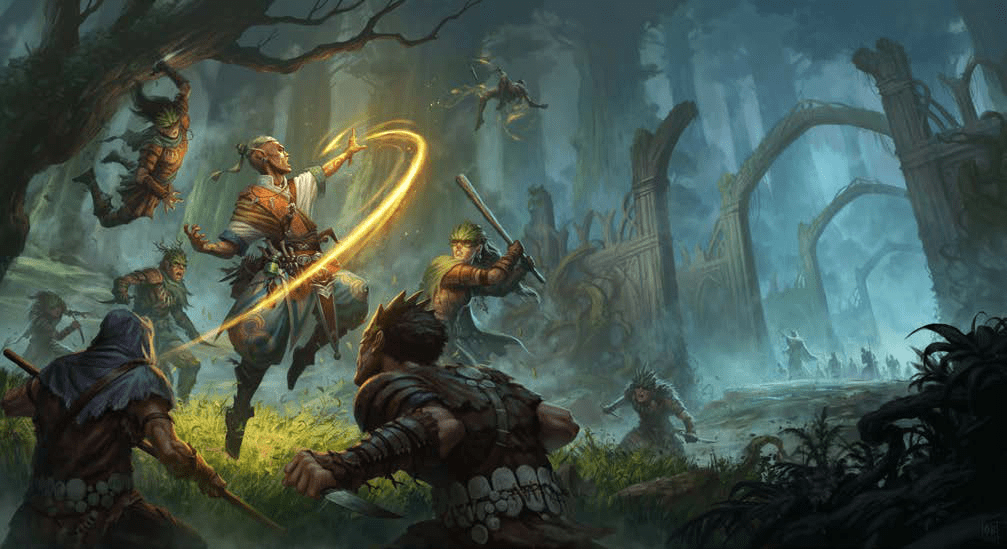
The group eventually gets the tribe through, finding themselves in a valley that’s been ‘lost’ to Golarion for some time, and is being ruled over by a white dragon who wields the Primordial Flame. If you like hexploration, you will love this chapter. The goal here is to build your tribe’s number along with your reputation so that you have the manpower you’ll need to take back your tribe’s stolen artifact.

Finally, the players come to the glacial palace that houses the mad white dragon. A town at the foot of the palace, though, holds people badly in need of liberation. Depending on how much word has spread of your deeds, they may or may not help you with the final assault.

How’d it go?

The players seemed to enjoy this book quite a bit. They really got into the idea that they had to recruit new tribe members as well as spread their reputation throughout the land. Also, being a team of completionists, they were more than happy to clear a pretty sizable hex map. They also seemed to appreciate the mix of social and combat encounters, since we absolutely have some PCs who are more geared towards being faces than fighters.

Speed run update!

With this AP, I wanted to try an experiment with leveling. Rather than leveling up with XP or by milestones, when starting a new book, the players were asked to level for the max level for that book. So, for this book, they were level 7 throughout.

As predicted, this made the first half of the book fly by, with the end of the book feeling like it was an appropriate challenge. What was interesting here was that the book didn’t seem to take less time (at least, by the numbers), but I think the trade-off for this book was different. Rather than moving faster, the players were extremely thorough, tackling every last hook they ran into. If we were running this at a ‘standard’ speed, I could see it taking way longer than a normal Paizo book. That, or players would be more picky about what they explore. In theory, there is a time limit for them to escape the valley, but this didn’t come into play with them being higher level. Had they been a more appropriate level, I think they would have felt the crunch.

I still think this method works well for this particular AP, if you’re limited on time but don’t want to pull encounters.

My thoughts

I absolutely loved the hexploration for this book. If you’re planning some hexploration in your game, pick up this book and check out how they did it. Lots of the hexes connect to each other, plot-wise, and there’s a great mix of encounters, from curiosities to social to combats. The fact that there was a solid reason to explore was the cherry on top of the sundae.

Now, don’t get me wrong: The caves and the liberation of Lubya were awesome too, but the hexploration was really where the players got to lean into being Big Damn Heroes and forging their way. It’ll be the thing I probably think about when I think back on this book in the future.

My recommendations

Spreadsheet. Holy crap, you need something to track the reputation and following. Encounters will sometimes give rep, followers, or both, and it’s painful to go back and figure out how much the players have gained over the last few sessions. Make a spreadsheet and update it diligently.

Calendar. I didn’t need this, but if you’re running this at a normal pace, you need to keep track of days! I’d recommend adding it to the hex map, since that’s where most days will advance.

Show their progress. On the splash screen, I gave players an abstracted way of tracking their reputation. Fair warning, though: The needle won’t move much until they’re past the midway point of the hex map. I reminded them that they simply hadn’t encountered enough people to get the rumor mill started.

Screenshot of a splash page. There are two scraps of paper with notes on them.

First scrap: Broken Tusk Reputation: The Sutaki will follow the Broken Tusk to the ends of Golarion!

Second scrap: Followers gained: 122

Don’t rush! The players will know what direction their goal is in pretty early on, and will pinpoint the exact hex not long after. Encourage them to take their time and build up their reputation and following! That’s where all of the story is, and if they show up known with a small following, it could be painful.

Next book!

Not going to lie: I’ll miss the hexploration. There’s some, but it’s not nearly as robust as what Lost Mammoth Valley has. I still think the book will be fun, though, with lots of chances for the group to act like Big Damn Heroes of their now huge tribe.

Hillcross looks like it’ll need some careful management, but it’s been a while since I read the book. Time to go refresh myself, I guess.

The thing I’m most excited about? One last encounter with Pakano. Seriously, I’ve run a lot of Pathfinder, and I’ve never had players hate someone so thoroughly.

Gatewalkers: Book 2 Chapter 1 done!

Over on D20Saves, I’m running Gatewalkers, one of the latest APs from Paizo! From the official website:

After they walked through that glowing gateway, nothing was ever the same. A band of characters become paranormal investigators to determine the cause of a global amnesic episode. Their quest takes them to lands near, far, and outside this reality altogether. Along the way, the characters meet fellow “gatewalkers,” defeat alien monsters, and explore strange realms touched by the Missing Moment. And when it comes time to learn the grim truth of what happened to them on that fated summer night, what then?

Warning: The first part of this blog will cover what happened in the stream, so there are spoilers for the beginning of Book Two. Part two will include my thoughts as a GM, so there are major spoilers for the AP overall.

Check out the playlist here if you want to watch the previous episodes!

Book Two opens with a bang. Unlike other Paizo books, there’s no gap between books. One moment, they’re on Castrovel, escaping from an interplanetary battle, and the next, they’re in a strange observatory with a rattled seer asking for help from whatever is currently beating down the door.

The gang has found themselves at Skywatch, though not quite on Golarion. Somehow, they’re on the Ethereal Plan, the plane that lies between all other planes. It’s not completely hopeless, however, as there’s a gate right outside of town that will probably get them back to the Material Plane. They just need to collect the seer’s party from various points around the ghostly Skywatch.

The gang is more than up for the challenge as they navigate non-Euclidian streets and beat up everything from bandits to dragons to find all of the stray party members. Everyone gathered, they make their way to the gate, activate it, and find themselves back in the Material Plane…

And all of their new companions dead. The party members they had spent a week saving vanish, with only the Seer, Sakuachi, just barely able to hold onto her form as a ghost. Horrified, they realize that a dark presence had reached out to Skywatch and yanked all who were there through to the Ethereal plane, leaving their bodies behind to freeze to death.

The party agrees to take on Sakuachi’s quest, realizing that they share a common enemy.

GM Stuff

Okay, seriously, if you’re a player in my stream, DO NOT KEEP READING. Don, James, Jorge, Daton, Ricardo, CLOSE THIS TAB.

Ethereal Plane

In my last post, I mentioned that I planned on switching book one to be in the Ethereal Plane rather than ‘weird, but still on the Material Plane’ Skywatch. This worked seamlessly with the overall feel for the AP, and even made the issue of navigating Skywatch more intuitive. It also focused the players’ energy on getting out, rather than pointing towards an exit but saying they couldn’t go there yet. They knew they probably needed Sakuachi’s crew, being all mystic, and they knew that they wouldn’t leave until all of their people were accounted for.

Killing off Skywatch

The bigger change I made in this chapter was killing off all of Skywatch. I had a few reasons for doing this:

  • Adding what’s essentially a second party to the team was too many moving parts for me
  • I wanted the PCs to take personal ownership of the quest, since that’s what moves the plot along at several points
  • It ups the stakes for the group from “let’s poke at mysteries” to “oh crap, this thing is a danger.”
  • I was worried about another Hubert situation, where they’d take an NPC’s sheet and turn them into an absolute monster in combat.

The players took the reveal in stride and happily took on Sakuachi’s quest, with her trailing behind them as a ghost. Of course, they still made the case that she could have a sheet, but I shot that down. I still expect them to break the plot with her, but it shouldn’t be quite as bad. Also, looking forward, I think she works best as a spirit. Her companions don’t serve a purpose, and for the most part, she’s chilling in the background. Might as well make her see-through!

The rough timeline I gave the PCs once they were back on the Material plane:

  • Everyone was at Skywatch in the Material Plane for their own reasons. Matz for treasure, bandits for banditry, Sakuachi for her quest.
  • All at once, everyone was pulled into the Etheral Plane, leaving their bodies behind.
  • Bodies froze to death over time, since fires went out eventually.
  • Whatever did this left tendrils of Blackfrost behind.
  • It’s implied heavily that this Osoyo jerk may be responsible.

Important to know

I’ve finished reading Book Three, and there’s a detail I skimmed over that I wish I had hit harder. The PCs will run across the former denizens of Skywatch later, but in prepping book two, I hadn’t realized that they were still around. So, if the players investigate, leave hints that the whole town left some months ago, heading north.

Also, if you plan on killing everyone off like I did, make sure Matz gives those last details to the PCs before they leave! Otherwise, they won’t know where their next plot hooks are.

Looking forward

After looking at how the rest of the plot pans out, turning Sakuachi into a ghost works pretty darn well. Most of her mission can be easily transferred to the PCs, or maintained with her being a ghostly presence.

I’m super duper looking forward to some of the set pieces, such as the mansion mystery. Hell, I’m even looking forward to the trek across the ice! Some people have complained about it, but if you’ve ever read Lovecraftian works, you know they love dumping the doomed protagonists into a desolate landscape where the only way is forward.

How I run it: Schedules!

Anyone who knows me knows that I play in a LOT of tabletop games, both as a GM and as a player. My current count is nine games, played in either monthly or bi-weekly. Most people assume I spend all my waking hours prepping, but honestly, I don’t spend more than thirty minutes a day dealing with RPG admin work. The trick is having a system and making good use of small pockets of time.

Most of this will be about being a GM, but if you just want to be a player in a bunch of games, much of this still applies! A player who remembers when games are and shows up with notes is always going to be able to find tables to join.

Organizing

Being organized is, unfortunately, key to this. I’ll be real: I’m not a naturally organized person. If you give me a backpack, it’ll be a disaster within a month of regular use. My crafting areas are only neat right after a cleaning spree. The only reason my bookshelves are neat is because they’re on-screen during calls, and my friends’ love language is shaming. Still, time spent hunting down crap is time spent not prepping, and I’m really trying to use every minute I manage to free up.

So, when it comes to games, I’m very organized. Everything is in its own folder. These folders back up so I can access them anywhere and a computer dying doesn’t destroy me. I have a dedicated gaming notebook that keeps track of all of my games. I pin important links and details.

When I start a game, the whole task for that day is to get everything set up:

  • Folders for anything I could possibly need in a game, so I don’t have to go hunting
  • VTT game
  • Discord channel (all of my games get, at a minimum, a channel in one of my servers)
  • Pin all of the important details, like where things are being stored and where we’re playing

I’ll repeat this: This is a whole-ass task. It takes a bit of time. If this is all I do for game prep for that day, I consider it time well spent.

Scheduling

This is where most games fall apart. Every webcomic about gaming will eventually have a comic about how hard it is to get five people to show up at a set date and time. It’s a universal problem, and you have to take it seriously if you want to game more.

Easy mode for this is having games on the same date and time on a regular basis. So, it might be every other week, the first Monday of the month, etc. I would be cautious about being overly optimistic about scheduling a game for every week, though. That’s a huge ask for players, and you could end up with more cancellations than you were anticipating. If your weekly game is canceled half of the time… bruh, you have a bi-weekly game. Schedule for reality, not your dreams.

Hard mode is having games that move around, which is over half of mine. They take more work to schedule, and you really have to plan ahead. However, it’s much easier to get people to agree to a date that can wiggle than a set schedule.

The trick is that you have to get on people’s calendars early, but not too early. People don’t like to commit too far out, but if you wait, you’ll find out that they’re busy every single night. The sweet spot for me has been to start pinging people around the 14th of the month for the next month’s games: That’s far enough out that you’re in front of the last-minute events but not so far out that people have no idea what they’ll be doing that week. Also, if you schedule too far in advance, people are more likely to forget.

For me, I send out polls to each group and pick the date with the most reactions. Save for one game, I don’t require 100% attendance. Some tables insist that everyone needs to be there, but I can say from experience that this is the swiftest way to kill your game. I tend to slightly (SLIGHTLY) over-recruit, then only ask 75% of the players to show up.

Honestly, for either, think hard before demanding 100% attendance at every game. I’ve seen this kill many a good table where 80% of the people were all in, but one had a chaotic life. Everyone there wants to game, or they wouldn’t have accepted the invite! If the game keeps getting canceled, the reliable players will drift away. It is better that one person has to get caught up every few sessions than to have a notebook full of ideas that never get used.

But wait! What if you’re not the GM? Does this still apply to you? Ideally, no, but sometimes, it could! As a player, you can still poke the GM to set a date if it looks like they might have forgotten. Heck, you can offer to be the person who does the scheduling. Being a GM is a big task, and it’s always nice when someone can lighten that load.

Prep

If scheduling is the game killer, prep is the GM killer.

The biggest danger with running a bunch of games is falling behind on prep and burning out. To fight both, you have to limit how much prep you’re going to do in a day. For me, I know the max I can fit in is 30 minutes. After that, I start to lose focus and unfocused planning is just wasted time. The trick is to be consistent. You’re not going to prep a whole AP in one short session a week, after all.

If I don’t have a game that day, I tend to do two fifteen-minute prep sessions for different games. I like hopping around, and my games are almost always in different phases of prep (reading / sheets / maps). I try to keep a chapter ahead of my players when running APs because you never know when they’ll be able to find a shortcut that the developers didn’t think of.

If I have a game that day, I’ll generally spend my whole time slot prepping for that game. That involves reviewing where we left off, checking my maps, and writing down some notes about what I think the players will encounter next. So, if they’re in room A15 of a dungeon, I’ll write notes about the next four or five rooms they could reasonably get to. If they’re entering a town for the first time, I write down the plot hooks I want to make sure I hit.

As for reviewing, I’m now a firm believer in recording my games. This has been a game-changer for me. Since I know I don’t have to take detailed notes during the game, I can focus more on the players and plot. It’s also faster than you’d think to review the video: The most important parts are usually in the last ten minutes, and a quick scan can tell me what maps they hit during the past session. Just make sure your players are cool with you recording them.

This is a lot. Is it worth it?

For me, yes!

I have a circle of gaming friends that would never fit into a single game. I also love running Adventure Paths, which come out at a breakneck speed. Besides that, I love dabbling in multiple systems. If I were only in one game, I’d lose a lot of chances to have fun with other people.

Maybe this is way too much for most people (most people would balk at the idea of being in nine games), but the advice still holds if you want to create a second game in your schedule. Hell, most of it still applies if you just have one!

Either way, may 2024 bring you as much gaming as your heart desires!