Dhampir$: Save the Princess (session two)

Author’s note: I’ve recently started a PF2 stream with a few friends on the Twitch channel Roll the Role. The premise: A crew of dhampirs with the same ‘sire’ have banded together to make coin, a name for themselves, and sort out their complicated past and future. This takes place after session two.

[ < Family Reunion ] [ Study Hall > ]

Anna settled into her room at the Barrel & Bullet saloon. She’d learned to travel light over the years, much to her displeasure. When she was young, and still known as a woman of station, even a visit to nearby notables would require several trunks, stuffed to the gills with gowns for every conceivable event: feather-light dresses for brunch, simple yet colorful gowns for afternoon tea, dark, figure-hugging silks for formal dinners, lacy constructions for balls. Father would often secure a second carriage to ensure they could travel in comfort, without hat boxes at their feet and chests rattling above them.

Now, somehow, she managed to fit most of her worldly goods into one extremely well-worn case. She sighed and motioned for where Lucia should settle it. The spirit did so, then settled in a dark shadow to watch over her mistress. Anna opened the case and pulled out what she needed: Her writing kit and her dressing gown. 

Downstairs, someone playing the part of a bard led a boisterous song in the round, encouraging patrons to join in, creating a hellish cacophony. It was a mélange of puns and overwrought metaphors, mostly about body parts and what one might do with them behind the cow shed. Anna sighed. “I really should teach you to sing, Lucia…”

The spirit’s voice rasped from the darkness. (In a creepy font) Shall I silence them another way, Mistress?

“No, no.” And Anna took out her journal. “After all, we might be forced to come this way again…” And she started to write.

✱✱✱

15 Gozran 4720 ~ Bullet and Barrel Saloon ~ North of Alkenstar

The visions did not lead us astray. We found our… brother? I’m still not certain what to call Lobo, but brother seems fairest. And, as the visions implied, we found Lenore as well, in good spirits as always, despite her predicament.

Where to begin…

I suppose, chronologically, Lobo makes the most sense. The poor thing… An orc, but unlike the rest of us, he wasn’t born with fangs. I’ll need to get the rest of his story out of him later, but from what I can gather, Lobo’s tribe attacked one of father’s estates as a youngling. Lobo ‘survived’, though some might debate that. Things became rather fuzzy in his retelling after that. He’s a man of spare words, which I suppose isn’t surprising, given that the rest of his rearing was left to literal wolves. 

He came upon us. He’d been tracking us, which was convenient, though he did try to attack poor Chadwick. Fortunately, we discouraged him, though he was obviously distressed by us. In spite of this, we forged an alliance. The same dragon that took Lenore also killed his pack–

Oh. Drat. I just realized. He was speaking of wolves, wasn’t he? I had assumed he meant his Orc brethren… Ah, well, I’ll clear that up in the morning.

At any rate, we found Lenore on the top of a mountain, with dragons performing a ritual of some kind. Why the mountain was necessary, I’ll never know, but I need to shop for something that allows me to fly for more than ten minutes. Or at least teleport. My shoes are ruined

We freed Lenore (of course), and discerned the ritual. It was for making a ravener… Fascinating. Terrifying, but more importantly… interesting. 

✱✱✱

Years before…

Anna opened her eyes. She was on the floor, staring up at the ornate tin plate ceiling of her bedroom. Her head ached, as if she had been drinking. There had been something, something terrible— 

She turned her head, and found her gaze locked with the dead solicitors. She pushed herself up into a sitting position, swallowing a scream. She looked around the room, well-lit in the midday sun. Besides the two of them, it was empty.

The wraith. 

She forced herself to her feet. Her heart, normally sluggish, hammered in her chest. She stared hard at every shadow of the room, waiting for a dark form to step out of it. There were stories about a dark figure, a portent of death for their line. A woman, shrouded in night. She had always thought it an allegory, or some flight of fancy inserted later by those who survived the dead. It was a person they could blame for their extraordinarily bad luck when it came to clinging to life. 

But she had seen it. And it had… it had left her alive. 

Her eyes fell to the dead solicitor. He had been about to attack her. At his side was a pistol. She bent to retrieve it. Her father had taught her a few things about firearms, having been robbed of a son he might share with, so she knew how to check it. It was, indeed, loaded. He’d fully intended to kill her. And yet… 

She shook her head. She didn’t have the time to think over the implications. Anna had a much more pressing issue at hand. Someone was trying to take her birthright… and she had a dead lawyer in her bedroom. 

Drat. She really could have used Maizon for this.

She tapped her foot as a plan formed in her head. Normally, the bodies she dealt with were already dead, and their families were well aware of this fact. All they had to do was return the body to the grave in a timely manner. This one required a story, something that would give her plausible deniability. Even if it wasn’t her who broke his neck, she knew it wouldn’t take long for an investigation to turn up certain unfortunate truths that made her the most likely culprit. 

She knelt, examining him. His neck… Perhaps a fall down some stairs? But then she might be accused of pushing him. No, she needed the blame fully off of her. She traced the bruising where the creature had grabbed him. Very much like an injury she’d seen a few times at the Acadamae…

She would have to work quickly. No one had come when she screamed, so the servants were occupied (she had her guesses). That wouldn’t last long, however. Eventually, the chambermaid would come asking about tea, or the butler would announce dinner. For a staff that was supposed to be invisible, they had a terrible habit of appearing at the worst possible moment.

She rifled through her bag and found a mossy green bottle. It held only a gulp of liquid, but that was all she needed. She uncapped it and drank the foul liquid in one gulp. She gasped, then swayed on her feet as she felt something inside her change. Though she couldn’t see the change, she could feel her muscles burn and harden as a newfound strength coursed through her body. She always kept one on hand, but it had been Maizon or Jace who had taken it when they needed heavy lifting done. 

Anna forced herself to move. How long did the potion last? A few minutes, at best. Sometimes less. She grabbed the solicitor’s rapidly cooling body around his chest and lifted. The bulk was awkward, but his weight felt like little more than an overburdened backpack. She started to drag him…

In his room, she found a curtain tie that would do the job. Up through the rabbit hole, round the big tree; down through the rabbit hole and off goes he… She secured the rope around the man’s broken neck, threw the other end over one of the sturdier ceiling fixtures, and pulled…

He was only halfway up when she felt the potion start to fade. She gripped tighter, but the rope started to slip through her fingers, burning her skin. Distantly, she heard the sounds of someone moving below. If his body fell, it would be heard, and they would come, and they would find her in the middle of a cover-up, which was even worse, and–

A dark shadow reached from behind her and grabbed the rope. The air in the room grew cold, and it felt as if a window behind her had been opened during a blizzard. She knew the day was warm, though. She knew what was behind her. But she also knew what was at risk. Anna forced herself to speak, keeping her voice level. 

“A bit higher, please.”

The hand yanked down, hard, undeath giving it a frightful amount of strength. Anna bent to secure the other end of the rope to the leg of a bureau, not wanting to waste the momentary truce. When she looked up again, she was alone once more, save for the body swinging from side to side above her.

Fascinating. Terrifying, but more importantly… interesting. 

The rest of the ruse was easy to set up. She gently laid down a chair, then found some stationary from a set long-forgotten. She’d learned to do a half-decent forgery while at school (money only went so far, sometimes), so crafting a letter from a lover breaking it off only took a few minutes. She left it out, then returned to her room. The stage was set.

Time passed. The chambermaid finally materialized and asked Anna where she would prefer to take her tea. Anna didn’t even look up from her book. “In the blue room. And do ask our guest if he would join me. I have some questions about the estate.”

The young woman dipped into a passable curtsy, then padded off down the hall. A moment later, a blood curdling scream broke the crypt-like silence of the LeClerche estate.

✱✱✱

Anna startled as an icy hand landed on her shoulder. Her mind had drifted… Perhaps she had been asleep? Her pen had dropped from her hand, leaving an inky blot on the desk. It wasn’t the worst stain the table had suffered. 

She felt Lucia’s presence behind her as it leaned in and spoke. (In a creepy font) Brother Cyt is done in the bath, mistress. Anna looked down at her journal. Not complete, but close enough. She set it aside to fully dry. A bath was just what she needed.

Dhampir$: Family Reunion (session one)

Author’s note: I’ve recently started a PF2 stream with a few friends on the Twitch channel Roll the Role. The premise: A crew of dhampirs with the same ‘sire’ have banded together to make coin, a name for themselves, and sort out their complicated past and future. This takes place after session one.

[ < A Prologue ] [ Dhampir$: Save the Princess (session two) > ]

Leaving Alkenstar before dawn, Anna had hoped to be enjoying the clean air of the countryside by evening. Instead, she found herself anointing her room with scented oils to keep the acrid smoke of the city at bay. They’d made good progress, but the smokestacks were hard to outpace. 

She sat at the tiny writing desk and took out her journal. It was a habit from childhood, drilled into her by an endless stream of nannies, who saw it as a calm and harmless pastime for a girl who was too curious by half. Perhaps if she had been interested in the arts or other mundane affairs, they would have been more comfortable with her explorations, but after the frog incident…

Well, they preferred a medium that was more easily put out of mind. 

Anna dipped her pen and began to write…

✱✱✱

12 Gozran 4720 ~ Rusty Bedfellow Inn ~ North of Alkenstar

Lenore has been taken. I expected one of us would one day be carried away, but I thought it would be a crowd with torches and pitchforks, or perhaps a duke in desperate need of a scapegoat. I didn’t expect a dragon. And a dragon with portal magic. 

Even stranger, her abduction came with a vision.

I do suppose I’m getting ahead of myself. We had been asked to take care of a small matter of a cult in the outskirts of Alkenstar. A rather dull matter, but cults have  a nasty habit of creating larger issues for us down the line (either adoration, admonition, or in the worst cases, both), so better to be nipped in the bud. Even better if we’ll be paid for it.

It was just as we were putting ourselves to rights that the portal opened, and poor Lenore was snatched away. We had no time to react, though I’ve spent more time than I like second guessing our actions. Perhaps if we had a counterspell ready, or one of us had moved faster…

Ah, well. I’m sure Lenore is fine. She’s unparalleled as a warrior, and resourceful as well. She wouldn’t have made it this far if she weren’t able to take care of herself. If anything, we siblings persevere…

But speaking of siblings… 

I’ve never been one who’s prone to visions. Poor aunt Martina was plagued by them, and I heard my mother would have episodes, but they never struck me. I had assumed that they skipped over me… until now. I would have been ready to disregard it as an overtired mind, but Cyt and Samael experienced them as well. A cold plain, a love for one’s kin, a thirst for blood, a need for revenge…

I do believe we have family in the North, which is where we believe Lenore was taken. It can’t be a coincidence. I don’t believe in coincidences. 

I should write of the unfortunate events of the bar, but I find myself growing tired, and I’m certain we’ll rise early. Suffice it to say, it is likely a good thing that we chose to leave Alkenstar for a time. 

✱✱✱

Anna sat back from the journal, yawning. From the darkness came a tutting. ภ๏Շ שєгץ ɭค๔ץɭเкє(in a creepy font) Not very ladylike

One of the shadows in the corner of the room had solidified. Anna hadn’t called her eidolon forth, but that rarely stopped her companion from showing up. Anna gave her a rueful look. “My accommodations are rubbing off on me. ‘Rusty Bedfellow,’ indeed. I’m shocked they didn’t rent by the hour. You’ll keep watch, my pet?”

Silence was the only response, but that was better than the usual morose retort. Before long, Anna was tucked into a bed that would be better used as kindling under whoever managed the cleaning staff, and was asleep.

✱✱✱

It was not a peaceful sleep.

She was back in her room, in the sickly light of the LeClerche manor. She stood at her window, watching as Maizon made his way to the main road, and hopefully to a caravan that would take him to the Mwangi Expanse. Jace was gone. Her father was gone. Most of the staff had left, save for their aging butler and a plain-faced chambermaid who she suspected he was tupping. Even them, they were planning on moving on as soon as Anna signed the papers…

She looked down at them. Their solicitor had drawn them up, likely while her father’s body was still warm. He’d laid out the particulars for her: She wasn’t quite alive, and her kind wasn’t known for being fecund. Therefore, wasn’t it in the best interests that she quit her claim on the LeClerche estate? She would be given a settlement, and a distant cousin (from a branch untouched by tragedy) would absorb their titles and estates. The name would be given to one of his mewling brats, and really, isn’t that what her mother and father would have wanted? To have the name continue? 

She looked up. The fog had swallowed Maizon. The house was silent. She had never felt so alone, and the dread of it threatened to swallow her whole. Her kind could live as long as elves, and just two decades in, Anna had lost everyone

A knock sounded. “Miss?”

The solicitor. Anna swallowed her growing despair and turned. “Enter.”

The door opened. The man her father had retained was in his middling years, youth being eaten away by fine lines and touches of gray. He wore a vest that Anna was certain he thought was the height of fashion, but that Absolom had given up on three seasons ago. He gave her a sad-eyed smile, acting out the part of the sympathetic compatriot.

“How are you doing today, Miss Anna?”

“As well as can be expected.” She realized her eyes were too dry, but it couldn’t be helped. Another side-effect of her ‘condition’: She rarely cried. “I hope the day finds you well.”

“Much the same. Your father and I hunted often. I was so stunned when I heard his horse had thrown him. He was an excellent equestrian.”

“If his death surprised you, then you couldn’t have studied our history too closely. Horses were a popular way to go. I always told Daddy he should avoid them.” 

The solicitor cleared his throat nervously. “Well, he was a man who little liked being told what to do.” Oh, he’d heard. “Have you had a chance to read over the papers?”

“I have. Do you know, I think Daddy liked riding because he thought he’d sorted the curse. He did all sorts of things he shouldn’t have…” Anna picked up the papers and started to leaf through them. “Ate fish with bones. Boated. Fenced. He even liked to toy around with firearms, though he was a terrible shot.”

“Er, yes, quite the character. Do you have any questions about the settlement?”

Her gaze landed on the settlement. A heady amount for a peasant. A paltry amount for one who might live as long as an elf. “I don’t know if I would have called him a ‘character.’ But he really thought he had beaten it. Even if he hadn’t, he was still a credit to the name, don’t you think?”

“Yes, just as your cousin shall be. I’ve heard he’s quite the bright lad. He’ll marry well, I have no doubts. It’s what your father would have wanted.”

Anna smiled, keeping her lips pressed together. “My father is dead. What he wanted doesn’t matter.” And she tossed the papers into the fire.

The solicitor cried out as the flames consumed them. He reached, but a word of magic made the flames hungry, consuming the parchment in seconds. He turned on Anna, hatred in his eyes. “You prissy little bitch…” He stepped towards her, one hand going for his pocket. Anna, too late, realized how alone she was, how easy it would be to pay off the servants. He pulled out a gun. “You know, maybe this is easier. The despondent daughter eats a bullet and saves the Howes some gold–“

A hand wrapped around the man’s neck, inky black and trailing a dark smoke. In an instant, the solicitor was thrown across the room, cracking the plaster and wrecking the wainscotting. His head lolled at an unnatural angle and his eyes stared blankly. Anna found herself staring at a dark form, a woman, but her face was gaunt and her eyes shone with a terrible light. (In a creepy font) Misstress… it hissed in a voice from beyond the grave, and it reached for her. Anna heard someone screaming, and it took a moment to realize it was her own voice. The hand touched her cheek, and all went black.

[ < A Prologue ] [ Next > ]

Caves of Chaos for Pathfinder 2e

One of the challenges of being a GM for a West Marches style of campaign is coming up with content where it’s easy for a large number of players to interact with the plot, while keeping the challenge rating flexible. My husband recommended Keep on the Borderlands, a classic module published in 1979 and written by none other than Gary Gygax.

I bought it from DriveThruRPG, and I’m glad I did. Not only is it an interesting piece of gaming history, but it’s an excellent adventure, even today. Converting it to work in 2e took way less energy than I was expecting, even though the module is old enough to have grown children of its own.

What is it?

Dungeon of Signs: B2 - Keep on the Borderlands - Review

Keep on the Borderlands has two halves to it: A keep that the players liberate and then mold, and the Caves of Chaos, which serve as the main threat. The Caves of Chaos aren’t quite as dramatic as they sound. It’s basically one huge map that features a number of caves, some interconnecting, some not. I ended up not using the “Keep” part of the module (the group already has a functional town), but the Caves of Chaos were well worth the price of the module.

And yes, I recommend grabbing the module. Not only is it a short, interesting read, but it has some tips on how the denizens caves should react to a bunch of adventurers running around and causing trouble for them.

Why use it?

Some of the advantages of using the Caves of Chaos:

  1. Solid maps. The layout of all of the caves are great. There’s plenty of room for a group of PCs to move around, but they have enough corners and doors to make line of sight important.
  2. Great dynamics. While you could, in theory, just use a key you find online for the Caves, I recommend giving the module a read. It recommends actions for various NPCs, and suggests how the caves might change over time as more of them are cleared out.
  3. Diversity of creatures. It’s not just goblins! The caves feature all sorts of enemies, giving players varied challenges that still make sense.
  4. Easy to scale. This might be more PF2 than anything else, but I found the caves to be fairly easy to scale to different levels. This is super important in a West Marches campaign, where you never know what the APL is going to be (though I did cap it at APL 3)
  5. Lots of pretty resources. This module has been out for a while, so the amount of player-created content is high. I found no shortages of maps, keys, and guides. I even found maps that were redrawn to work with Roll20!

What I had to change

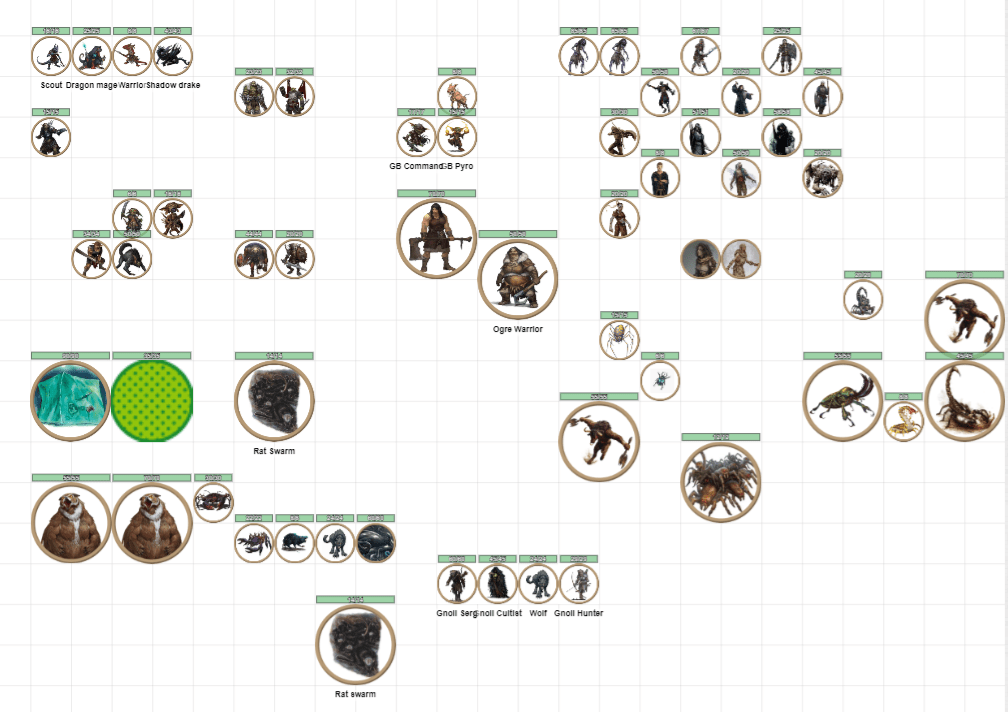
Keep on the Borderlands was absolutely written for wargamers. The number of expected mobs was huge, and the playing field was much larger. The squares were ten feet, and it wasn’t unusual to have a room filled 10 to 15 mobs. I ended up switching to five-foot squares, and drastically reduced the number of enemies.

There were also a few creatures I had to change, since they’re either too high level, or they don’t exist yet in Pathfinder 2e (as of this writing, only two of the Bestiaries are out). For example, the medusa was straight out, and stirges haven’t made it over to PF2 yet. I ended up swapping in new creatures, since I didn’t feel like writing my own, and it isn’t like there’s a shortage of options to choose from.

The original maps work off of 10′ squares, which I changed to 5′ squares. It wasn’t like we needed the room, after all, since I wasn’t throwing dozens of goblins at the players.

Getting converted

For each of the maps, I decided that I would keep the general theme, but set up at least three types of encounters: Trivial, Moderate, and Severe, with one Extreme tossed in one of the caves for fun. Because I didn’t know what APL I would be working with, I went ahead and created scaled versions of each encounter. That way, I didn’t have to worry running out of lower level caves, nor did I have to worry about a group of level threes tearing through a bunch of goblins.

Then, I made a table of rough conversions from the module to PF2. This way, I could go back to it as I built out the caves. Most of the creatures were a straight conversion, though it was nice to know what level range I was working with. If a family didn’t go high enough, I’d grab something from another family, or I’d toss a challenge adjustment on one of them. The only creature I had to toss out completely was the medusa, but a hag worked well as a replacement, hidden among the prisoners.

My creature page

Once that was done, I set up the encounters for each cave. I did this for three APLs (one through three), because one of the downsides of a West Marches campaign is that you never know who is going to show up. It was a little more work, but in the end, it was worth it, since it greatly reduced the amount of time it took me to set up a cave.

Setting up the maps

Remember how I said player-created content was a huge benefit to running this AP? I had no shortage of wonderful, detailed, re-imagined maps. I ended up going with the cheekily named “Caverns of Entropy” from Roll20 user Keith Reinig. Even better, right after I bought the set, he added another one with dynamic lighting.

I also grabbed the overland and player maps from Weem as a reference for players between sessions. As they explored, I added their notes and the cave layouts, which cut down on players accidentally keeping vital information to themselves (something none of the players would have done intentionally).

Finally, I added a page in Roll20 for all of my prepped creatures. I ended up using this holding pen so much that I think I’ll keep this around even after I’m done with the caves.

Running the caves!

Now that everything was set up, I was ready to let players make a wreck of my plans. I decided to play it relatively straightforward: The valley appeared near town due to some magical shenanigans and a non-combatant NPC was tasked with getting adventurers to clear it out. This gave the players a hub to work around, since it was presumed that all information was shared with him, and he shared said information with each group. Each session started with players gathering at his shop, where they were shown a map and told details that the previous adventurers had uncovered. From there, they’d decide what they wanted to do, and then set out.

I allowed players to scout one cave entrance per excursion, with a particularly good roll allowing them to also get details about neighboring caves. I’d give a hint as to the kind of creatures inside based on the trash outside the cave (or lack of it). Intelligent creatures might have broken weapons outside their cave, while unintelligent creatures might just have piles of bones. Enemies with military discipline might have neater piles, while a more chaotic group will have stuff strewn everywhere.

Players’ notes

After any scouting, they’d tell me which cave they’d decided on, and I’d put them on mute for ten minutes while I set up. Because this is a mixed level server, I never knew what the APL would be, but having the creatures and encounters set up beforehand saved a ton of time. Once I came back, they’d clear out whichever cave they’d chosen, with a soft-limit of 2.5 hours. Once time was up and they were out of combat, they had to leave, even if there were still creatures roaming around. Since I often run during the week, I can only stay up so late.

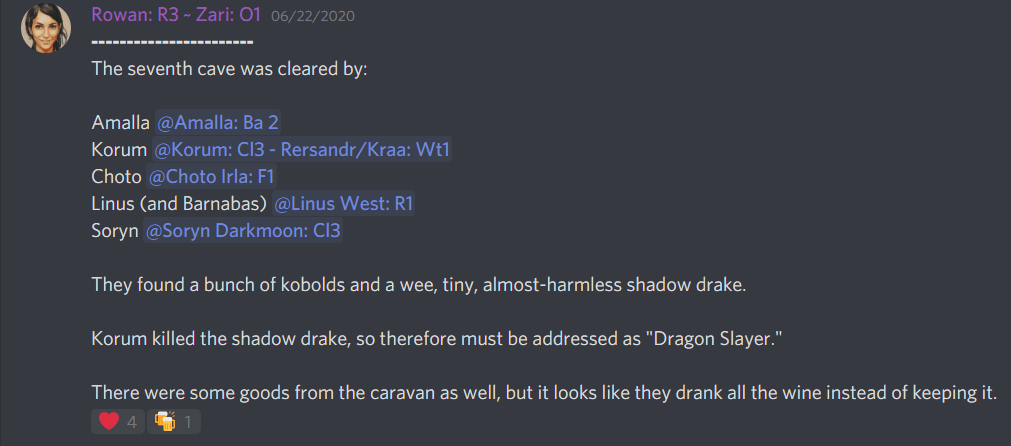
Once the players returned to town, I’d update the map with what was cleared and any notes that were made and post it to the Discord, as well as a synopsis of who went and what the players found.

After-session round-up

How’d it go?

Prepping and converting the Caves of Chaos was no joke, but it was so worth it. I’d guess that I spent around 10 hours converting and scaling encounters, setting up maps, and creating tokens, but this lead to twelve sessions where I had to do minimal prep. To be honest, if I hadn’t obsessed about scaling and instead just scaled everything to APL 2, I could have shaved quite a bit of time off of that prep.

Also, the maps? I wasn’t kidding when I said that they’re truly awesome. Modern map-making tends to focus on a beautiful backdrop to what is essentially an open playing field. The CoC caves have hallways and rooms and dead-ends and secret doors, leading to a more dynamic playing field as activity happens outside the line of sight, PCs get separated, or they get penned in between two different groupings. The maps are also interconnected, which allowed players to sneak into other dungeons and do them in reverse, taking out the boss first, then his minions, and then the scuts at the door.

The players enjoyed the whole quest line. By the time the last cave was cleared, nearly every one of the players on our roster had been to at least one cave, making it a true team effort. I had planned on making the caves disappear at the end of the quest line, but the players started making plans on what they wanted to do with them, so I guess they’ll become a feature of the town. Of course, they are magically created, so who knows what might pop up in the future…

Diving into West Marches

Ever since I saw Matt Colville’s video on running a West Marches campaign, I’d wanted to run one. For those who don’t know, a West Marches campaign turns the idea of a ‘gaming table’ upside down.

  • Instead of one GM and a set number of players, you have a huge pool of players. You may even have a pool of GMs.
  • Instead of a set group of players showing up every week, players self-organize into groups and then figure out a time that works with a GM.
  • Instead of a plot that takes a group around the world, travelling from town to town, the plot centers around a single town that has the Buffy-like habit of drawing problems to it.
  • Instead of a monolith plot, there are multiple threads going on at any time, allowing players to investigate what interests them.

I love the idea of being able to game with a larger group of players, running a plot that was less focused on telling a grand story and more a collection of interesting situations. While I do love a good epic story, it can be exhausting to plot for (especially if you’re an obsessive planner like me). And the allure of having other GMs to fall back on is especially nice. At the time, though, I was already running a campaign, so I put the idea on the back-burner.

Fast-forward to a few months ago, and an interesting opportunity fell in my lap: Becoming a GM for a RP server that hooked into the world of Court of Corvids. I pitched the idea of doing it West Marches style, and Kellandale was born.

The system

One of the biggest hurdles to having a game with handfuls of players and multiple GMs was also the most boring: Record keeping. How do you keep track of XP awarded, gold, purchases, who is playing what, what allowances have been made… After reviewing bots and a moment of madness where I considered writing up an app, we ended up going the route of simplicity.

XP is awarded monthly to everyone on the server. It’s based on the amount of server chatter that month, which we measure by using MEE6. Total server levels * 2 = Total XP for that month. This made keeping track of what level everyone is super easy, since you can find out when someone joined by searching for their username. Does this mean someone could join, say nothing, then roll in a few months later with a level three champion? Sure. But that’s balanced by…

The only way to get gold is to go on missions. When you start on the server, you get 15 gold for your starter gear. After that, if you want to buy gear, runes, potions, spells, or any other adventuring gear, you have to go on a GM-lead mission.

The only thing you get from missions is gold. Now, I love loot as much as the next GM, but I also appreciate the need for balance. Balance is easy at a table with one GM and four players: Just look at their sheets and make sure that they have a similar amount of cool stuff. Is someone behind? Drop something for them in the next encounter. But what do you do on a server where you have multiple GMs and a gaggle of players? How do you make sure everyone has the same access to cool stuff?

The town sells everything you need. The boring solution was you give everyone the same access to cool stuff. Players get a certain amount of gold for every mission. There’s no looting the bodies and selling the gear back at town. Chests don’t hold more than low-level healing potions or items for flavor. Kellandale is a town that’s “big enough” to buy any item you need, as long as you have the gold in hand.

RAW at all times. Aside from a few house-rules that had to be implemented due to the strange nature of the game, we stick to RAW, Paizo-only at all times. This does mean less flavor for players, since they can’t have a cool, GM-bespoke weapon that feeds into their character’s history. Tracking exceptions was too much of a headache, though. We balance that with…

Your rent is paid. Gold earned through missions goes towards adventuring equipment. It’s presumed that the PCs are earning spending money throughout the week using their Lore skills, so rather than roll for it, we assume that they make enough to pay for room and board. Want to go out for a nice dinner? No need to mark down that you spent 5 silver on some Cheesy Chicken at Massimo’s. It’s covered. Want to have a cool looking weapon with no mechanical benefits? Go to town. Heck, want to own a house? As long as it fits your background, go for it.

The GM decides how to run the session. We decided early on that standardizing was going to create a bigger headache than it was worth. So, if a GM is running a session, they decide how they’re going to run it. So far, we’ve run games via voice-only, text, and Roll20, but I wouldn’t be surprised to see a few other options pop up at some point. The only catch is that it has to be free for players to access.

Offer alts. One problem we realized we would have eventually is that eventually we would have wide spread of character levels. Older players might want to play with the newer players, but taking a level one along on an adventure with a crew of level fives is practically impossible to balance.

We decided to balance this by allowing alts. Once your first character hit level three, you could roll up a free level one alt. After this, monthly XP would be split between the player’s characters however they chose. Racing to get to to 20? Don’t put any XP on your alt. Want to play at the lower ranks for a while? Toss them all on there, or split them between the two characters. Get your alt to level three, and you can create a third character.

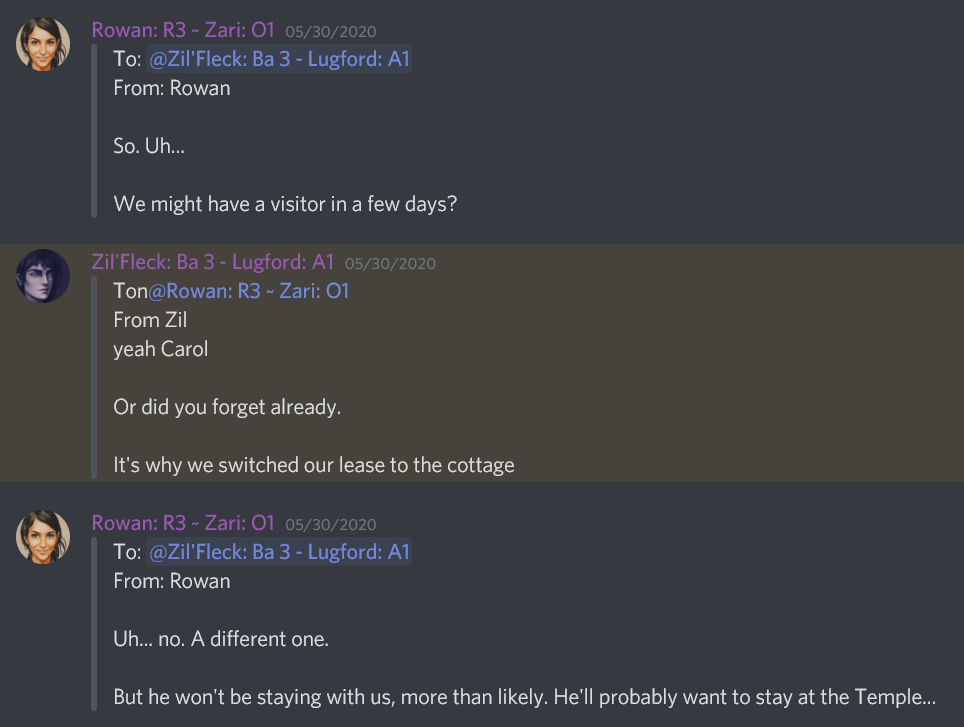
Messaging stones. Several of us came from a modern-setting server where everyone had a smart phone, so everyone could message everyone else. This was super convenient, since it allowed players to communicate without having to ‘happen’ to run into each other or having to run a scene for a quick exchange. Golarian, of course, doesn’t have a data network… but it does have magic! So we created a simple, yet powerful, mechanic: Messaging stones.

That time when my character’s brother came to town…

Every PC is given a free messaging stone when they come to Kellandale. Once they have it, they can send messages to any other PC who has a stone, as long as they’ve met them in game. Yes, they are incredibly powerful, and I would likely ban them at a regular tabletop game, but for a server filled with people in time zones around the world, it’s been the grease that keeps the gears moving.

How’s it going?

We started the server in December, though the first sign-ups didn’t happen until January. Since then, we’ve gone from barely having enough players to keep one GM busy to needing to bring on a fourth GM to make sure all players can be in a session regularly. On the way, we learned some things.

Figuring out sign-ups. One of the suggestions in Colville’s West Marches video was that players would self-organize. It became clear (at least to me) early on that players were not going to self-organize into groups and approach a GM. After all, this was a server where most players barely knew each other. The original West Marches campaign was made of friends. While we’re still feeling our way around the best way to do this, some patterns have emerged.

First, we learned to use the @everyone tag to let people know something is happening. If you’re in one Discord server, you’re probably in a dozen. We couldn’t depend on people checking in every few days.

Second, we started using reactions to figure out what time works best for interested players. For my games, a check meant you were interested and available, an O meant you were interested in being an alt, and an X meant that time absolutely didn’t work for you.

Apparently, no one was interested in fireworks this year.

After a day, I’d look over who was interested and set up the next few sessions. Turnaround time ended up being super important, since waiting too long to get on people’s calendars often lead to people getting booked elsewhere. I could almost always get everyone squeezed in, but if it came down to it, I’d have some people put down as alts with first dibs.

Embracing the meta. Everyone is in a town for the long haul. We’re never leaving, save for a short jaunt. Therefore, if you make a character, they have to have a reason to settle down. And yes, weird things are always going to happen around town, since we can’t travel far, so learn to hang a hat on it.

Building encounters properly is important. This one was a tough lesson to learn. As a GM, you never know who’s showing up to your game. Even if the sign-up was finalized a week before, players shift around, someone decides to bring their alt rather than their main, you get late adds and drops. If there was ever a game where you needed to live by the encounter building rules, it’s a PF2 West Marches campaign.

I learned to be super flexible with planned mobs. As combat got underway, I’d keep an eye on how the group was doing and delete out-of-sight trash mobs if needed. I’d also liberally apply elite or weak adjustments if I felt like the players needed a challenge or a break. I also planned when I could, making sure to calculate a few options so I wouldn’t be sent scrambling if a level 3 didn’t show, and suddenly the APL dropped by one.

Discord data! I love me some data, and since the server was on Discord, I had so much data. Discord has an API you can hit that allows you to download all of the channel data from any Discord you’re a member of. I ended up using said data to create a roster, grab who the new players were, check out which reacts were getting the most use, and see patterns for channel usage.

Future questions

Just because we’ve been doing this for half a year doesn’t mean we know everything. There’s a few issues we’ll have to wrangle with down the road.

Higher level play? The highest level characters on the server right now are level 3. We’ll likely have our first level four characters in August. While we’re not at high-tier play, we are entering into the middle-tier. Do we need to start putting together more complex plots for these higher level characters, or do we just put bigger rats in basements?

The trickiest part about introducing high level play is that there’ll still be lower-level characters running around town. How do we introduce big threats without making it improbable that a level one would stick around?

Level caps? Forced retirement? If a player never puts XP on their alt, they’ll get enough XP to level about every two months. This puts super high-level play off in the future, but mid-tier play is quickly approaching. Do we need to do anything to keep the levels of the characters flatter, or is it okay to have a small group that’s rocketing ahead? And what happens when someone reaches level 20? Do they continue to play, or do they fall into the background, allowing the player to start over again?

Scaling? Right now, we have just over 20 active players (which includes GMs), and four active GMs. This seems to work out fine, as people are able to be in sessions. But will this ratio still work if we hit 40 players? Or 100?

Want to join us?

Kellandale is tied to Queuetime’s Patreon. Anyone who donates once to the $5 tier gets access to the RP Discord and can sign up for sessions as soon as they have an approved character sheet.

[ Sign created with http://apps.pathstoadventure.com/Tavern-Sign-Crafter/craft.asp ]

Larg(ish) combats take two: Off-screen fights

In my Council of Thieves game, the PCs lead a group of lower level rebels. They’ve used them throughout the AP, sending them off on side missions, using them to make up for skill gaps, or bringing them along when the PCs have a large combat.

Recently, the group decided to use them as a distraction. The rebels would keep part of the guard engaged while the main group orchestrated a jailbreak. Due to the layout of the prison, the players wouldn’t be able to directly communicate with the rebels, meaning I would have to simulate what was going on above ground.

True, I could have hand-waved it, but I try to avoid that when it comes to plans like this. Also, the dev in me can’t resist a chance to whip up a script to make things interesting.

The simulation

At first, I thought about writing up something that would take into account hit points, AC, chances of hitting, damage, etc. I decided that was going to be too high effort, especially for a single combat.

Instead, I went with a ‘wound’ system (Note: not the alternative rules from Unchained). I figured a wound would represent a bit of fortitude or luck, like access to healing or a chunk of hit points. Losing a wound point would be akin to getting hit and not having a potion / healer on hand or getting hit especially hard. Running out of wounds would mean your luck had run out.

Combat would work like this:

  • For every two levels an NPC has, they would get one ‘wound’ level. This would be the max number of wounds they can take.
  • Every round, half a wound would be dealt to a random NPC on each side.
  • Once an NPC’s taken their max number of wounds, they are out of the combat and can’t receive more wounds.

For this combat, I decided that being out of wounds didn’t mean the NPC was dead: They’re just unable to fight anymore. Anyone who was at zero wounds would have some sort of injury that would require a heal check and time as well as some magical healing to overcome (like a bone fracture, a bruised rib, a deep wound, etc). While a bit harsh, I wanted to simulate what it was like to be in a combat where you can’t run when it seems dangerous: You have to stick around until you can’t possibly fight anymore.

I also decided that the rebels would scatter as soon as they were down by half. If they waited longer, they may not have enough hands to help the seriously wounded escape with them. In my simulations, this took somewhere between 25 and 30 rounds. I liked that range because it would make things interesting for the jailbreak team. If they took too much time, they might have a second wave of guards descending upon them. If they moved quickly, they might be able to completely take over the prison and guard house.

I decided that the guards wouldn’t retreat as quickly. After all, they’re right by their stronghold, and the ones in the street are working off the assumption that they have back-up coming any second now.

Because it was possible that the main party might come upstairs and clean house, I decided that I’d simplify combat for those left standing. Rather than worrying about hit points, I’d just worry about landing hits. One hit means dealing half a wound (or maybe a full wound if the damage was high enough). When it comes to mopping up, I don’t generally like to split hairs.

The script

In theory, I could have just a rolled a die every turn and kept track of wounds on paper. I wanted to be able to run the simulation a bunch of times, though. This is cumbersome if doing it with pen and die, but trivial when running code. Running the script a bunch of times helped me adjust the numbers so that the fight was interesting without being impossible.

In fact, the multiple simulations are why half a wound is dealt out rather than a full wound: It made the numbers work how I wanted. It also helped me brainstorm how I might interpret the end results.

This script requires Python 3. Also, you need two CSV files, which I included examples of in the repo. Each line is the NPC’s name, how many wound points they have, and how many wounds they start the combat with (generally zero).

[Script] – [CSV file 1] – [CSV file 2]

How’d it go?

When it came time for the combat, I warned the players that I had a script going that would be simulating the battle above, so they should keep that in mind. I felt it was fair to give them a heads up, since I’d been hand-waving much of the off-screen activity of the rebels.

When the combat started, I fired up the script, advancing it at the end of each round. The players mowed through the combat downstairs, and around round 17 ran upstairs and mopped up the guards the rebels had been fighting. By that point, there were two wounded rebels.

Because they knew time was of the essence, I felt like the players pulled out all the stops to end the combat quickly. At the start of the combat, they had no idea if my script was going to hurt people or outright kill them, which seemed fair. They’d never been in this sort of combat with the younger rebels before, so they couldn’t really predict the outcome.

Afterwards, I explained the mechanics of the script. I felt that the PCs could get a rundown from the rebels as to how it went, so a bit of meta-gaming was fine. They didn’t push back on the consequences, and accepted that the rebels that were wounded were going to be down for a day or two. Heck, one even pointed out that one should be out longer!

Future plans for the script

The script was written for a specific combat, so I knew the damage flying back and forth would be somewhat close. In the future, though, I may want to vary the damage output, making one group weaker or stronger.

I also may want the damage dealt to shift as the groups change. Because my simulations showed the groups always being about the same size, I didn’t worry about this, but I could see a future combat where this might vary quite a bit.

Finally, I may have make the script lethal, especially if my players decide to overthrow all of Cheliax…

Council of Thieves: Book Five (as book four)

Fair warning: This post is a long one, since I had to completely rewrite the book twice. Buckle up.

One of the most common suggestions to people who want to run CoT is that they run the books out of order. Since books one, two, and three focus on stopping the shadow beasts, it only makes sense to continue with that thread rather than take a break for a different adventure.

That said, Book Five took quite a bit of reworking before I felt like it was usable. Besides scaling down, some events had to be removed, and a lot of blanks had to be filled in.

Book Five is also like Book Three in that it’s totally possible to take on the end game right after the first session, skipping over the middle part of the AP. If you’re someone who does Just In Time Prep, you’ve been warned.

What I changed (Part One)

Oh, quite a bit. For pretty much the whole book, I figured out what the absolutely vital piece of information / action for each scene was and then re-wrote everything. I knew I had to hit certain beats, so I focused on those:

  • Finding out about House Drovange and the Council of Thieves from an insider
  • Getting some sort of introduction to the Mother of Flies
  • Rescuing the Mother of Flies so the party can learn about Walcourt
  • Taking on Walcourt so the party can kill Ilnerick and create / destroy the Aohl

Re-ordering AP events

Due to swapping books four and five, this meant that the fall of the mayor and Senior Drovange couldn’t have happened yet. Therefore, I had to remove any reference to riots or chaos and save those events until after Ilnerick is take care of. Oddly enough, this wasn’t that hard, since most of the book ignores the events in the Crown Sector.

The Kick-Off

The inciting incident involves dealing with a ‘trusted’ new NPC who the players have never met. My group leans towards paranoia, so the chances of them biting were slim. Instead, I pulled out what absolutely had to be introduced with that scene:

  • Confirmation that Ilnerick is in Westcrown
  • Some information about house Drovage (including their involvement with the Council of Thieves)
  • The involvement of the hags in whatever went down when Eccardian was born
  • The fact that there’s a splinter faction within the CoT

Rather than a new NPC, I used the interlude with the Children of Westcrown to deliver an alchemist to the heroes for questioning. Rugo is a bastard son of Senior Drovage, kept around because he’s utterly loyal, fairly useful, and good to have in case the house is left completely without heirs. With some threatening, he should reveal everything the players need to know in order to move on with the plot.

Mother of Flies

In the book, the players are ambushed while seeking out someone the contact knows, and a follower of the Mother of Flies steps in to help. Instead, I decided to condense things a bit, making the scene where the heroes interrogate Rugo the same scene as the ambush.

To make this work, I moved The Mother of Flies from the Hagwoods to the sewer, reworking her backstory. After her sisters were killed, she fled, but has made her way to the city, hoping to take revenge on the Drovenge family. Unfortunately, her lair was discovered and she’s currently under siege by the Council. At the moment, she’s holding them off, but every day they lose ground.

Some of her agents are still free, and have taken to roaming the sewers, killing reinforcements when they can and looking for a chance to break the siege from the other side.

So, I have two moving parts in the sewers now: Siege reinforcements and Mother allies. As soon as I’m done with the PCs interrogating Rugo, they’re stumbled upon by the reinforcements. As soon as that ruckus is underway, the Mother’s allies come to see what’s going on. After helping out with the combat, the allies can offer some information about the Mother of Flies:

  • She was chased out of the Hagwoods after her counterparts (Sister and Daughter) were killed
  • She came to town to enact her revenge
  • The CoT figured out she was around and have her under siege
  • Rugo was a part of the massacre and was a target for the Mother. The allies that are behind enemy lines are there because they were doing reconnaissance

The main ally is the from the book (Dog’s Tongue), and will give out enough information to hook the players into at least checking out the Mother of Flies.

If the players help end the siege (which is likely, since the siege is also going to make getting around in the sewers harder if they ignore it), they find out where Walcourt is, the history behind Drovage and the Mother of Flies agrees to hole up away from them and leave town once they enact her revenge for her. After that, the players are free to plan an assault on

And then things went to hell

A good plan never survives contact with the players, but I hadn’t expected them to completely wreck them before we even got to the first session.

I was in the middle of planning Book Five when the players finished Book Three. After clearing out Delvehaven, the players decided to resurrect one of the vampires. She was previously a vampire hunter, so likely to be good or neutral, and probably had information they needed. This obliterated the need for half of next book.

I was weirdly delighted with this turn of events. I was losing an interesting NPC (Ailyn, the Pathfinder Bard) soon, so this would give me someone new to introduce the story. Also, it felt a bit more elegant, since even with reworking, the siege felt awkward. Still, it required some scraping of my plans and figuring out if they even needed to deal with the titular Mother of Flies. After all, they’d have the plans for Walcourt and hints about Drovage being involved with the Council of Thieves. They’d be missing some backstory, but that could be inserted later.

What I changed (Part Two)

I decided to create four plots for this book:

  • Reviving Vahnwynne (and dealing with the fallout)
  • Potentially dealing with the Mother of Flies
  • Doing a favor for the temple of Calistria
  • Taking on Walcourt

Reviving a slayer

Reviving Vahnwynne comes with three complications: Finding someone to do the resurrection, acquiring a diamond worth 10k, and dealing with the fallout.

As I wrote before, the Temple of Calistria is the only game in town when it comes to doing a non-evil resurrection. The Temple won’t simply take payment for their services (in fact, they’ll refuse it). Instead, they’ll require a favor. They won’t force the players to carry it out before the resurrection, but when they come calling, they’ll most certainly have a window in which to get it done.

Acquiring a diamond is less of an issue, especially since one of the Children of Westcrown happens to be the daughter of a prominent jewelry merchant. The biggest problem there is finding the cash, since much of the previous spoils have gone into buying property or outfitting the rest of the rebels.

Finally, the fallout. I’ll write about this more in another post, but in short, Vahnwynne comes back with emotional scars. She was a CG person who was forced, via the nature of vampirism, to commit evil acts. Coming back, the memories of such events stay with her, haunting her days and nights. It also doesn’t help that she’s brought back by a group of strangers. If they want her help, the PCs will have to invest some time in getting to know her (and her issues) and helping her recover.

The Mother of Flies

With the resurrection of Vahnwynne, the Mother of Flies becomes unnecessary when it comes to pushing the plot forward. She has some interesting information about the backstory of the Drovage family, but that’s about it.

Rather than use her as an arbitrary stumbling block, I decided to make her optional. I also opted to place her in the sewers of Westcrown (as suggested in a Paizo forum thread) in order to tighten up the plot. She fled from the Hagwoods with a band of followers and has resettled in forgotten part of the sewers, plotting her revenge against Drovage. At the time of the AP, she’s been discovered and is currently under siege.

Vitti, the rebels’ druid, can clue the main PCs in on her existence. In my game, he’s been mapping the sewers, and would note that there’s some strange activity going on. The usual signs of life are disappearing and they’re running into more groups of humans. The players can opt to follow this thread if they want, with the reward being information and a possible alliance, either against Walcourt or for one of their more long-term goals. It also doesn’t hurt that a victory would mean taking out a good chunk of the Council of Thieves standing forces.

I also changed the hook, since the players rarely use the sewers to go anywhere. Instead, two of the CoW (Vitti and Larko, for my game), barely escape an encounter with a band of Council thugs. They tell the PCs what happened and leave it up to them what to do next: Investigate, delay, or ignore the threat.

The Siege

Moving the Mother of Flies underground meant I had to redo the siege. The book lays it out as a rather linear experience involving a lot of enemy fey, which doesn’t make a lot of sense, so I redid it to make it feel more like a group of people being penned in.

The center of the siege is the Mother’s hut, which she placed at a very specific point in order to draw on its power. There are three open areas around her hut, which were originally intended as space for their camp to grown. The Council’s thugs now occupy those spaces, however, blocking her and hers in.

The thugs, at this point, have tried a few pushes, but quickly found that the Mother’s crew can do some serious damage to them. Mother’s side, however, has found that they can’t make a move without the two other sides falling upon their back line. Even if they coordinate with Dog’s Tooth’s group, it still leaves them vulnerable. Both sides are at an impasse.

Each side has about 15 people in it, though several of those people are slaves (something the fey don’t recognize as different than any other enemy). Each group is comprised of one lower level magic caster, one lower level priest, a mix of fighters and rogues, a ranger, and a skald / bard / some other force multiplier. The highest level enemies will be whoever escaped from the fight in the sewers.

Calistria

I’ll be detailing this subplot in another post, but the short version is that the players are tasked with recovering the body of a murdered temple priestess and punishing those responsible in whatever manner seems fit. This will take the crew out of town to a manor, allowing for a nice change in scenery and a chance to use some of their more esoteric skills.

Walcourt

I wasn’t a huge fan of Walcourt as it was in the book. It looks like a fun romp… for any other game. The tone of my game had gotten a bit grim, so I decided to remove some of the goofier elements and play up the corruption of Ilnerick. Rather than being a standard hive, I fashioned it to mimic a Pathfinder lodge, specifically, Delvehaven. The motifs and decor will be familiar to the PCs, and some of the vampires will be former Pathfinders who were tempted too close to his lair.

I ended up using the wonderful Village to Pillage: Murder Mansion as my map. I left most of the levels furnished, only bothering to customize the basement. In game, Walcourt formerly belonged to a noble house that fell during the Chelish civil war. The manor and its lands have never been rehabilitated, in spite of the fact that it sits in the middle Crown Sector. The official reason for this is that the matter of ownership is unclear since many houses could possibly lay claim to the land and the house, but the leaders of Westcrown have made it clear that whoever claims the land must also pay the back taxes on it. Unofficially, Walcourt is kept empty so that the Council of Thieves has a secure location on the island.

Also, you have to keep your pet vampire somewhere, right?

How did it go?

The kick off

Session one was basically set-up for the entire book, What Lies in Dust style. The players got all the hooks during this session and were given no particular order in which to do them. Vahnwynne was raised, they found out about something going on in the sewers, the deal with the temple of Calistria was struck, and they learned the location of Walcourt.

The players immediately accepted that their newly risen party member was traumatized and set about ways to alleviate it. They dug deep into their various tricks to find spells, skills, concoctions, and treasure to figure out ways to help her, which is always nice to see as a GM.

Dropping all the hooks on them at once also seemed to work well, since it gave them freedom to prioritize. The book is very linear, so I’m glad I reworked the plot so that they’re not dependent on each other.

The sewers, the fey, and the siege

The players decided to go into the sewers first, reasoning that if the sewers were now off-limits, the CoW were going to have a harder time getting around.

I set up a crew of Council reinforcements for them to stumble upon. I made it a CR 13 encounter, figuring I’d let the players get into a dangerous situation and then have the red cap Dog’s Tooth step in. He could help turn the tide and get the players moving on the Mother of Flies plot.

One misstep I made: I underestimated my players. They actually did fairly well against the reinforcements, even if the encounter was running long. I had meant to get them to the fey hideout this session, but I ended up having to stop right after introducing Dog’s Tooth.

Meeting the fey

In the third session, the group met Dog’s Tooth and his camp, and it confirmed my suspicions: If the PCs started with common ground with the fey, they’d have no problem making a deal with them. They figured out that many of the fey in the camp were evil, but knowing from the start that they had a common enemy and that the fey intended to leave town after their revenge was had, they decided to play ball.

The PCs got some rough details from Dog’s Tooth about the siege, letting them know that the battlefield had three areas, and that each one held ten to fifteen mortals. This was where I ran into a small problem.

If you give your players some rebels…

…They’ll want to bring the rebels to the fight.

After hearing about the number of potential combatants, the players immediately started planning on bringing all of the Children of Westcrown with them. All of them. I choked at first, since that meant I’d have fourteen friendly NPCs to control.

I almost said no, but then I decided to think about it. After some discussion with my husband (who’s also one of my players), I worked up a solution that would, hopefully, keep combat moving and keep me from having to control an absurd amount of mobs.

The system ended up working quite well. The combat never got bogged down, and while it was still a long fight (around two hours), it never felt slow or drawn out.

The fallout

The players were happy that they were able to clear out a chunk of the Council and got to learn a bit more about the Drovage family. They were also interested in forging an alliance with the fey, though I decided to delay that a bit. The fey informed the players that they had to relocate, and that they would be in contact once that was done.

The players also decided to take a few prisoners from the siege so that they could find out where the other hideouts for the CoT were… which involved maps I totally did not have. Between sessions, I threw together a few possible encounters: A main gathering place for the CoT thugs, a tavern just outside of town (used as a secret entrance to the city), and a warehouse in the docks (mostly for smuggling goods into and out of the city).

Calistria

I had major worried about this side-quest, since there was a chance that the players could seriously foul it up. I decided to heed the advice of Matt Colville, though, and not worry about how the players would get themselves out of a jam.

In the end, the players did perfectly fine: They got out with everything they needed and even made few new allies along the way. It was also a nice break from a combat-heavy book.

The warrens

In the end, the only place that the players ended up hitting up was the Warrens. Once again, I grabbed one of the awesome Village to Pillage maps, tossed in a ton of NPCs, and let the players go nuts. They captured a few guild members, allowing me to toss some more information at them.

The most important discovery was a coded note with instructions to watch certain people. While the players were able to decode the text portions of it, the names of the actual people were left as a mystery. They did manage to get a few names out of the captured thieves, but they didn’t manage to grab the ones who would have been able to tell them that they, the PCs, were on that list.

This was fully intentional, as I wanted to make the players a tiny bit paranoid without sending them into a frenzy of self-defense. Sometimes, a GM needs to be a bit evil, okay?

Delvehaven

Finally, after getting their insider (resurrected Vahnwynne) better and raising some hell, the group descended upon Delvehaven.

Honestly, while this encounter looked super tough on paper, the group breezed through it. They used their insider knowledge, planned the heck out of what they were going to do, and brought all the higher level people with them. Illnerick never stood a chance.

If I could do it again…

Looking back, I’m not sure I’d change a thing. I liked how the book played out, I figured out how to run large-ish combats, and the players seemed to enjoy themselves.

One thing that did bug me: Downtime. With this book, I offered a ton of downtime, spreading out the major events over months. There was nothing especially pressing. Even the request from Calistria didn’t have a due date (as long as they didn’t put it off too long). This lead to the number of sessions doubling, which wasn’t a bad thing, per se, but caused the tension to ease up a bit too much.

I decided that was fine, though. After all, it just made removing all downtime in the next book more distressing…