Gatewalkers Book 2 Chapter 2 GM Insights: Smooth Sailing

Over on D20Saves, I’m running Gatewalkers, one of the latest APs from Paizo! From the official website:

After they walked through that glowing gateway, nothing was ever the same. A band of characters become paranormal investigators to determine the cause of a global amnesic episode. Their quest takes them to lands near, far, and outside this reality altogether. Along the way, the characters meet fellow “gatewalkers,” defeat alien monsters, and explore strange realms touched by the Missing Moment. And when it comes time to learn the grim truth of what happened to them on that fated summer night, what then?

Warning: The first part of this blog will cover what happened in the stream, so there are spoilers for the beginning of Book Two. Part two will include my thoughts as a GM, so there are major spoilers for the AP overall.

Check out the playlist here if you want to watch the previous episodes!

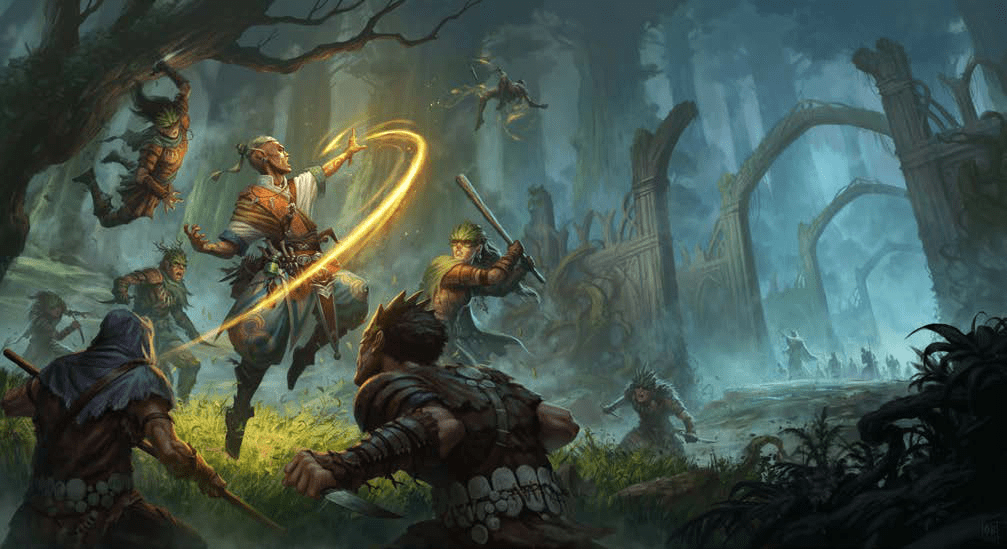
The second chapter of Book 2 opens with the players looking out over a great frozen lake with no way to get across. True, they have a raft, but that’s certain to be eaten by the storm-tossed waves before they get too far. Their only option is to scour a ship graveyard and hope something is still seaworthy enough to get them to civilization.

Making their way through wrecks that could barely suffice as kindling, they find a ship that looks amazingly whole. They board her, only to be attacked by the machinery itself. Happily, the captain appears and calms the ship down. Unfortunately, he’s a ghost, though less mad than those on other ships. He agrees that if the crew can get his ship free of the magical ice surrounding it, he’ll sail them to wherever they want. They just have to make nice with a naiad queen.

So, once again, solving everyone else’s problems other than their own, they make their way to her temple, and after clearing out some of the denizens, they convince her to share the ritual that will remove the ice. After some stomach-clenching rolls, the group succeeds and is able to sail into the lake and towards Egede.

Of course, it can’t be all smooth sailing. Along the way they encounter psychedelic bubbles that, at best, force those who inhale them to have hallucinations. At worst, they drive people mad, and they encounter a whole ship of people who apparently took in a deep breath. The party received a worrying glimpse into their lost memories before being set upon by the specter of Osoyo.

They survived, finally coming to the costal town of Egede, where they bid their captain farewell as he finally takes his ship and his crew to the great beyond.

GM Stuff

Okay, seriously, if you’re a player in my stream, DO NOT KEEP READING. Don, James, Jorge, Daton, Ricardo, CLOSE THIS TAB.

This chapter, in spite of having a lot in it, went by fast. Seriously, I almost forgot to write this blog post. As of this writing, the party is almost done with chapter 3! So if you’re a GM who only preps one chapter ahead, maybe reach a bit further for this book.

Encounter-wise, everything was fairly straightforward. None of the fights left the crew anywhere near a TPK, and none of the encounters left them confused. In fact, the hardest thing they ran into was the ritual. It took a few goes, but finally, they succeeded. If your players ranks are low and you don’t want the ritual to just be NPCs rolling dice, consider having the naiad queen handwave it. After all, if the ice isn’t lifted, they’re not going anywhere!

Finally, ghost Sakuachi is still working out fine! Thought I will say that the players are desperate to make her a statted NPC, I play up that she’s barely holding on to the material plane at this point in time. There are spots in the AP where her team could have stepped win with skills, but this group is fairly well-balanced, so can handle pretty much anything that comes their way.

Looking forward

While I’m enjoying book 2, I’m really looking forward to everything coming together in book 3. The mystery, finally talking to their patron, and the trek across the icy planes: It’s going to be so good.
Pathfinder 2e Adventure Paths: My GM and Player Recommendations

Every few weeks, someone on r/Pathfinder2e asks for thoughts on what AP their group should run. In the spirit of “I’m tired of writing out my response every time”, I figured I’d make a blog post about it instead.

Yes, I mostly blog to save myself time later.

What I’m including

I’m including every AP that I’ve at least experienced part of, either as a GM or a player. I also include how I ran it (since I sometimes like to switch things up and run APs in a non-conventional way).

I’m not including Adventures, even though I’ve experienced a few. Maybe a blog post for another day!

The Adventure Paths

Agents of Edgewatch

Role: GM
Game type: West Marches
Status: Mostly completed

I ran Agents of Edgewatch as part of a West Marches game, which worked shockingly well. I had to move the main elements of Book 1 to our town, but they were fairly easy to transplant. For later books, I added teleportation circles to the town that were only active for those working their way through the adventure. This did require removing some bits, but no one missed them.

I enjoyed running it so very much, and it’s one of the rare APs that I find myself wanting to run again. It’s full of so many fun set-pieces, and being set in Absolom could give players a chance to really branch out during the adventure. If your players do like to wander, grab a copy of Pathfinder Lost Omens: Absalom, City of Lost Omens. It’s filled with lots of hooks and little details that can bring the campaign to life.

That said, let’s talk about the elephant in the room: The first part of the book has you working as guards who make their money by getting it off of the people they’re guarding. I highly recommend just paying them to keep the peace, rather than taking the property of the people they’re policing.

If you want a high-level review of the cool encounters, check out my blog post about stripping AoE for parts.

Abomination Vaults

Role: GM
Type: Standard
Status: In progress Done!

This is hands down one of the best APs I’ve ever run. I’m going to put a huge caveat on that statement, though: I love dungeon crawls, and so do the rest of my players. There’s something very satisfying to me, clearing levels one by one, plunging deeper into unknown depths. Not every player is into this sort of set-up, though. Players really, truly need to understand that they won’t be leaving Otari, and that the thing they will be dealing with for ten levels is the dungeon. The dungeon does switch up themes as you go, but you’re not going to some exotic new locale or running into a town of completely new NPCs.

That said, you are fairly close to Absolom so a lenient GM could work in some sidequests there. My players never bothered, opting instead to order what they wanted through a weekly caravan. Like, I said, we like dungeons.

From the GM side, you should either grab the modules already on your favorite VTT or settle in for a lot of prepping. Because players can go any direction, you can’t just prep the ‘next few’ areas. Once they’re near a floor, you should have it ready to go. On the flip side, this AP does allow you to be more passive as a GM. Most of the time, I was sitting back while the players discussed where they wanted to go next. I didn’t have to run complex social encounters or dinner parties, and most NPC interactions were limited to just one NPC. It’s a pretty chill experience until it’s killing time!

Some warnings:

  • Quarters are tight, so limit bodies. This means discouraging too many minions. It can work, but if everyone has a wolf, someone is going to be sitting in the hall in some encounters.
  • Emphasize that the players should not go down until they’ve cleared most of the floor. They will get their butts handed to them.
  • Rest is important! If the party is low on resources or sitting on a nasty disease or curse, they should go get that fixed before moving forward.

I wrote more about Abomination Vaults in its own post!

Fists of the Ruby Phoenix

Role: Player
Type: Standard
Status: Complete

This is one we streamed over on D20Saves with a group of experienced players. It was an absolute blast, and delivered on what it promised: A bunch of heroes entering a fighting tournament and accidentally saving the world. There’s a fair mix of social and combat as well as some traditional combats, so you can’t afford to create a group of one-trick ponies.

This is a high-level AP, so it’s not one I would throw at new players. You really should know what you’re doing with your characters and running complex encounters.

Strength of Thousands

Role: GM, then player
Type: West Marches, then stream
Status: Started, abandoned, started again!

This AP didn’t work quite as well in a West Marches game, so it was abandoned fairly early. I did read the first part, though, and it’s left me aching to either run or play in this one for legit years. How can you resist a Magic School AP? Also, book one had one of the best collections of NPCs I’ve seen in an AP ever.

Thankfully, one of the GMs over on D20Saves has agreed to run it for us, so I’m getting another crack at it!

Quest for the Frozen Flame

Role: GM
Type: Speed run
Status: In progress Done!

I’ve been blogging about this AP book by book, so you can check out my previous posts here. In short, it’s a great AP for players who are down for a wilderness campaign that focuses on surviving, exploring, and building a following. I want to be clear, though: When Paizo said it was a wilderness campaign, they meant it.

Some suggestions:

  • Have a spreadsheet ready to keep track of renown and followers gained. You don’t want to have to backtrack and figure it out because suddenly it matters at the end of a book.
  • Dear lord, use ABP. The loot is sparse.
  • Make sure players know they can take downtime to craft items they might need. They will not have access to cities. In fact, the players in my game are in book three and just heading to their first major encampment.

Gatewalkers

Role: GM
Type: Standard
Status: In progress Done!

This is another game that’s being streamed on D20Saves. We’re currently in Book 2, and it’s been a wild ride. Book one especially has a lot of hard lefts that no one in the party predicted. This is a great AP for people who happily follow plot hooks, but may be a struggle for a party who resists going with the flow. Also, some of the fights are deceptively hard. If your party is too squishy, you’ll run into trouble quickly.

I have a series of GM posts about prepping and running this AP if you want a more in-depth review.

Stolen Fates

Role: Player
Type: Standard
Status: In progress

And other D20Saves stream! We’ve only just begun, but so far, it’s been an intriguingly weird adventure. Amusingly enough, we’ve had more gates in book one than we had in all of Gatewalkers. In fact, I feel like this would pair well with Gatewalkers as a follow-on adventure to get the players to level 20.

And that’s it!

I’ll update this post as I finish / start new APs. For now, this is the complete list as of July 2024! Rankings are highly subjective, if I were giving out awards:

  • Favorite overall: Abomination Vaults
  • Most likely to run more than once: Fists of the Ruby Pheonix
  • Most modded: Gatewalkers
  • Most niche: Quest for the Frozen Flame

Caves of Chaos for PF2: The Creatures!

Way long ago, I wrote a blog post about revamping an adventure that was older than most of the players on our server: Caves of Chaos, from Keep on the Borderlands. One thing that post was missing was a specific breakout of what exactly I shoved in the caves. I figured I could get to that later, since I didn’t feel like deciphering my notes at the time. Well, a scant four years later, I’m finally getting around to that.

Look, I’m consistent. I’m not fast.

Background

This isn’t a republishing of the Keep on the Borderlands. You’ll still need to acquire the original book (available on DriveThruRPG or the Internet Archive) to see how the various caves interact, since some of them can repopulate others, some have allied with others, and some are at war. Also, it’s an interesting dive into RPG history!

I didn’t include any adjustments for the Keep part of the Keep on the Borderlands. That’s the part I feel can most easily be replaced by something campaign-specific (maybe you already have a keep you know about!) or adjusted for the flavor of your table. Heck, maybe the players don’t even want a keep, and are fine with roughing it in the nearby woods.

Each cave has been given a level, and each room in the cave has been given an encounter level. Encounters were built assuming a standard 4-person party. Keep in mind, though, that while caves get harder as they go further in, nothing is stopping the players from rushing to the other end of the valley and taking on the hardest caves first. If this is how your players roll… make sure they have back-up characters at camp.

Because of the cave system layout, players should be encouraged to scout caves to figure out what might be in there. Presumably, there’s detritus outside of the cave mouths that give a clue as to what might be inside. I include these for each cave, but it’s basically a hard-level DC for a Recall Knowledge to identify the specific creatures, or an at-level DC for Survival to identify the family.

Caves

Cave A: Hidden Kobold Lair

Information:

  • Level 1 cave
  • Find: DC 15 Perception
  • Scout: DC 15 Survival – Creatures from the Kobold family. Maybe a dozen?
  • Recall Knowledge: DC 17 Society – A clutch of kobolds reside here, preying on caravans as they pass.
  • In the hallway leading in, there’s a Hidden Pit trap.
RoomLevelCreature(s)Treasure?Notes
1Low3 Kobold Warriors
2Trivial1 Rat Swarm
3NoneDoor is locked with a poor lock. DC 15 to open
4Moderate2 Kobold Scouts
5Severe1 Kobold Mage
3 kobold Warriors
6Moderate5 Kobold Warriors

Cave B: Hidden Orc Lair

Information:

  • Level 2 cave
  • Find: DC 13 Perception
  • Scout: DC 16 Survival – Medium sized creatures, probably of the Orc family. Maybe a half-dozen?
  • Recall Knowledge: DC 18 Society – Orcs are near here. Not quite enough to be a warband, but still, a sizable number.
RoomLevelCreature(s)Treasure?Notes
7Trivial2 Orc Brutes
8Moderate2 Orc Warriors
9None
10NoneYes
11NoneYesLocked (simple): DC 20
12Severe1 Elite Orc Warchief
2 Orc Warriors
YesSecret door: DC 18 Perception

Cave C: The Other Orc Lair

Information:

  • Level 2 cave
  • Scout: DC 16 Survival – Medium sized creatures, probably of the Orc family. Maybe a dozen?
  • Recall Knowledge: DC 18 Society – Orcs are near here. The makings of a small warband.
RoomLevelCreature(s)Treasure?Notes
13NoneYesSecret door: DC 18 Percep
14Moderate2 Orc Brutes
2 Orc Warriors
15Low2 Orc Brutes
16Severe1 Elite Orc Warchief
2 Orc Warriors
1 Orc Brute
Yes

Cave D: Goblin Horde

Information:

  • Level 1 cave
  • Scout: DC 15 Survival – Creatures from the Goblin family. Maybe a dozen?
  • Recall Knowledge: DC 17 Society – At least a dozen goblins have holed up here.
RoomLevelCreature(s)Treasure?Notes
17Trivial2 Goblin WarriorsYes
18Trivial2 Goblin WarriorsYesA goblin can spend actions to get the Ogre in Room 22 to join them. This will turn the encounter from Trivial to Severe.
Secret door: DC 15 to notice
19Moderate1 Goblin Warrior
1 Goblin Commando
1 Goblin Pyro
Yes
20Severe1 Goblin War Chanter
1 Goblin Pyro
1 Goblin Commando
Yes
21Moderate4 Goblin WarriorsSecret door. DC 20 to notice (Level 1, very hard)

Hobgoblins in room 29 may come in, but not during combat.

Cave E: Ogre Cave

  • Level 3 cave
  • Scout: DC 18 Survival: A large creature lives near here. Probably an ogre?
  • Recall Knowledge: DC 20 Society: An Ogre Warrior lives in this cave.
RoomLevelCreature(s)Treasure?Notes
22Trivial1 Ogre WarriorYes

Cave F: Hobgoblin Tribe

  • Level 3 cave
  • Scout: DC 18 Survival: Hobgoblins live near here. Maybe two dozen?
  • Recall Knowledge: DC 20 Society: A large tribe of hobgoblins have set up here. There are signs that they have taken prisoners recently.
RoomLevelCreature(s)Treasure?Notes
23Moderate1 Hobgoblin Archer
2 Hobgoblin Soldiers
Yes
24Low3 Hobgoblin SoldiersThere is a reward back in town for rescuing the prisoners.
25Low2 Elite Hobgoblin SolidersYes
26Moderate2 Hobgoblin ArchersYes
27Moderate2 Elite Hobgoblin SolidersYes
28Trivial1 Hobgoblin SoliderYes
29Moderate1 Elite Hobgoblin Archer
2 Weak Hobgoblin Soliders
30Severe1 Hobgoblin General
2 Weak Hobgoblin Soldiers
Yes
31Moderate6 Weak Hobgoblin SolidersYes

Cave G: Clutch of owlbears

  • Level 3 cave
  • Scout: DC 18 Survival: There’s signs of owlbear scat. The air is weirdly moist. It doesn’t look like a large number of them live here.
  • Recall Knowledge: DC 20 Nature: This cave hosts a clutch of owlbears.
RoomLevelCreature(s)Treasure?Notes
32Low1 OwlbearTreasure
33ModerateGrey Ooze
2 Ooze Mephits
Treasure
34Severe2 Owlbears

Cave H: Bugbear Alley

  • Level 3 cave
  • Scout: DC 18 Survival: A tribe of creatures from the bugbear family have set up here. Less than a dozen.
  • Recall Knowledge: DC 20 Society: A tribe of bugbears have set up here to prey on caravans.
RoomLevelCreature(s)Treasure?Notes
35Low2 Weak Bugbear Thugs
36Severe1 Elite Bugbear Tormenter
1 Bugbear thug
Yes
37NoneYes
38Moderate2 Weak Bugbear Thugs
39Moderate2 Bugbear Thugs
40None
41None

Cave I: The Maze

  • Level 3 cave
  • Scout: DC 18 Survival: You see signs of creatures going in, but not coming out.
  • Recall Knowledge: DC 20 Nature: This cave is wild, and likely houses wildlife…
  • Recall Knowledge: DC 20 Society: …and something that likes twisty passages.
RoomLevelCreature(s)Treasure?Notes
42Low6 Bloodseekers
43Moderate2 Weak Stag Beetles
44Low3 Hunting Spiders
45Severe2 MinotaursYes

Cave J: Gnoll Cult

  • Level 3 cave
  • Scout: DC 18 Survival: A large number of bipedal creatures have set up here. Probably gnolls, around a dozen.
  • Recall Knowledge: DC 20 Society: There are markings around this cave. Gnolls live here, likely cultists.
RoomLevelCreature(s)Treasure?Notes
46Low2 Gnoll Hunters
47Moderate2 Gnoll Hunters
1 Gnoll Cultist
48NoneYesLocked with an Average Lock (DC 25)
49Moderate2 Gnoll Cultists
1 Weak Gnoll Hunter
50Severe1 Gnoll Sergent
1 Gnoll Cultist
2 Weak Gnoll Hunters
Yes

Cave K: Death Cult

  • Level 4 cave
  • Scout: DC 19 Survival: A number of humans reside here. So may no longer be alive… About two dozen.
  • Recall Knowledge: DC 21 Society: Lots of humans come and go from this location. A dropped locket hints at recent captives being taken inside.
  • Recall Knowledge: DC 21 Religion: The way some of these creatures move points towards there being undead in the cave.
RoomLevelCreature(s)Treasure?Notes
51None
52Moderate2 Skeletal Champions
53Moderate4 Zombie Brutes
54Low2 Corrupted Priests
55NoneGravehall trap, in the hallway leading out. Trigger upon messing with the shrine or removing items.
56Moderate3 Grioth Cultists
57Severe1 Zombie Lord
2 Shambler Troops
1 Dirge Piper
58LowHaunt: Entombed Spirit
59Severe2 Weak Priests of Kabriri
60None
61Moderate1 Elite Necromancer
62Moderate1 Wraith
63Moderate2 Elite Gelatinous Cubes
64Moderate1 Annis HagThe hag is disguised as one of the prisoners. She’s 50/50 on killing the heroes who just rescued her, since she could be their next target.

Final thoughts

Treasure. I don’t lay out specific treasure that can be found. The GM can sprinkle whatever the group needs most. If there’s a town nearby, they’ll want gold, but if they’re opting for more of a wilderness setting, then they’ll need gear. Also, it’s possible to strip the caves of treasure completely and have bounties set on each cleared cave.

Not everyone is ready to rumble. Keep an eye on the room descriptions. Guards, of course, are always ready to fight, but if they’re lounging around eating lunch and playing cards, NPCs need time to be alerted, grab their weapons, and get to the fight. This is very important when it comes to caves where the encounters are right on top of each other.

The Caves are fluid. I found most players cleared caves in one go, but if they fall back, keep in mind that the various groups have allied with each other. If you leave someone alive, they’ll combine with their allies, which changes the balance going forward.

I hope some of you try this out! It’s a really fun module to break out, especially since so much of the story comes from how the players react to the caves. It’s also an interesting piece of history that stands up surprisingly well to the test of time.

Quest for the Frozen Flame AP: Book 2 Summary and GM Experience

A while ago, I posted about running Quest for the Frozen Flame, a Pathfinder 2e Adventure path. This past month, we finished book 2! In the interest of making the blog posts I wish existed, I wanted to do a rundown of the book from the GM perspective.

Warning! Past this point, there be unfettered spoilers for the Frozen Flame AP, including some for book 3. If you’re a player who hasn’t finished the AP yet, close this tab!

Book 2 Summary

Overall summary from Paizo:

In the brutal tundra of the Realm of the Mammoth Lords, only the hardiest folk have what it takes to withstand unsparing weather, track down big game, and fight back hostile followings. The Broken Tusk following has survived another winter, but a new year just began, and signs of danger foretell a year unlike any before.

This book opens with the tribe navigating a set of caves. The path behind them is blocked after the closing events of book one, so the only way forward is through them. The group is tasked with clearing a path to the exit for the tribe, which contains many vulnerable members who can’t fight or navigate traps.

No Paizo AP is complete without a dungeon, and I’m pleased to report that these caves were quite a bit of fun to navigate. They had a mix of fights, terrain, traps, and even social interactions that made them feel more alive than Diablo-style ‘kill all the things to proceed.’

The group eventually gets the tribe through, finding themselves in a valley that’s been ‘lost’ to Golarion for some time, and is being ruled over by a white dragon who wields the Primordial Flame. If you like hexploration, you will love this chapter. The goal here is to build your tribe’s number along with your reputation so that you have the manpower you’ll need to take back your tribe’s stolen artifact.

Finally, the players come to the glacial palace that houses the mad white dragon. A town at the foot of the palace, though, holds people badly in need of liberation. Depending on how much word has spread of your deeds, they may or may not help you with the final assault.

How’d it go?

The players seemed to enjoy this book quite a bit. They really got into the idea that they had to recruit new tribe members as well as spread their reputation throughout the land. Also, being a team of completionists, they were more than happy to clear a pretty sizable hex map. They also seemed to appreciate the mix of social and combat encounters, since we absolutely have some PCs who are more geared towards being faces than fighters.

Speed run update!

With this AP, I wanted to try an experiment with leveling. Rather than leveling up with XP or by milestones, when starting a new book, the players were asked to level for the max level for that book. So, for this book, they were level 7 throughout.

As predicted, this made the first half of the book fly by, with the end of the book feeling like it was an appropriate challenge. What was interesting here was that the book didn’t seem to take less time (at least, by the numbers), but I think the trade-off for this book was different. Rather than moving faster, the players were extremely thorough, tackling every last hook they ran into. If we were running this at a ‘standard’ speed, I could see it taking way longer than a normal Paizo book. That, or players would be more picky about what they explore. In theory, there is a time limit for them to escape the valley, but this didn’t come into play with them being higher level. Had they been a more appropriate level, I think they would have felt the crunch.

I still think this method works well for this particular AP, if you’re limited on time but don’t want to pull encounters.

My thoughts

I absolutely loved the hexploration for this book. If you’re planning some hexploration in your game, pick up this book and check out how they did it. Lots of the hexes connect to each other, plot-wise, and there’s a great mix of encounters, from curiosities to social to combats. The fact that there was a solid reason to explore was the cherry on top of the sundae.

Now, don’t get me wrong: The caves and the liberation of Lubya were awesome too, but the hexploration was really where the players got to lean into being Big Damn Heroes and forging their way. It’ll be the thing I probably think about when I think back on this book in the future.

My recommendations

Spreadsheet. Holy crap, you need something to track the reputation and following. Encounters will sometimes give rep, followers, or both, and it’s painful to go back and figure out how much the players have gained over the last few sessions. Make a spreadsheet and update it diligently.

Calendar. I didn’t need this, but if you’re running this at a normal pace, you need to keep track of days! I’d recommend adding it to the hex map, since that’s where most days will advance.

Show their progress. On the splash screen, I gave players an abstracted way of tracking their reputation. Fair warning, though: The needle won’t move much until they’re past the midway point of the hex map. I reminded them that they simply hadn’t encountered enough people to get the rumor mill started.

Screenshot of a splash page. There are two scraps of paper with notes on them.

First scrap: Broken Tusk Reputation: The Sutaki will follow the Broken Tusk to the ends of Golarion!

Second scrap: Followers gained: 122

Don’t rush! The players will know what direction their goal is in pretty early on, and will pinpoint the exact hex not long after. Encourage them to take their time and build up their reputation and following! That’s where all of the story is, and if they show up known with a small following, it could be painful.

Next book!

Not going to lie: I’ll miss the hexploration. There’s some, but it’s not nearly as robust as what Lost Mammoth Valley has. I still think the book will be fun, though, with lots of chances for the group to act like Big Damn Heroes of their now huge tribe.

Hillcross looks like it’ll need some careful management, but it’s been a while since I read the book. Time to go refresh myself, I guess.

The thing I’m most excited about? One last encounter with Pakano. Seriously, I’ve run a lot of Pathfinder, and I’ve never had players hate someone so thoroughly.

Kindle Scribe: A Game Changer for Reading TTRPG Books

I spent a good part of last year dithering over whether I wanted to buy a Kindle Scribe or not, mostly for reading TTRPG books. I searched for anyone who had used theirs in the same way, but came up empty. Finally, an upcoming trip and a sale tipped the scales, and I bought one. So, in the interest of being the change you want to see in the world, I’m going to write the post I wish I had been able to find.

Why the Scribe?

Why did I hone in on the Scribe versus any other option?

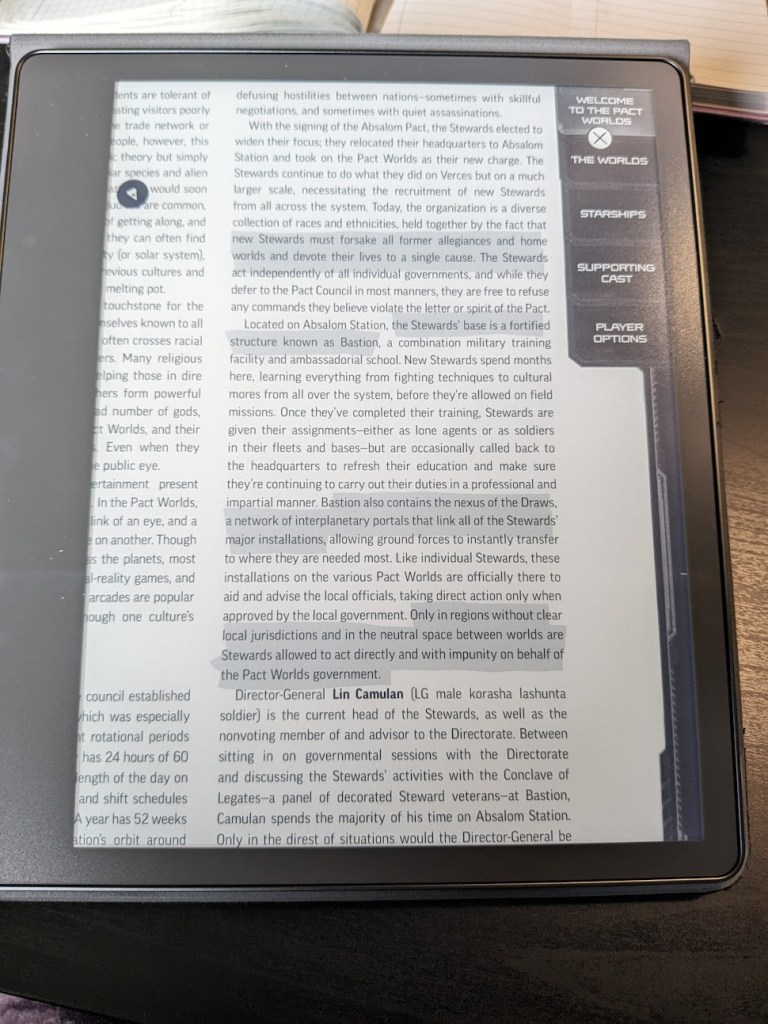
My Kindle with Starfinder Pact Worlds, minimized, loaded, showing highlighting and zoom

Large format. The larger screen works super well for PDFs and image-rich documents. You can technically read PDFs on the smaller Kindles, but it really doesn’t work well for heavily formatted documents.

Highlighting and notes. With RPG books, I have to highlight as I go. Even if I never go back and reference it in that format, it keeps me focused. Otherwise, I tend to space out, thinking about a rule or bit of lore I just read and how I could use it.

Paper-like surface. I read a few books on my iPad, but I found I really didn’t like reading on the glossy, bright surface. I got through the books, but after a few, I decided it wasn’t my bag. I also tried printing out a few PDFs, and while this worked a lot better for me, my tree hugger soul screamed at all of the wasted paper. I ended up binding the books so it wasn’t a complete loss, but I’d really love to not get glue everywhere again.

No distractions. I do read PDFs on my computer regularly, but I’ll be the first to admit that I can get distracted when the whole world is one alt-tab away. This is fine with prepping APs, but for bigger books, I’d prefer to stay focused.

Weight. It’s so light! Like, stupidly light, even with the nice cover! And it’s still small enough to fit in one of my bigger purses with ease. I recently went on a cruise, and I barely noticed it in my bag. My paperbacks weighed more!

Zoom. You know what you can’t do with paper? Zoom in. As my eyes age, this is becoming more and more important for taking in information quickly. It’s easy to waste too many cycles squinting.

Backlight. Light is also important for aging eyes. Sometimes, finding a lamp is inconvenient.

Downsides

As always, it’s not all kittens and sunshine.

PDF size. You have to minimize RPG PDFs if you want them work on the Scribe. Technically, they’re not over the limit as is, but the Scribe will start to choke. You can do this for free on various websites (Adobe, I love PDF, Small PDF), but it’s still annoying to have an extra step.

Sideloading. If you want your PDF on your Scribe, you might have to use an Amazon service. Technically, you can sideload, but I’ve had better luck using the Email to Kindle service. It’s free, but it still makes me slightly nervous, since it’s possible for services to get shut down.

Amazon ecosystem. The elephant in the room: You’re feeding the Amazon beast. For some people, this is a deal breaker, even if you never buy one of their ebooks.

Cost. It’s cheaper than other options, but it’s not cheap, especially if you’re getting it for just one purpose. And you’ll want to get a cover as well for protection and pen storage, and they can get spendy.

Greyscale only. It’s crisp, but it’s still grey. There’s rumors of a color Kindle coming, but friends, I have been reading those rumors for a good decade now. Don’t hold your breath.

Notes. This is a weird one… You can generally takes notes on the Kindle, but if you’re working on a personal PDF, this function is greyed out. So while you can write on the page, you can’t use the sticky notes feature.

Final thoughts

I love my Scribe, and don’t regret it, even if it was an expensive purchase. It revolutionized how many RPG books I could get through, since I was no longer squinting at tiny print or limiting my reading to when I had decent light and a comfortable reading position. I’m on my sixth RPG book of 2024, which is more than I’d read several years COMBINED. Also, I can highlight, which I’m loathe to do with a $60 physical book.

FYI: You know that warning people put on their blogs about affiliate links and possible kickbacks? I’m not a part of that program because I’m not cool enough.

Gatewalkers: Book 2 Chapter 1 done!

Over on D20Saves, I’m running Gatewalkers, one of the latest APs from Paizo! From the official website:

After they walked through that glowing gateway, nothing was ever the same. A band of characters become paranormal investigators to determine the cause of a global amnesic episode. Their quest takes them to lands near, far, and outside this reality altogether. Along the way, the characters meet fellow “gatewalkers,” defeat alien monsters, and explore strange realms touched by the Missing Moment. And when it comes time to learn the grim truth of what happened to them on that fated summer night, what then?

Warning: The first part of this blog will cover what happened in the stream, so there are spoilers for the beginning of Book Two. Part two will include my thoughts as a GM, so there are major spoilers for the AP overall.

Check out the playlist here if you want to watch the previous episodes!

Book Two opens with a bang. Unlike other Paizo books, there’s no gap between books. One moment, they’re on Castrovel, escaping from an interplanetary battle, and the next, they’re in a strange observatory with a rattled seer asking for help from whatever is currently beating down the door.

The gang has found themselves at Skywatch, though not quite on Golarion. Somehow, they’re on the Ethereal Plan, the plane that lies between all other planes. It’s not completely hopeless, however, as there’s a gate right outside of town that will probably get them back to the Material Plane. They just need to collect the seer’s party from various points around the ghostly Skywatch.

The gang is more than up for the challenge as they navigate non-Euclidian streets and beat up everything from bandits to dragons to find all of the stray party members. Everyone gathered, they make their way to the gate, activate it, and find themselves back in the Material Plane…

And all of their new companions dead. The party members they had spent a week saving vanish, with only the Seer, Sakuachi, just barely able to hold onto her form as a ghost. Horrified, they realize that a dark presence had reached out to Skywatch and yanked all who were there through to the Ethereal plane, leaving their bodies behind to freeze to death.

The party agrees to take on Sakuachi’s quest, realizing that they share a common enemy.

GM Stuff

Okay, seriously, if you’re a player in my stream, DO NOT KEEP READING. Don, James, Jorge, Daton, Ricardo, CLOSE THIS TAB.

Ethereal Plane

In my last post, I mentioned that I planned on switching book one to be in the Ethereal Plane rather than ‘weird, but still on the Material Plane’ Skywatch. This worked seamlessly with the overall feel for the AP, and even made the issue of navigating Skywatch more intuitive. It also focused the players’ energy on getting out, rather than pointing towards an exit but saying they couldn’t go there yet. They knew they probably needed Sakuachi’s crew, being all mystic, and they knew that they wouldn’t leave until all of their people were accounted for.

Killing off Skywatch

The bigger change I made in this chapter was killing off all of Skywatch. I had a few reasons for doing this:

  • Adding what’s essentially a second party to the team was too many moving parts for me
  • I wanted the PCs to take personal ownership of the quest, since that’s what moves the plot along at several points
  • It ups the stakes for the group from “let’s poke at mysteries” to “oh crap, this thing is a danger.”
  • I was worried about another Hubert situation, where they’d take an NPC’s sheet and turn them into an absolute monster in combat.

The players took the reveal in stride and happily took on Sakuachi’s quest, with her trailing behind them as a ghost. Of course, they still made the case that she could have a sheet, but I shot that down. I still expect them to break the plot with her, but it shouldn’t be quite as bad. Also, looking forward, I think she works best as a spirit. Her companions don’t serve a purpose, and for the most part, she’s chilling in the background. Might as well make her see-through!

The rough timeline I gave the PCs once they were back on the Material plane:

  • Everyone was at Skywatch in the Material Plane for their own reasons. Matz for treasure, bandits for banditry, Sakuachi for her quest.
  • All at once, everyone was pulled into the Etheral Plane, leaving their bodies behind.
  • Bodies froze to death over time, since fires went out eventually.
  • Whatever did this left tendrils of Blackfrost behind.
  • It’s implied heavily that this Osoyo jerk may be responsible.

Important to know

I’ve finished reading Book Three, and there’s a detail I skimmed over that I wish I had hit harder. The PCs will run across the former denizens of Skywatch later, but in prepping book two, I hadn’t realized that they were still around. So, if the players investigate, leave hints that the whole town left some months ago, heading north.

Also, if you plan on killing everyone off like I did, make sure Matz gives those last details to the PCs before they leave! Otherwise, they won’t know where their next plot hooks are.

Looking forward

After looking at how the rest of the plot pans out, turning Sakuachi into a ghost works pretty darn well. Most of her mission can be easily transferred to the PCs, or maintained with her being a ghostly presence.

I’m super duper looking forward to some of the set pieces, such as the mansion mystery. Hell, I’m even looking forward to the trek across the ice! Some people have complained about it, but if you’ve ever read Lovecraftian works, you know they love dumping the doomed protagonists into a desolate landscape where the only way is forward.

Gatewalkers: Book one done!

Over on D20Saves, I’m running Gatewalkers, one of the latest APs from Paizo! From the official website:

After they walked through that glowing gateway, nothing was ever the same. A band of characters become paranormal investigators to determine the cause of a global amnesic episode. Their quest takes them to lands near, far, and outside this reality altogether. Along the way, the characters meet fellow “gatewalkers,” defeat alien monsters, and explore strange realms touched by the Missing Moment. And when it comes time to learn the grim truth of what happened to them on that fated summer night, what then?

Warning: The first part of this blog will cover what happened in the stream, so there are spoilers for Book One. Part two will include my thoughts as a GM, so there are major spoilers.

Check out the playlist here if you want to watch the previous episodes!

The last chapter opens just after the players have learned that they were all wrong: They’re neither in the First World nor in some underexplored region of the Mwangi Expanse. They’re on the wrong planet! The gate they jumped through landed them on Castrovel, the planet NEXT to Golarion. Just as they were getting their head around the problem of getting home, they accidentally inflicted the elf-killing curse on their best hope of getting back.

Thankfully, she’s only mostly dead, so they take on the task of restoring her and exploring the weird world of Castrovel, which honestly deserves its own AP.

GM Stuff

Okay, seriously, if you’re a player in my stream, DO NOT KEEP READING. Don, James, Jorge, Daton, Ricardo, CLOSE THIS TAB.

The good

The players loved the Castrovel twist. They threw themselves into interacting with the local denizens and figuring out how to get back home. Also, in what’s extremely rare with experienced players, none of them saw it coming, but didn’t feel like it came from nowhere. Bravo, Paizo.

They also had fun in the dungeons in this part of the book, which are fairly unique and evocative. There’s a long-abandoned library that’s utterly alien in every form. There’s an encounter set on the back of a mythical beast. And hooooboy, that final battle is one that no one was expecting. You could take this chapter and plunk it in any adventure for a fun bit of weird.

Oh, and that last fight? Holy cow, that was a lot of fun. If you plan on GMing this, figure out in advance how you’re going to do the transitions, because it’s well worth doing well for the full impact.

Some warnings

It’s assumed that the players hand a cursed key over to a particular elf, who will immediately be struck down. 90% of the chapter involves helping to cure her. If your players have started suspecting that the key they’re carrying is dangerous, I would think about how you’re going to rebrand those encounters. I wouldn’t skip them, because they are a ton of fun, but they do need some reworking when it comes to why the players are doing them.

Also… Hubert. I’m currently reading book three, and I’m fairly confident there’s no off-ramp for this NPC. With my group, the players ended up reworking him as a beastkin fighter, but not every GM wants tagalongs. If you’d prefer to keep the party to just players, I’d recommend either having him stay behind when they gate out of the First World, or maybe stay with the Oatia (Castrovel elves).

Other thoughts

SO MUCH HAPPENS IN THIS FREAKING BOOK. Seriously, it feels like two books worth of material. In a way, I wish they had spread it over two books, because Castrovel was a ton of fun and could have been mined a bit further.

Having prepped book two and started book three, I’ve realized that I want to do some overhauls. It’s a perfectly fine AP and could easily be run as-is, but a few tweaks never hurt.

First, I’m adding more planes. The first book has you jumping around so much that I was disconcerted to find out there were no jumps (at least that I recall) in book two. So, I’m adding one by putting Skywatch in the Ethereal Plane.

  1. It explains why everything is weird.
  2. It created a more focused goal: Escape the plane.
  3. It explains why contact was cut suddenly (everyone got sucked into another plane).

This required fewer updates than you might think. Using Deep Dream Generator, I used Deep Style to update the maps. Uploading them, I didn’t even have to update the dynamic lighting!

The next thing I’m doing is…

Killing off Sakuachi. Kind of.

Look, before you judge me or think I’m going hard on Paizo, I’ll say the NPC godcaller is FINE. Yes, guiding her on her vision quest is a bit on the nose, but I’ll take ‘too direct’ over ‘wait, how do I get my players to this random area where all the plot is?!’ any day. It’s just that I know my players. If you give them an NPC, they’ll want to give that NPC levels and bring them into combats and outfit them, and she has BODYGUARDS.

Y’all, they made the freaking hedgehog a legit BEAST in fights.

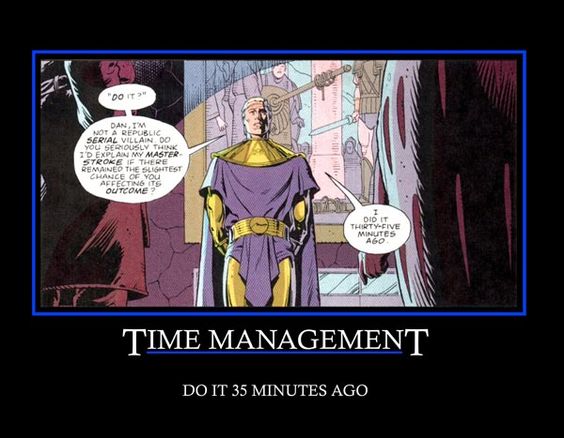
I could say no, but I’d be saying no over and over again. So, instead, I’ll pull an Ozymandias.

Motivational Meme format:

Ozymandias stands before two figures. "'Do it?' Dan, I'm not a republic serial villain. Do you seriously think I'd explain my master stroke if there remained the slightest chance of you affecting its outcome? I did it thirty-five minutes ago."

Subtitle: Time Management - Do it 35 minutes ago.

They get to run around with the spirit caller, still fleshy, in the Ethereal plane, hunting for a way out and tracking down her people. Once everyone is together, they leave through a gate and…

Look back upon a wrecked city. The Godcaller and her guards are ghostly apparitions, stunned as the party is. The bodyguards fade, with nothing keeping them attached to the material plane, but Sakuachi stays… barely. She has a job to do, and less time than ever to do it. And she can’t do it herself.

The party is nudged to retrieve some items off of her body (which can be found near the telescope where they met and where the Space Elves lost contact with her) and continue her quest, with the oddly timed approval of the Professor.

I mean, they’ll probably still ask if they can give her levels as a Ghost archetype, but at least I’m not dealing with the bodyguards anymore.

How I run it: Schedules!

Anyone who knows me knows that I play in a LOT of tabletop games, both as a GM and as a player. My current count is nine games, played in either monthly or bi-weekly. Most people assume I spend all my waking hours prepping, but honestly, I don’t spend more than thirty minutes a day dealing with RPG admin work. The trick is having a system and making good use of small pockets of time.

Most of this will be about being a GM, but if you just want to be a player in a bunch of games, much of this still applies! A player who remembers when games are and shows up with notes is always going to be able to find tables to join.

Organizing

Being organized is, unfortunately, key to this. I’ll be real: I’m not a naturally organized person. If you give me a backpack, it’ll be a disaster within a month of regular use. My crafting areas are only neat right after a cleaning spree. The only reason my bookshelves are neat is because they’re on-screen during calls, and my friends’ love language is shaming. Still, time spent hunting down crap is time spent not prepping, and I’m really trying to use every minute I manage to free up.

So, when it comes to games, I’m very organized. Everything is in its own folder. These folders back up so I can access them anywhere and a computer dying doesn’t destroy me. I have a dedicated gaming notebook that keeps track of all of my games. I pin important links and details.

When I start a game, the whole task for that day is to get everything set up:

  • Folders for anything I could possibly need in a game, so I don’t have to go hunting
  • VTT game
  • Discord channel (all of my games get, at a minimum, a channel in one of my servers)
  • Pin all of the important details, like where things are being stored and where we’re playing

I’ll repeat this: This is a whole-ass task. It takes a bit of time. If this is all I do for game prep for that day, I consider it time well spent.

Scheduling

This is where most games fall apart. Every webcomic about gaming will eventually have a comic about how hard it is to get five people to show up at a set date and time. It’s a universal problem, and you have to take it seriously if you want to game more.

Easy mode for this is having games on the same date and time on a regular basis. So, it might be every other week, the first Monday of the month, etc. I would be cautious about being overly optimistic about scheduling a game for every week, though. That’s a huge ask for players, and you could end up with more cancellations than you were anticipating. If your weekly game is canceled half of the time… bruh, you have a bi-weekly game. Schedule for reality, not your dreams.

Hard mode is having games that move around, which is over half of mine. They take more work to schedule, and you really have to plan ahead. However, it’s much easier to get people to agree to a date that can wiggle than a set schedule.

The trick is that you have to get on people’s calendars early, but not too early. People don’t like to commit too far out, but if you wait, you’ll find out that they’re busy every single night. The sweet spot for me has been to start pinging people around the 14th of the month for the next month’s games: That’s far enough out that you’re in front of the last-minute events but not so far out that people have no idea what they’ll be doing that week. Also, if you schedule too far in advance, people are more likely to forget.

For me, I send out polls to each group and pick the date with the most reactions. Save for one game, I don’t require 100% attendance. Some tables insist that everyone needs to be there, but I can say from experience that this is the swiftest way to kill your game. I tend to slightly (SLIGHTLY) over-recruit, then only ask 75% of the players to show up.

Honestly, for either, think hard before demanding 100% attendance at every game. I’ve seen this kill many a good table where 80% of the people were all in, but one had a chaotic life. Everyone there wants to game, or they wouldn’t have accepted the invite! If the game keeps getting canceled, the reliable players will drift away. It is better that one person has to get caught up every few sessions than to have a notebook full of ideas that never get used.

But wait! What if you’re not the GM? Does this still apply to you? Ideally, no, but sometimes, it could! As a player, you can still poke the GM to set a date if it looks like they might have forgotten. Heck, you can offer to be the person who does the scheduling. Being a GM is a big task, and it’s always nice when someone can lighten that load.

Prep

If scheduling is the game killer, prep is the GM killer.

The biggest danger with running a bunch of games is falling behind on prep and burning out. To fight both, you have to limit how much prep you’re going to do in a day. For me, I know the max I can fit in is 30 minutes. After that, I start to lose focus and unfocused planning is just wasted time. The trick is to be consistent. You’re not going to prep a whole AP in one short session a week, after all.

If I don’t have a game that day, I tend to do two fifteen-minute prep sessions for different games. I like hopping around, and my games are almost always in different phases of prep (reading / sheets / maps). I try to keep a chapter ahead of my players when running APs because you never know when they’ll be able to find a shortcut that the developers didn’t think of.

If I have a game that day, I’ll generally spend my whole time slot prepping for that game. That involves reviewing where we left off, checking my maps, and writing down some notes about what I think the players will encounter next. So, if they’re in room A15 of a dungeon, I’ll write notes about the next four or five rooms they could reasonably get to. If they’re entering a town for the first time, I write down the plot hooks I want to make sure I hit.

As for reviewing, I’m now a firm believer in recording my games. This has been a game-changer for me. Since I know I don’t have to take detailed notes during the game, I can focus more on the players and plot. It’s also faster than you’d think to review the video: The most important parts are usually in the last ten minutes, and a quick scan can tell me what maps they hit during the past session. Just make sure your players are cool with you recording them.

This is a lot. Is it worth it?

For me, yes!

I have a circle of gaming friends that would never fit into a single game. I also love running Adventure Paths, which come out at a breakneck speed. Besides that, I love dabbling in multiple systems. If I were only in one game, I’d lose a lot of chances to have fun with other people.

Maybe this is way too much for most people (most people would balk at the idea of being in nine games), but the advice still holds if you want to create a second game in your schedule. Hell, most of it still applies if you just have one!

Either way, may 2024 bring you as much gaming as your heart desires!

Pathfinder 2e Ritual Calculator

Another day, another round of “Katie makes a tool because she hates little maths.”

I love Pathfinder 2e rituals. They’re legit one of my favorite parts of the game. A spell anyone can cast that you can pick up fairly early but comes with consequences if you actually try to use it right away? Delicious! I absolutely love to collect them and watch them blow up in my face.

One problem: Figuring out the DCs stresses me out when we’re in the middle of a game. Yes, it’s just two numbers, but they’re two numbers that really need to be right, especially since I also often have feats that change them. So… enter the calculator.

Features

  • If you pick a ritual rank, you’ll get the DCs for both the primary and secondary caster.
  • You can pick which feats you want to apply, which will modify the DCs.
  • Yes, it won’t stack the same bonus.

I think I got all the feats, but if I missed one, please tell me! Note that I’m only interested in ones that change the DC, not every single ritual feat.

Future updates?

Future updates are possible! There are a few things I wanted to add, but I needed to move on to another project. I really want to calculate the chance of success based on which casters you have and how good they are. I feel like this could help people really understand that you don’t cast rituals the second you get your hot little hands on them… or you do and just let all your dead friends be chickens.

And if you have any suggestions, let me know!

How I run it: Pathfinder 2e House Rules

One of the beautiful things about Pathfinder 2e is that it doesn’t require a lot of homebrew to get it up and running. For the most part, if you can think of something you’d like to do, the rule is in the books somewhere. Still, it’s not uncommon for groups to come up with their own house rules, and my tables are no different. I’ve developed my own list over the past few years, aiming to make play smoother and set table expectations early. Or, once, misreading a rule and then deciding I liked my interpretation better.

Medicine: Treat Wounds

Per RAW, you have to call out your DC for treating wounds ahead of time. The first time I saw this rule, I thought that you’d get the best possible result based on your training, and I played that way for quite a few levels before I got corrected by a player. I decided to stick with the rule, though.

  • It cuts out the in-the-moment hemming and hawing over which DC to go for
  • It still rewards investing in the skill since you can’t get a DC you didn’t train for.
  • It offers more bang for the buck, meaning players are more willing to use it.

Hero Points

I love Hero Points and want to see them used. I also hate remembering to give them out. RAW, you’re supposed to give them out when players do something heroic, but this has always annoyed me as a metric. I’ve found it leads to people who play support getting ignored (even though they’re playing a big part in those big hits for front-liners) and some players hamming it up in hopes of getting rewarded. Also, I’m busy GMing the game, keeping a dozen random things in my head at one time, all while keeping a poker face in place. I don’t want to keep a subprocess open dedicated to “Are the players being good enough?”

So, instead, I put Hero Points on a timer. Every hour, every player gets one. I don’t even bother watching the clock: the players do that. This takes something off of my plate at no cost to the players.

Recall Knowledge

One of the few places where Pathfinder 2e is vague is what information Recall Knowledge gives players. Post Remaster, this has been clarified, allowing the player to ask a question but not receive a numerical value, which was already a house rule for most people.

Except for me.

This may be my “Ears of the City” trauma speaking, but I don’t enjoy Q&A mechanics in most games (MOTW being one of the few I enjoy). I also play with experienced players who just want a chance to not metagame, knowing that the thing they’re looking at is immune to fire. So, I toss the AON entry at them and move on.

It’s a lot of information, so if a player is new, I point out the most important parts of the entry to them or if I know the players haven’t seen this creature before.

Yes, it’s a huge reward for one roll, but that encourages players to use Recall Knowledge. They’re less likely to bother if they have to blow three actions to get all the information. This way, it’s sensible to do in the first round, along with buffs and positioning.

Secret Rolls

Speaking of Recall Knowledge, let’s talk about secret rolls.

I know I should do more of these; I just can’t be bothered. To do them, I have to ask someone for their bonus and roll for them (so not very secret) or have their bonuses in front of me (when my screen real estate is already at a premium). Then, I have to keep my admittedly terrible poker face in place while telling them the result. It’s not a huge amount of extra work, but running a game is about managing all the little things that can eat up your attention and energy, and this one isn’t worth it.

Besides, I have good players who love to lean into a bad result. Did they get a Nat 1? They’ll insist that thing is true until proven otherwise. It’s fun to watch them play out the result rather than try to figure out if what I told them was true or not.

Activating Auras

Sometimes, a house rule comes less for ease and more because the GM keeps screwing up. Many creatures in PF2 have auras, and many of those auras are considered to be ‘always on.’ Except… I never remember they had them until combat started, and many times, several players have charged in and acted.

So, my players know that I only activate them on the creature’s turn, sometimes blowing one of their actions if I feel like the players could use some help (I almost always regret this since the players are generally fine). Yes, I could use the aura feature in my VTT, but I hate having a bunch of blobs all over my screen when I don’t need them.

Automatic Bonus Progression

This is less a house rule and more something you can expect in any game I run. This alternate rule is my ride-or-die. With it, I can stop worrying about whether players are getting enough treasure to buy their base runes.

  • RAW, it’s suggested that I should be adjusting treasure, but I’ve never bothered with that. As long as they’re limited by level, the power creep of having a bit more gold doesn’t seem to come up.
  • I also don’t adjust for spellcasters. I know some people do this, but so far, it hasn’t been an issue in any of my campaigns.
  • Because of ABP, property and striking rules are useless, so players convert those directly to cash.

Monthly games

I’ve written before about my love of monthly games, but they do come with some house rules of their own. Specifically, I assume that players rest between sessions, no matter what we end up on. Due to the time between games, it’s easy to forget where we left off or accidentally hit ‘rest’ on a sheet.’ Also, time is more precious with a monthly game, so you don’t want to waste ten minutes trying to figure out if we need to regain spells or hit points.

Rolling is in the open, using the VTT’s dice roller

Yes, even mine.

I don’t care if players can see the bonuses.

No, you can’t set up a camera to point at your shiny number rocks, so you can avoid using a digital roller.

You don’t even know what ‘pseudorandom’ means.

What the hell is wrong with you?

There’s often a Lodge nearby

As I’ve said before, I’m a fan of the GMPC. As a result, I’ll often hand-wave that there’s a Pathfinder Lodge nearby with NPCs ready to hire. I even use the Iconics since they come with sheets and fun backstories! They WILL take their share of the loot, and after their initial sheet, the players are responsible for running them and gearing them up, as well as deciding how to level them up.

And that’s it!

While I run mostly RAW, I fully believe in tweaking the rules that make my life easier or work better for my table. These are tweaked for a table of players with high system mastery and are good at keeping OOC knowledge out of in-character choices. They may not work for a table of players who can’t help but use the knowledge they shouldn’t have,