The Big Book of Screamsheets

A few months ago, my VTM group, having hit peak chaos that you can achieve in V5, transitioned over to Cyberpunk Red. I have to say, I’m thoroughly enjoying the system, though I was distressed at how quickly I ran through the pre-written one-shots (called Screamsheets in the CPR ecosystem). For those not in the know, a screamsheet is a one-page sheet that mimics a local newspaper, often with a supplementary adventure to go with it. They’re an awesome way to kick off a session by giving the players something to look over and research while you get the last of your GM bits and bobs in a row.

Around the time I ran out of screamsheets, I was reading The Big Book of Cyberpunk for inspiration, which is a collection of over a hundred cyberpunk short stories. I realized that quite a few of them would make decent adventures on their own if you ripped the protagonists out and plopped the crew in. Thus, a new project was born: The Big Book of Screamsheets!

(Note: I’m calling it the “Big Book of Screamsheets” as an homage to the inspiration, not as a promise to publish 100+ screamsheets.)

Each screamsheet is inspired by a story from The Big Book of Cyberpunk. Reading the story isn’t required for running the sheet, and ‘inspired’ may be doing some heavy lifting. Sometimes, I lift the whole plot. Sometimes, I just take an element that I found to be interesting and expand on it. Also, because the story’s title could be a spoiler, I only include it in the GM notes at the end.

A bit about my style

Because I know my players will grab onto any potential hook like a terrier with a stolen bone, I don’t tend to put red herrings in my games. My screamsheets reflect this, with each story leading to uncovering a part of the underlying plot. Even in games that start with the crew getting the hook directly, the stories will help them uncover clues as to what the heck is going on. Each story has their own set of skills that can be used for research, as well as what information certain DVs will get them.

I also tend to take an ‘all roads lead to Rome’ perspective when it comes to plot: There are many ways to get pulled in, but everything will lead to one final resolution. That said, there isn’t one given outcome assumed. While one group may negotiate with words, another might use guns, and that’s perfectly fine.

When it comes to combat, I give some guidance as to how many combatants, but nothing is set in stone. Crank up the heat as needed.

Finally, I have a section on ways the crew could get paid, though not how much. I leave that to the GM since they know how much they want their players to feast or starve.

The Screamsheets!

Enough chatter! Let’s get to the screamsheets!

Abomination Vaults: Stripping it for Parts

I’m a huge lover of Paizo’s Adventure paths. They’re a huge timesaver for busy GMs, and not just those who want to run a long pre-written campaign! You can easily pull out interesting scenarios from the APs, rub off a few serial numbers, and slot them into your custom campaign with no one the wiser. I’ve written about this for other APs, and now it’s time for me to give Abomination Vaults the same treatment.

Overall notes

Abomination Vaults is a unique campaign in that each chapter is a floor. Because of how the vaults are set up, there’s many floors you could pull out on their own and plop into a campaign. Creatures tend to stick to their designated areas, so there’s no worry about the floors bleeding together. They also tend to all have their own theme, based on who’s moved in.

You also don’t have to use the whole floor, since many have encounters that are self-contained enough to pull out and plop in the basement of some BBEG’s lair or in your own dungeon.

  1. Overall notes
  2. Book one
    1. Otari
    2. Floor 1: Ruins of Gauntlight
    3. Floor 2: The Forgotten Dungeon
    4. Floor 3: Cult of the Canker
    5. Floor 4: An abandoned retreat
  3. Book 2
    1. The Stolen Blade
    2. Dorianna’s Dreams
    3. Floors 5 and 6: The Arena and Labs
    4. Floor 7: Soul Keepers
  4. Book 3
    1. Floor 8: Decaying Gardens
    2. Floor 9: Hunting Grounds
    3. Floor 10: The Temple
  5. Final thoughts

Book one

Otari

One major thing you can pull from this book is the town of Otari. It’s a small port town that’s perfect for adventurers just starting out. It’s filled with interesting characters who have their own potential plots going on, and it’s not too far off from Absolom. It could be a fun place for PCs to start their adventure, stock up, or save at some point.

Floor 1: Ruins of Gauntlight

The first floor is completely above ground, so it would fit in any swamp-like setting. It’s filled with the sorts of creatures you could see cramming into a deteriorating structure, including natural creatures, the fey, and even an undead or two. There’s even non-combat encounters, including a brownie that my group adopted (Tangletop!) and a tribe of mitflits (who my players immediately slaughtered).

Possible hooks:

  • The PCs need to clear this old fort / lighthouse / whatever out for cold hard cash.
  • The party stumbles upon the structure and decides to make it a new hideout.
  • They’re there to ‘rescue’ the soulbound doll Mister Beak (the previous owner doesn’t know the doll left of his own accord and has fallen in with a bad crowd).
  • The locals think the old outpost is haunted, but it turns out that this is just Tangletop trying to keep the other creatures nearby away.

Floor 2: The Forgotten Dungeon

This is the first floor that’s completely underground. It has an interesting mix of creatures, with a dose of undead, aberrations, and even some infernal! The overall vibe I get from this floor is that of an abandoned villain’s lair. The old experiments have broken loose, the old staff has been turned, and the devils are stuck until their contract is completed. This also features a fight with a river drake that thoroughly handed my players their butts the first time they encountered it.

Possible hooks:

  • That drake has taken up residence in an abandoned structure outside of town, and it’s bothering the residents. The party has been hired to get rid of it… but no one knew that the abandoned mansion wasn’t so abandoned.
  • If you have a BBEG in your campaign, this could be an old lair of his before he upgraded. Crawling through it could give your party more information about their potential rival.
  • If you want to make allies of the morlocks, they want their old digs back, but aren’t quite up to the task of clearing them out. They do have their old boss’s funds, so they’re willing to throw money at the problem! Just don’t ask what happened to him…

Floor 3: Cult of the Canker

An undead library! This floor is a library populated by intelligent undead, so could fit in many places: Geb, a necromancer’s lair, the site of a former cult that went in a bit too hard… And, being a library, it’s a great place to drop lore or information that would be difficult to deliver via NPC. It also features an NPC who became a fast favorite of my group: Augrael! He’s a friendly ghoul who really just wants to sit in his cubby hole and read his books (I made him a fan of bodice rippers, but you do you). He’s not a fan of his ‘coworkers’, so he can offer a place for the party to rest and heal.

Possibly hooks:

  • This library used to belong to the group’s patron, but it was taken over by a cult of undead morlocks.
  • This library belongs to the BBEG of the campaign, and could offer clues about their motivations and abilities.
  • It could be a non-combat location if your party is in Geb or an otherwise undead-friendly location.
  • The group has been tasked with delivering books to Augreal… they just have to find him first amidst all the hostile undead.

Floor 4: An abandoned retreat

The theme for the fourth floor is a luxurious retreat for a villain that has been long abandoned. Of course, other creatures have moved in, and some unfortunate individuals were never able to leave. There’s a mix of undead, aberrations, and demonic, so a little bit of something for everyone. The main goal of this floor is to find the ghost of a long-dead adventurer so he can give you a lore dump, but he can easily be swapped out for anything that would suit your campaign better.

Possible hooks:

  • Something has been harassing the local town… turns out it’s a werewolf, holed up in some local caves. Time to problem solve!
  • If you have a BBEG, this would be a great place for the players to learn about them without being face to face.
  • Or, heck, clean up the descriptions slightly and pop your BBEG in there! They could take the place of the voidglutton (who can be rough on a level 4 party)
  • An adventuring party lost one of its members when they separated in the dungeon. They’ve come down with a case of being lily-livered, so have hired you to find their friend.

Book 2

Book two includes quite a few side quests for the party, and they’re fairly easy to pop into most campaigns.

The Stolen Blade

A famous sword, passed down over generations, has been stolen. The owner knows who it was, but doesn’t know where the culprit is, and doesn’t reveal to the party why the thief may actually have a claim to it. This quest has the players bouncing around town a bit to find clues, then cornering the thief in a cave before he can run off with his prize.

Dorianna’s Dreams

The party has been approached about a young woman in town who’s been suffering from increasingly strong nightmares, none of which she remembers upon waking. Her father is desperate to find the cause and do whatever it takes to heal her. This has the party doing some investigation based on their own wits (or what wits they can hire), and leads them eventually to a confrontation with a creature from Leng.

Floors 5 and 6: The Arena and Labs

These floors go together, if you’re plugging whole floors into your campaign. The first is the largely abandoned lair of a BBEG (starting to see a theme?), while the second level is occupied by various groups that have moved in. The most striking feature is one that spans both floors: An enormous colosseum that currently houses a shanrigol behemoth, but this could be swapped out for most gargantuan creatures. Outside of the arena, there are signs of terrible experiments being done in the past, some of which are still being carried out.

The arena isn’t the only feature of the floors. Floor six has a tavern, with its very own punk band!. Honestly, if you steal anything from this book, let it be these guys. They deserve to make it big in more campaigns.

Possible hooks:

  • Once again, this is a good addition to any campaign where the players are chasing a somewhat unhinged BBEG. There’s lots of places to sprinkle clues about what their nemesis can do, and hooks to where they should go next.
  • A talent scout has contracted the party, with rumors of a band with a hot new sound… they just have to make their way to them. Easy money!
  • The party hears a rumor of an undefeated champion somewhere near their home. It’s not really their problem… but someone keeps luring young idiots to challenge it, and no one has come back…

Floor 7: Soul Keepers

This floor is more devil-y than some of the others, and includes a puzzle that has the players collecting various keys around the dungeon in order to open a magically sealed door. It also has a collection of stasis chambers that can have players either saying “Let’s poke every button” or “Absolutely not” and turning their heel. The ‘big bad’ of the floor is a contract devil eager to make a deal in order to get a soul owed to him, so meeting him could lead to a fun new plot or a blow-out of a fight.

Possible hooks:

  • Set this in Chelliax, and it’s just another admin building! If the players aren’t on the offensive, they have a handful of interesting NPCs to talk to. If they’re there to throw down, it’s already thematic!
  • Odd requests have been popping up on the request board in town: Find certain creatures, but do not kill them. Capture them, then leave them in a clearing outside town. The mayor wants to know what’s behind this.
  • If the party is morally grey, they receive a letter requesting help tracking down a certain ne’er-do-well and bringing him to a newly rented office in town. It reads like the guy owes someone money, but something feels off…
  • A tiefling bounty hunter has gone missing, and his partner is desperate to find him. Everyone thinks he just skipped town, but she knows him better than that…

Book 3

Normally, by the last book in an AP, I don’t have much to suggest when it comes to plundering. AV, however, still has lots to borrow and shove into your own games! Book three has a few clusters of NPCs, some interesting dungeons, and a big set-piece for whatever BBEG you might have in your campaign.

Floor 8: Decaying Gardens

The major NPCs of this floor are a group of Calgni cultists… but nice ones! They probably won’t turn the party into soup since they’re so intent on finding their oracle who hears whispers from a magical MacGuffin. They’re more than happy to work with the party, given that they’re polite and don’t poke them too hard about their strange beliefs. On the less cult-y side of things are a small party of Drow / cave elves who are hunting these wild caves for food and sport. The caves also feature wee bog mummies (their original bodies came from deep gnomes) and a delightful mix of deadly flora and fauna.

Potential hooks:

  • The friendly cult is in freakout mode, since their oracle wandered off. They need you to find him and bring him back, unharmed… though one might bribe the party to lead him somewhere even more secret, and tell only her the location.
  • The drow have been tasked with getting this floor under control, but they’ll begrudgingly admit they bit off more than they could chew. Since the party is hanging around and looking dangerous anyway, maybe they could help out?
  • Not far out of town, the roof of a cavern has fallen in, revealing dangerous previously unknown in the peaceful village. The mayor is asking for someone to come and ‘neutralize’ the cave, either through negotiations or violence.

Floor 9: Hunting Grounds

This floor has two groups of NPCs that you could easily pluck up and place into a campaign that has any access to the underdark. The first is a sizable enclave of Drow (the ones the hunters on floor 8 belong to, but you can easily just use them) who are stuck where they are due to previous vows, but would really rather go home. The other is a group of Caligni who would also prefer to return to their main settlement deep in the Underdark, but are blocked from going back. There’s also a group of immediately hostile urdefhan and an abandoned temple that could be scooped up and reused.

Potential hooks:

  • The Drow hunters have lost track of a precious MacGuffin (a crystal lens in the AP, but it can be anything). They can’t return to their people without it, but their attempts to find it have been thwarted by a cave system filled with dangerous flora and fauna.
  • The Caligni outpost was only supposed to be out here for a few months, mapping this section of the Underdark. While they were working, however, their way back has been blocked by a dragon. Being a selection of slightly sturdy cartographers, they’re stuck where they are until someone takes care of the problem for them.
  • A mysterious temple has been discovered outside of an abandoned settlement. The party is hired to check it out and document it for a local historian. This could easily lead to floor 10, or a plot of the GM’s choice.
  • A town has been reporting disappearances, mostly of scouts or individuals who live alone in the outskirts. An investigation points to a cavern that’s supposed to be empty… or at least, it was.

Floor 10: The Temple

The last floor! This entire floor is a gauntlet, with the players being pushed through various challenges meant to wear them down. That isn’t a metaphor, by the way. It was literally built for the followers of the BBEG of AV to prove themselves. For your players, it could be that, or it could be the barriers set in place by their foe to slow them down.

Potential hooks:

  • Obviously, this could be put in place by their nemesis to keep their inner sanctum from being invaded by the unworthy. If you do this, you may want to remove a room that’s explicitly set aside for their peons to rest in before entering the sanctum.
  • This could also be presented as a challenge to overcome. A local lodge has set it up as a way to train potential Pathfinders more efficiently than tossing them to someone more experienced and saying “Good luck!”
  • Or you could do a bit of both. The party has been tasked with infiltrating a local cult, and if they choose the sneaky option, they could pretend to be members in order to get a shot at the big boss.

Final thoughts

AV is hands down one of my favorite APs, mostly because it’s filled with so many fun and varied encounters. I really hope more people give it a go, either as an AP, or inserting chunks of it into their ongoing campaign.

Gatewalkers AP: Book 3 Chapter 1 Recap and GM Insights

Over on D20Saves, I’m running Gatewalkers, one of the latest APs from Paizo! From the official website:

After they walked through that glowing gateway, nothing was ever the same. A band of characters become paranormal investigators to determine the cause of a global amnesic episode. Their quest takes them to lands near, far, and outside this reality altogether. Along the way, the characters meet fellow “gatewalkers,” defeat alien monsters, and explore strange realms touched by the Missing Moment. And when it comes time to learn the grim truth of what happened to them on that fated summer night, what then?

Warning: The first part of this blog will cover what happened in the stream, so there are spoilers for the end of Book Two. Part two will include my thoughts as a GM, so there are major spoilers for the AP overall.

Check out the playlist here if you want to watch the previous episodes.

Recap

In this chapter, the PCs finally made it back to Ustalav! In the town of Lepidstadt, they made a beeline to Dr. Ritalson’s manor, only to find that they had just missed him. Not to worry, though! The staff invited them to relax for a few days and recuperate from their journey, and perhaps even talk to some of their fellow Gatewalkers who had arrived just before them.

Of course, the gang decided to do some breaking and entering instead.

To be fair, it was clear that something was off in the mansion, which lead to them finding a basement filled with horrors. They realize that Ritalson had not only been spying on various Gatewalkers in their dreams, but also killing them and using their memories to increase his own knowledge and access to power.

They ran off to confront him before he could return, knowing that he is no longer their biggest problem. Ritalson had been working for someone… Osoyo.

Jorge, Don, Ricardo, James, and Daton: I love you all, but you need to LEAVE this post now! Spoilers ahead!

GM thoughts

Honestly, the biggest danger in this chapter is the players themselves. If they’re not suspicious of Ritalson by now (and good lord, they should be), and they take the week to chill out, they could very well end up with their brains in a jar. Hey, at least there’s a new party upstairs they could take over…? But seriously, if your players haven’t twigged to the good doctor being kinda sus, drop some hints in their lap to get them looking around.

The ‘dungeon’ of the chapter was also quite good, and perfect for ripping out and adding to your own campaign. It’s rife with places where you can add in your own plots, and if you’ve needed a place to get some infodumps out of the way, there’s a place to find heap of journals and research. You would just need to update two rooms to fit your campaign, unless your main baddy is also a big psychic whale.

Speaking of looking around, I loved the investigation in this chapter. There are so many clues to find if the players are keen to dig for them. My players aren’t even done yet! Some of the clues are housed in books that they managed to take with them, so they’ll be doing a lot of reading on the road.

Looking forward

We have the big trek over the ice! I think I’ll be pre-rolling most of the encounters to streamline my planning and dead air on the stream. Also, I want to make sure they have the encounters that will hit home the hardest, so… maybe those dice are going to be a bit loaded.

Gatewalkers AP: Book 2 Chapter 4 Recap and GM Insights

Over on D20Saves, I’m running Gatewalkers, one of the latest APs from Paizo! From the official website:

After they walked through that glowing gateway, nothing was ever the same. A band of characters become paranormal investigators to determine the cause of a global amnesic episode. Their quest takes them to lands near, far, and outside this reality altogether. Along the way, the characters meet fellow “gatewalkers,” defeat alien monsters, and explore strange realms touched by the Missing Moment. And when it comes time to learn the grim truth of what happened to them on that fated summer night, what then?

Warning: The first part of this blog will cover what happened in the stream, so there are spoilers for the end of Book Two. Part two will include my thoughts as a GM, so there are major spoilers for the AP overall.

Check out the playlist here if you want to watch the previous episodes.

Chapter Four recap

Chapter four takes place in the long abandoned city of Domora, former home of the Godcallers of Sarkoris. The PCs, determined to help their baby Godcaller fulfill her destiny, branch out over the city to research what they can. After a fair amount of mucking about, they realize they need to investigate a cistern that may contain the magics and lore she needs. After a chat with the spirit Ruun, they run a gambit of challenges, finally allowing Sakuachi to transform into a white owl, her soul bonded to the god of old. They all agree to return, finally, to Ustalav to check in with their patron.

GM thoughts

Okay, seriously, if you’re a player in my stream, DO NOT KEEP READING. Don, James, Jorge, Daton, Ricardo, CLOSE THIS TAB.

Investigation. The players enjoyed the investigations in this chapter, which had a nice balance between lores and skills to keep everyone busy. It helped that each investigation included clearing out some nasties, so even our meatiest-headed characters were vital to moving forward.

Cistern. Most of the cistern was perfectly fine, but the challenges themselves were a bit samey. I decided to spice things up and change two of the encounters. Rather than two stone owls, room F12 had two Griffons, and F7 had two Elite Giant Mantises. I kept F11 the same because the stone owls are kind of cool.

Sakuachi the owl. In the book, Sakuachi keeps her human form… but I decided to just use the owl and give her some limited telepathy. Any powers she has in the book have also been stripped for now, since the players aren’t hurting.

Overall book thoughts

This AP is probably amongst the lowest ranking of the Paizo 2e APs, and it does have some flaws… but flaws that I think are easy enough for a GM to solve without rewriting the whole book.

For me, making Sakuachi a ghost and killing off her party helped fix many of the issues with book two. Also, putting Skywatch in a different plane helped focus that particular chapter. Without it, the whole book hinges on the players helping this random group of strangers out. My players will happily follow plot hooks, but I could have also seen them just leaving and going on their way.

Now, if homebrew is your bag, this is a book that you could absolutely remove and replace with your own adventures! All you really need to do is make sure the players get back to Ustalav, so if you want to do a roadtrip-style adventure, that would totally work. Just make sure they don’t get to Ustalav under-leveled… or do, and watch the struggle bus kick off. It’s your circus, you do what you want with your monkeys.

Looking forward

I am very excited to get back to Ustalav. It’s been on the players’ to-do list for months. They also love investigating and chatting with NPCs, so I think the mansion is going to be fun for them.

Some complain about the long overland travel section, but I feel like it fits perfectly with Lovecraftian mythos. Creepy travel in a hostile landscape with no way to go but forward? Chef’s kiss. Man loved him some unforgiving expanses.

Exploring Abomination Vaults: A Dungeon Crawler Experience

On September 15th, 2024, my group finally finished the epic dungeon-crawling Adventure Path known as Abomination Vaults. When I first heard that Paizo was putting out a mega-dungeon, I was stoked. While I haven’t been able to do many, I’ve always been enamored with the idea of a campaign focused on one dungeon, where things get more dangerous the deeper you go. Having a modern one where I didn’t have to convert the whole thing was doubly exciting.

The deets on us

The sessions were held once a month, for about three hours each. This may seem like a short amount of time to many, but this was an extremely focused group bent on getting to the bottom of the vaults. I don’t think we had a single session that we spent on fluff.

Even so, it wasn’t a short campaign. We ran from April 2021 to September 2024, with only a few skipped months due to holidays and scheduling issues. Doing some back-of-the-envelope math, I think AV is more dense than your average Paizo AP. One book is usually six four-hour sessions for my groups, and by my calculations, AV took us a quarter longer than your average AP. This math feels right, because AV is super dense. Every inch of the ten 40×70 grid maps is filled with something to fight, figure out, or talk to. There are encounters you can skip, but most players won’t want to leave potential enemies at their backs.

We had a shifting cast of characters since this was a campaign where we worked on a quorum rather than insisting everyone was there. The crew:

  • Kobold Thaumaturge
  • Strix Swashbuckler
  • Cave Elf Fighter (Bows)
  • Kobold Alchemist (Mutagenist, but threw lots of bombs)
  • Tengu Sorcerer
  • Dhampir Oracle

The oracle had to drop due to Real Life Cool Shit, so we swapped in the Iconic Kyra to follow the group around and keep them on their feet.

We used Automatic Bonus Progression, but no other variant rules since the AP didn’t recommend them. Yes, Virginia, you can play without Free Archetype.

Overall takeaways

This is an awesome AP. I squealed when they announced it, then worried it wouldn’t live up to my expectations. It really did, though. Hell, it even exceeded them, since it’s easy to have a dungeon crawler that starts to, well, crawl. The pace kept moving along at a nice clip, and there was always something to find just around the corner. Every floor is themed, so you don’t have to stress out too badly if a PC is less effective for a while. Things will swap around, I promise you, and it will give players a chance to dig into what else they could be doing to help their fellow party members.

One interesting thing as a GM was that much of the game was spent with me sitting back while the players planned. For me, this was a nice break from APs where there’s more roleplaying from me to get the story moving forward. Not that I mind running NPCs (I enjoy it!), but man, it was kind of nice to give them a map of what they’d explored, then sip my tea as they talked about where they wanted to go next, and how they should prep.

This is also one of the few APs that I could see running again since so much of the story comes out based on where the players go, and what they pick up along the way.

The elephant in the room: Difficulty

On Reddit, this is often considered a super deadly AP, with groups racking up body counts before they’ve found the first set of stairs. Meanwhile, our group had zero deaths. There were a few close calls, but that’s expected in PF2.

That’s not me saying that these other players were just clueless! We had a few advantages that many AV groups don’t have:

  • Experience. Over half the players were experienced with PF2, and all of us were experienced with TTRPGs of a similar ilk.
  • Old farts. When I say ‘experienced’, I don’t mean five years. Some of us are in our fourth decade of gaming. This means many of us came from an era when dungeon crawls were common. We already understood the metarules behind them, like pulling back when you need to, exploring carefully, and being prepared to run.
  • For some games, we had a larger crew. This alone can help balance for a creature that the group isn’t quite built for.
  • The NPC healer came in clutch. Sometimes, I just had her waiting by the stairs to heal after battles, but that was enough to keep the group out of the danger zone.
  • Shorter sessions meant no one got mentally exhausted, which can be the biggest killer in games.

GM suggestions

Prep in advance. In many APs, you can make an educated guess as to where your players could go in the next session. After all, there’s only so many encounters they can run into based on their current location. This is not the case with Abomination Vaults. Once a group is on a floor, nearly every room will be a possibility. So, if your players are close to going to the next floor, make sure you have it ready to go. And this isn’t just the creatures: Keep an eye out for interactions between encounters. Sometimes, running into a friendly NPC first can negate another room, or finding a switch or a clue can make another encounter less (or more) difficult.

Rest! Emphasize to your players that they’re the ones who control when they rest, and that there’s no gun to their head to push forward. They can fall back to town or a safe hidey-hole and rest as often as they like. While my players tended to only rest at the end of a session, there were a few times that they had one rough fight, noped out, and rested while they made a plan. They also chose to rest a few times when key daily resources were depleted rather than push forward with just cantrips and big sticks.

This goes for players, too. Being tired will kill you in this AP, so if players are starting to flag, it might be time to go back to town and have some fun, non-lethal interactions there.

Player map. I gave my players a map of where they had been at the start of each session, which gave them a chance to plan on their own. You can do this by hand, or you can do what I did on Roll20 if that’s your VTT.

  1. At the start of the game, make sure Explorer mode is on.
  2. Make sure your vision is attached to your players’ tokens.
  3. Put their flag on the floor you want to make a map of.
  4. Log in as a player.
  5. Take a screenshot.
  6. In the image editing software of your choice, fiddle with exposure until all of the areas are more clearly defined.

It’s a bit of work, but it’s better than dealing with an endless Q&A about where they’ve been and it gives them something to mark up if need be.

Stairs are not an invitation, not a summons. Another important thing to drill into your players: Just because they found the stairs to go down doesn’t mean they have to go down. Depending on which direction the players go, they could find the stairs down just a few rooms in. Going down immediately means they skip much of the content, and that they’ll likely be under-leveled for what they’re about to face. So, remind them that they likely don’t want to leave hostile forces at their back, and try to get them to hold off going down until they’ve cleared at least 80% of a floor.

Leash your murderhobos. The Vaults are full of things that want to kill the players, but they also are host to a number of friendly NPCs and factions. If murder is what they want to do, okay, but some of the fights that this could kick off are extreme or just very boring. Also, they’ll need information going forward if they really want to get the full story of what’s going on in the Vaults.

Lock all doors. If your players are the kind to wander and open every door willy-nilly, consider locking all doors until they come to them. The encounters are dense on these maps, with many starting the second the players stumble into them. You can also feel free to let them fuck around and find out! You do you, boo.

Otari fun! Don’t ignore the town! My group did less lingering there due to the nature of our time slot, but if you have more time to play with, make sure to play up the town plots. There’s a ton of cool characters and hooks to dig into that can help bring the town to life.

By the books…

Book one

Favorite bits: Augreal, the bookworm ghoul, and Tangletop, the grumpy sprite. The group immediately adopted both of them. They made a point to bring Augreal bodice rippers every time they did another dive, and hired Tangletop to keep their rooms in order. They also slowly grew more fond of Magiloy the Bartender. Amusingly, outside of a few required conversations, they ignored the main NPC with the most backstory and hooks.

Roughest bits: The vampiric mist was a bit of a struggle, though they got through it. There was also a drake that thoroughly stomped their butts. This was the fight that drilled home that, yes, sometimes they were going to have to run and come back later. Not only did they run, but they didn’t come back to deal with it for a few levels.

Book two

Favorite bits: Oh my god, the punk band. Paizo put a legit punk band in their mega-dungeon, and I had so much fun with them. I even had their set playing throughout that dungeon in the background. The players ended up getting them gigs in Otari, much to the distress of some of the locals. I also loved the fact that they could see the shanrigol behemoth well before they had to interact with it, leaving them with a growing sense of dread.

Roughest bits: To be honest, the behemoth wasn’t the toughest fight because they were able to prepare for it. The hardest part of this book was dealing with the seugathi, who had a habit of attacking from areas the PCs couldn’t reach (or sometimes see!). By the end of this book, they were practically foaming with hate any time they ran into one.

Book three

Favorite bits: This book was full of social interactions, but my favorite was the drow encampment because one of the players was playing an agoraphobic cave elf. The whole campaign, his character was grumpy about being forced to walk back to town all the time and hang out with a bunch of ‘upsiders.’ They met the drow, and he was suddenly Mr. Social, macking on all the ladies and playing made-up card games with the off-duty guards.

Roughest bits: This book featured the most instances of running and coming up with a plan. There was a huge spider, a huge mole rat, a terrible bird, and some creatures hidden in caves in the wall. Thankfully, this was also the book that had the most comfortable places to retreat, which was important since they refused to activate even one teleportation ring.

Final thoughts

I absolutely loved running Abomination Vaults. It lived up to my highest expectations, and even as the GM, I was excited to see how each session would turn out. Even if you aren’t interested in running an AP, this one is worth grabbing so you can strip it for parts. Each dungeon can be run on its own as a standalone adventure and could easily hold plot points for your homebrew campaign. It’s one of the few APs that I could see running again in the future, if a new group was interested. Once the maps are set up, there’s remarkably little for me to do but wait for players to choose a direction.


Reading RPG books without wanting to die

I’ll open this with admitting something: I was never someone who read RPG books front to back. Though I rarely shied away from a challenge, I assumed that I’d pick up what I needed as I went. If I was going to build a character, I’d look at that section. If I was GMing, I’d glance over a few potentially pertinent areas, download some cheat sheets, and look up stuff as I went. To be honest, this had worked fairly well for twenty years and across multiple systems.

What changed was one of my players who was audacious enough to have a birthday, and wanted to play in a system I’d never run before. This left me with a tighter timeline than normal, and only one shot to really get it right. Therefore… I had to actually read the book. Even though it was a crunch, I ended up enjoying the process, and found myself looking at my bookshelf filled with TTRPG books and wondering if I should start tackling them properly.

A year and thirteen books later, I’ve come down to some tricks that help me read TTRPG books at a somewhat reasonable rate. It’s not fast, but it gets the job done!

Goals

I don’t read RPG books like I would read, say, a textbook for a class. I know that I can always look things up later, and I have no problem telling my players that I’m going to pause to look up a rule. My goal is to know that a rule exists. I don’t need to know exactly how flanking or soft cover works the first time I run a game, but I should know that both are absolutely a thing. I don’t need to memorize pages of spells, but I should know the general mechanics behind casting.

I also stop reading when I can feel my attention drifting. Outside of the birthday game, I’m not under a time crunch, so it’s best if I close the book for the day and come back to it when I have the cycles to take in what I’m reading. My goal is not “finishing the book in record time” but “finishing the book with enough knowledge to run a session.”

Tools

Kindle Scribe. As I’ve stated before, the Kindle Scribe was a game-changer for me when it came to reading RPG books out there. There are other large-format readers out there, of course, but I don’t have hands-on experience with them.

Books I actually bound!

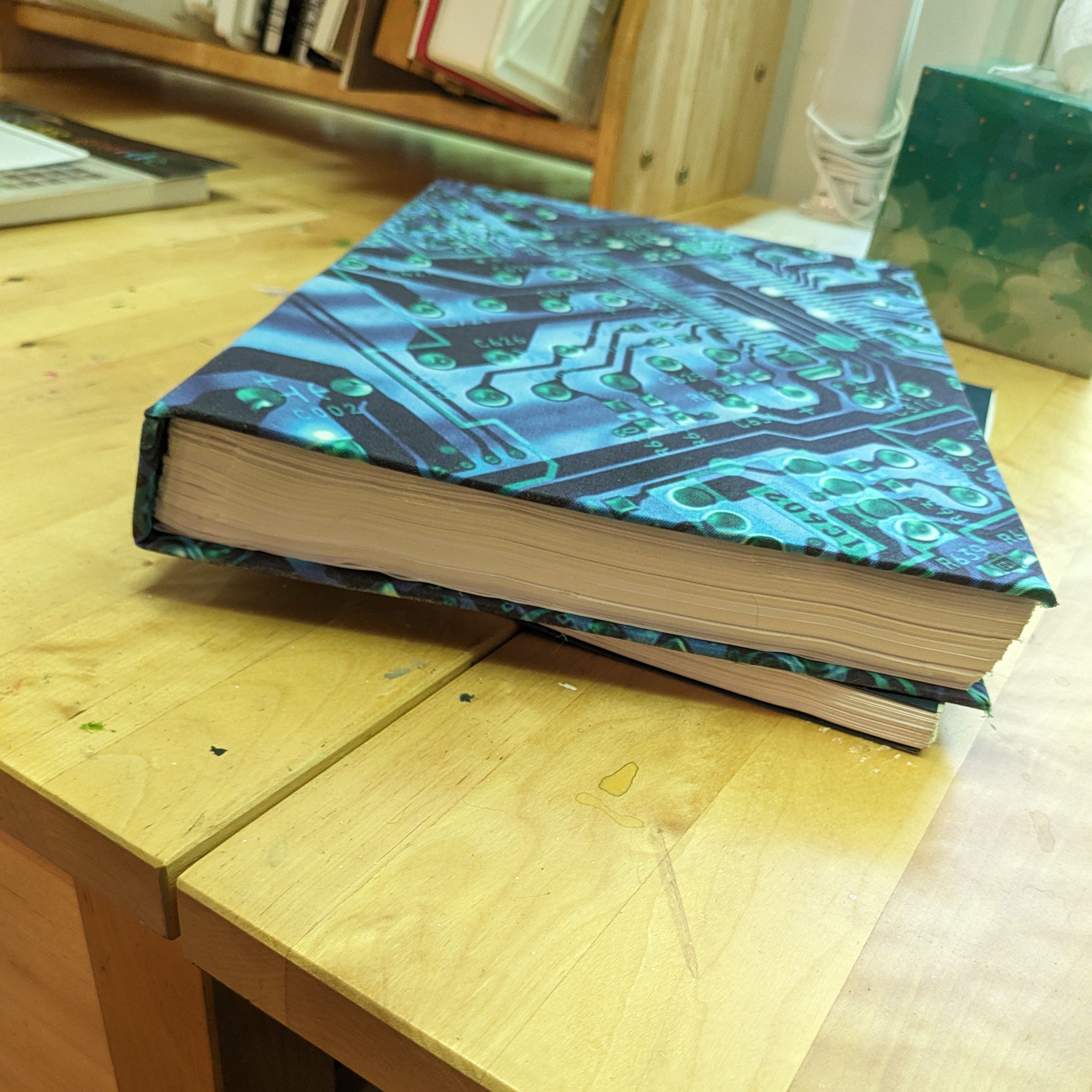
Paper and highlighters. If I can’t use the Scribe for some reason, then I consider printing the book out and using highlighters. This isn’t a complete waste for me, because I’ll often bind the book into a format that can sit on a shelf.

Flags and highlighter tape. If all I have is a physical copy of the book, I’ll fall back on flags, transparent sticky notes, and highlighter tape. No, I can’t just read the book, okay?

Method

Note: This is the method that works for me. It’s not perfect, but it’s what works for the time and attention levels I have.

I skip stuff. I totally skip anything that I’m likely to go into depth on later.

  • Feats: If I’m GMing, these are rarely something I have to consider. If I’m playing, I’ll look at the ones that apply to the character I’m building in the moment.
  • Spell lists: As a GM, I’ll use spells, but I can hold off reading them until I’m planning for a session.
  • Stat blocks: I do read bestiaries, but mostly for the flavor. I skip stat blocks until I’m going to actually use a creature.
  • Equipment lists: Again, these are rarely something that I need to know about until I’m actively planning for a game or running a character.

There’s a few benefits to skipping all of these for me. First, it makes the books go by a lot faster. In crunchy systems, tables of gear and spells can take up a significant amount of the page count. Second, it gives me something that I can look forward to discovering later! I love leveling up and combing through spell lists to find cool options I’d never seen before. If I already know all the options, it can start to feel a bit boring.

I dive deep elsewhere. Of course, I pay close attention to the general rules, but some sections, I’ll really hone my focus, even breaking out stickies or a notepad if need be.

Combat is a big one to read carefully for me, since what players do in the first combat can often end up set in amber. I’m not shy about correcting rules we read wrong, but human behavior is weird. It can take a while to get them out of the habit of thinking they can totally do X each turn.

I also like looking carefully over subsystems, but for a different reason: They don’t come up that often if you don’t know about them! That sounds obvious, but seriously, it’s easy to put together combat and social encounters and then try to cobble more complex situations with a couple of random DCs. The designers put together something much cooler, though! Use it!

Also, I tend to read the GM-centric sections a few times. It’s tempting to skip them if you’re experienced GM, but for the love of all that’s good, please don’t. Every system has a different way of balancing itself, and it’s important to buy into that before the first die is rolled.

So, in short:

  • Skip anything that’s just a long list (feats, spells, equipment)
  • Read the general rules (So, how feats work, how spells work, how to buy equipment, etc)
  • Read combat carefully so you don’t screw it up out of the gate
  • Read the GM sections carefully so you understand the game philosophy

Imma repeat that caveat

This is the system that works for me. I’m more than happy to skip certain sections, but if reading them brings you joy, you do you. If you’re not planning on ever GMing, you can totally skip the GMing sections! If you prefer to learn combat by watching a bunch of videos, have at it. I’m only putting what I do out there because I get asked from time to time, and I got tired of writing out the same reply over and over.

Gatewalkers Book 2 Chapter 3 GM Insights

Over on D20Saves, I’m running Gatewalkers, one of the latest APs from Paizo! From the official website:

After they walked through that glowing gateway, nothing was ever the same. A band of characters become paranormal investigators to determine the cause of a global amnesic episode. Their quest takes them to lands near, far, and outside this reality altogether. Along the way, the characters meet fellow “gatewalkers,” defeat alien monsters, and explore strange realms touched by the Missing Moment. And when it comes time to learn the grim truth of what happened to them on that fated summer night, what then?

Warning: The first part of this blog will cover what happened in the stream, so there are spoilers for the beginning of Book Two. Part two will include my thoughts as a GM, so there are major spoilers for the AP overall.

Check out the playlist here if you want to watch the previous episodes.

Chapter Three recap

You know, it feels like we were just here. When I say this book moves fast, I mean it! Heck, as I’m writing this, the players are a good chunk of the way through chapter 4.

The majority of this chapter takes place in the Medevian city of Egede. Once bolstered by an unending crusade, this town has fallen on hard times without the influx of money and patrons on their way to take on the World Wound. The party had to contend with a paranoid population that had fallen sway to the ‘Committee for Moral Rectitude.’

To the surprise of anyone who’s seen the questionable moral choices of an adventuring party, the group quickly proves themselves to be beyond reproach. Unsurprisingly, this required the judicious application of violence, but if we’re being fair, the other side started it. Now able to rest in peace, the party got a letter from Dr. Ritalson (remember him?) congratulating them on their progress, commenting on their new companion, and paying the party for their efforts thus far.

With their newfound reputation and money, they manage to get a caravan to Kenabras, the only lead they have at the moment when it comes to Sakuachi’s mission. They don’t get far before they’re distracted by a falling star, which their seer interprets as a sign. Breaking off from the caravan, they make their way across the healing wasteland to find a strange insect burrow. Inside, they fight terrible beetles and the crusader they either obeyed or controlled. After rescuing some reclaimers, they finally get a clue as to where they should be going: Domora!

Okay, seriously, if you’re a player in my stream, DO NOT KEEP READING. Don, James, Jorge, Daton, Ricardo, CLOSE THIS TAB.

GM thoughts

I keep saying it, but seriously, this book moves fast. If you’re a GM who only prepares what they think they’ll need for the next session, push yourself a little harder. Players who follow the plot and don’t wander off for side adventures will quickly churn through the available content.

Another warning: The plot heavily depends on following Sakuachi’s lead. If they’re fighting that, you need to find another way to get them to that falling star. Heck, put it on the way to Sarkoris rather than 200 miles off course, and maybe have a few caravaners kidnapped. That way, they can’t avoid it, and the party will get their lead for their next destination.

Finally, Ghost Sakuachi is still doing great, plot-wise. Nothing has required her being physical, and she’s still able to deliver plot points as needed. The only hiccup is the players trying to use her to scout, which I haven’t allowed so far due to how strategic my players are. However, if your party is a bit more chaotic, she could help players think ahead.

Looking forward

The investigation in Domora is already underway. I really love that this AP has included actual investigations, which fits well with my group and the themes of the adventure. They’re also a decent blueprint on how to do investigations that aren’t just a series of die rolls. Leads lead somewhere that the players have to check out and interact with, which allows everyone to participate.

Looking towards the next book, I expect that one to go quickly as well, save for crossing the ice. I’m most looking forward to them finally getting back to Ustalav and putting all the pieces together.

Embarking on a new Starfinder RPG Adventure: Against the Aeon Throne

After eyeballing the Starfinder RPG for a good many years, I’ve decided to pull together a game! The stars (HA!) are aligning on several fronts. One monthly game is ending. I’ve managed to collect most of the books through Humble Bundle. I’ve been slowly tackling reading them. Also, with Starfinder 2e coming out, we want play something in space, but the official system won’t be out until 2025. And even when it comes out, it’ll be a while before the core books are all released. So Starfinder 1e it is!

Note: This post is spoiler free, so my players can feel free to read it. This won't hold true for anything else in the series.

Choosing an AP

Starfinder has so many good options when it comes to Adventure Paths. All of the themes sound amazing, from the incredibly creepy to freaking Pacific Rim. I couldn’t find one that my players wouldn’t want to play in. I decided that, if all options were great, I should probably optimize for saving on money and effort. Only one AP fit the bill: Against the Aeon Throne. I already own the PDFs, and the AP is offered as a module by Roll20. It’s also low-level, which works for a group still getting a handle on the rules.

Also, reading over the reviews from more experienced players, it looks like it’ll be a good introduction to the Starfinder universe. None of my players have played much Starfinder, and I’m fairly certain none of them have cracked the book past being able to make their character. (Love y’all, but you know it’s true). This will allow me to drip feed lore to them rather than hitting them with a firehose.

Prep so far

I’ve read through book one using my usual laborious highlighting method. I’ve also read through a few other Starfinder books, including the CRB. It helps that the Starfinder books are written in an accessible and fun voice, so they read a lot faster than some drier RPG books might.

I’ve also gone through Roll20’s module for the first book. Tip to others: Even if your VTT has a module for your AP, make sure to go over the lighting and creatures. For me, this module was created before a few new features were deployed, so I had to add them in. Also, modules tend to only include maps from the AP, so I needed to go dredge up a few more.

Finally, I’ve been listening to Androids & Aliens from The Glass Cannon Network to get a feel for how combat flows. I know to take any Actual Play with a grain of salt (including a group that is learning the system as they go), but so far, it seems to be a decent representation of how the game works. Also, it’s a fun group and a super creepy AP (they’re running Dead Suns, which was on the short list).

Recruiting

If there’s any place where I’m going to get screamed at, it’s here, but hear me out.

Most of my monthly games are run on a shared Discord server, where we’ve taken to gathering so we can optimize boosts. There’s around two dozen of us on there, playing a wide range of games and systems. When I knew I’d be starting a new game, I put out the call… and ended up with a VERY full roster. Right now, I have eight interested players, which is high even for my ‘over-recruit and sort it out later‘ self. I know, I know, I should be grateful that this is the problem I have, but still, I know it’ll pose some interesting complications when it comes to things like ship combat and modifying encounters.

My theory is that once the game starts, some people will have to drop, some will show up for some sessions, and I’ll have a core who will be at every game. Until we hit homeostasis, I guess I’ll have a more chaotic crew than normal. At least there’s a ship where I can stow them?

Concerns

My biggest concern, of course, is that we’re kicking off a new system. Even with a group of experienced players, this can cause growing pains. Heck, I’d say there’s a few more issues when it’s a seasoned group. Rules are confused with other systems, and there’s the temptation to say “I know how X works, I’ve been doing this for decades!” I’ll probably set a table rule that, until we have a handle on the rules, we really do need to look up EVERYTHING as we go. It will slow down play, but I’ve found the rules you look up at the table stick better than the ones you say you’ll look up later (and never do).

Space combat also has me concerned. I haven’t quite got my head wrapped around it, and the APs don’t let you avoid it. For now, we’re using the base rules rather than the ruleset in Starfinder Enhanced, but that might change at some point.

It’s also a game with quite a few players in a system I’m not 100% confident in, so I’ll have to get used to adjusting combats. Here’s to hoping their CR system works as it should! I’ve become spoiled by the numbers ‘just working’ in Pathfinder 2e, but I have enough experience with tweaking Pathfinder 1e combats to carry me through. Hopefully.

Thoughts?

If any more experienced Starfinder players have thoughts or suggestions, I’m all ears, since we’re still collecting resources and learning.

Gatewalkers Book 2 Chapter 2 GM Insights: Smooth Sailing

Over on D20Saves, I’m running Gatewalkers, one of the latest APs from Paizo! From the official website:

After they walked through that glowing gateway, nothing was ever the same. A band of characters become paranormal investigators to determine the cause of a global amnesic episode. Their quest takes them to lands near, far, and outside this reality altogether. Along the way, the characters meet fellow “gatewalkers,” defeat alien monsters, and explore strange realms touched by the Missing Moment. And when it comes time to learn the grim truth of what happened to them on that fated summer night, what then?

Warning: The first part of this blog will cover what happened in the stream, so there are spoilers for the beginning of Book Two. Part two will include my thoughts as a GM, so there are major spoilers for the AP overall.

Check out the playlist here if you want to watch the previous episodes!

The second chapter of Book 2 opens with the players looking out over a great frozen lake with no way to get across. True, they have a raft, but that’s certain to be eaten by the storm-tossed waves before they get too far. Their only option is to scour a ship graveyard and hope something is still seaworthy enough to get them to civilization.

Making their way through wrecks that could barely suffice as kindling, they find a ship that looks amazingly whole. They board her, only to be attacked by the machinery itself. Happily, the captain appears and calms the ship down. Unfortunately, he’s a ghost, though less mad than those on other ships. He agrees that if the crew can get his ship free of the magical ice surrounding it, he’ll sail them to wherever they want. They just have to make nice with a naiad queen.

So, once again, solving everyone else’s problems other than their own, they make their way to her temple, and after clearing out some of the denizens, they convince her to share the ritual that will remove the ice. After some stomach-clenching rolls, the group succeeds and is able to sail into the lake and towards Egede.

Of course, it can’t be all smooth sailing. Along the way they encounter psychedelic bubbles that, at best, force those who inhale them to have hallucinations. At worst, they drive people mad, and they encounter a whole ship of people who apparently took in a deep breath. The party received a worrying glimpse into their lost memories before being set upon by the specter of Osoyo.

They survived, finally coming to the costal town of Egede, where they bid their captain farewell as he finally takes his ship and his crew to the great beyond.

GM Stuff

Okay, seriously, if you’re a player in my stream, DO NOT KEEP READING. Don, James, Jorge, Daton, Ricardo, CLOSE THIS TAB.

This chapter, in spite of having a lot in it, went by fast. Seriously, I almost forgot to write this blog post. As of this writing, the party is almost done with chapter 3! So if you’re a GM who only preps one chapter ahead, maybe reach a bit further for this book.

Encounter-wise, everything was fairly straightforward. None of the fights left the crew anywhere near a TPK, and none of the encounters left them confused. In fact, the hardest thing they ran into was the ritual. It took a few goes, but finally, they succeeded. If your players ranks are low and you don’t want the ritual to just be NPCs rolling dice, consider having the naiad queen handwave it. After all, if the ice isn’t lifted, they’re not going anywhere!

Finally, ghost Sakuachi is still working out fine! Thought I will say that the players are desperate to make her a statted NPC, I play up that she’s barely holding on to the material plane at this point in time. There are spots in the AP where her team could have stepped win with skills, but this group is fairly well-balanced, so can handle pretty much anything that comes their way.

Looking forward

While I’m enjoying book 2, I’m really looking forward to everything coming together in book 3. The mystery, finally talking to their patron, and the trek across the icy planes: It’s going to be so good.

Pathfinder 2e Adventure Paths: My GM and Player Recommendations

Every few weeks, someone on r/Pathfinder2e asks for thoughts on what AP their group should run. In the spirit of “I’m tired of writing out my response every time”, I figured I’d make a blog post about it instead.

Yes, I mostly blog to save myself time later.

What I’m including

I’m including every AP that I’ve at least experienced part of, either as a GM or a player. I also include how I ran it (since I sometimes like to switch things up and run APs in a non-conventional way).

I’m not including Adventures, even though I’ve experienced a few. Maybe a blog post for another day!

The Adventure Paths

Agents of Edgewatch

Role: GM
Game type: West Marches
Status: Mostly completed

I ran Agents of Edgewatch as part of a West Marches game, which worked shockingly well. I had to move the main elements of Book 1 to our town, but they were fairly easy to transplant. For later books, I added teleportation circles to the town that were only active for those working their way through the adventure. This did require removing some bits, but no one missed them.

I enjoyed running it so very much, and it’s one of the rare APs that I find myself wanting to run again. It’s full of so many fun set-pieces, and being set in Absolom could give players a chance to really branch out during the adventure. If your players do like to wander, grab a copy of Pathfinder Lost Omens: Absalom, City of Lost Omens. It’s filled with lots of hooks and little details that can bring the campaign to life.

That said, let’s talk about the elephant in the room: The first part of the book has you working as guards who make their money by getting it off of the people they’re guarding. I highly recommend just paying them to keep the peace, rather than taking the property of the people they’re policing.

If you want a high-level review of the cool encounters, check out my blog post about stripping AoE for parts.

Abomination Vaults

Role: GM
Type: Standard
Status: In progress Done!

This is hands down one of the best APs I’ve ever run. I’m going to put a huge caveat on that statement, though: I love dungeon crawls, and so do the rest of my players. There’s something very satisfying to me, clearing levels one by one, plunging deeper into unknown depths. Not every player is into this sort of set-up, though. Players really, truly need to understand that they won’t be leaving Otari, and that the thing they will be dealing with for ten levels is the dungeon. The dungeon does switch up themes as you go, but you’re not going to some exotic new locale or running into a town of completely new NPCs.

That said, you are fairly close to Absolom so a lenient GM could work in some sidequests there. My players never bothered, opting instead to order what they wanted through a weekly caravan. Like, I said, we like dungeons.

From the GM side, you should either grab the modules already on your favorite VTT or settle in for a lot of prepping. Because players can go any direction, you can’t just prep the ‘next few’ areas. Once they’re near a floor, you should have it ready to go. On the flip side, this AP does allow you to be more passive as a GM. Most of the time, I was sitting back while the players discussed where they wanted to go next. I didn’t have to run complex social encounters or dinner parties, and most NPC interactions were limited to just one NPC. It’s a pretty chill experience until it’s killing time!

Some warnings:

  • Quarters are tight, so limit bodies. This means discouraging too many minions. It can work, but if everyone has a wolf, someone is going to be sitting in the hall in some encounters.
  • Emphasize that the players should not go down until they’ve cleared most of the floor. They will get their butts handed to them.
  • Rest is important! If the party is low on resources or sitting on a nasty disease or curse, they should go get that fixed before moving forward.

I wrote more about Abomination Vaults in its own post!

Fists of the Ruby Phoenix

Role: Player
Type: Standard
Status: Complete

This is one we streamed over on D20Saves with a group of experienced players. It was an absolute blast, and delivered on what it promised: A bunch of heroes entering a fighting tournament and accidentally saving the world. There’s a fair mix of social and combat as well as some traditional combats, so you can’t afford to create a group of one-trick ponies.

This is a high-level AP, so it’s not one I would throw at new players. You really should know what you’re doing with your characters and running complex encounters.

Strength of Thousands

Role: GM, then player
Type: West Marches, then stream
Status: Started, abandoned, started again!

This AP didn’t work quite as well in a West Marches game, so it was abandoned fairly early. I did read the first part, though, and it’s left me aching to either run or play in this one for legit years. How can you resist a Magic School AP? Also, book one had one of the best collections of NPCs I’ve seen in an AP ever.

Thankfully, one of the GMs over on D20Saves has agreed to run it for us, so I’m getting another crack at it!

Quest for the Frozen Flame

Role: GM
Type: Speed run
Status: In progress Done!

I’ve been blogging about this AP book by book, so you can check out my previous posts here. In short, it’s a great AP for players who are down for a wilderness campaign that focuses on surviving, exploring, and building a following. I want to be clear, though: When Paizo said it was a wilderness campaign, they meant it.

Some suggestions:

  • Have a spreadsheet ready to keep track of renown and followers gained. You don’t want to have to backtrack and figure it out because suddenly it matters at the end of a book.
  • Dear lord, use ABP. The loot is sparse.
  • Make sure players know they can take downtime to craft items they might need. They will not have access to cities. In fact, the players in my game are in book three and just heading to their first major encampment.

Gatewalkers

Role: GM
Type: Standard
Status: In progress Done!

This is another game that’s being streamed on D20Saves. We’re currently in Book 2, and it’s been a wild ride. Book one especially has a lot of hard lefts that no one in the party predicted. This is a great AP for people who happily follow plot hooks, but may be a struggle for a party who resists going with the flow. Also, some of the fights are deceptively hard. If your party is too squishy, you’ll run into trouble quickly.

I have a series of GM posts about prepping and running this AP if you want a more in-depth review.

Stolen Fates

Role: Player
Type: Standard
Status: In progress

And other D20Saves stream! We’ve only just begun, but so far, it’s been an intriguingly weird adventure. Amusingly enough, we’ve had more gates in book one than we had in all of Gatewalkers. In fact, I feel like this would pair well with Gatewalkers as a follow-on adventure to get the players to level 20.

And that’s it!

I’ll update this post as I finish / start new APs. For now, this is the complete list as of July 2024! Rankings are highly subjective, if I were giving out awards:

  • Favorite overall: Abomination Vaults
  • Most likely to run more than once: Fists of the Ruby Pheonix
  • Most modded: Gatewalkers
  • Most niche: Quest for the Frozen Flame