Gatewalkers: Stripping it for parts

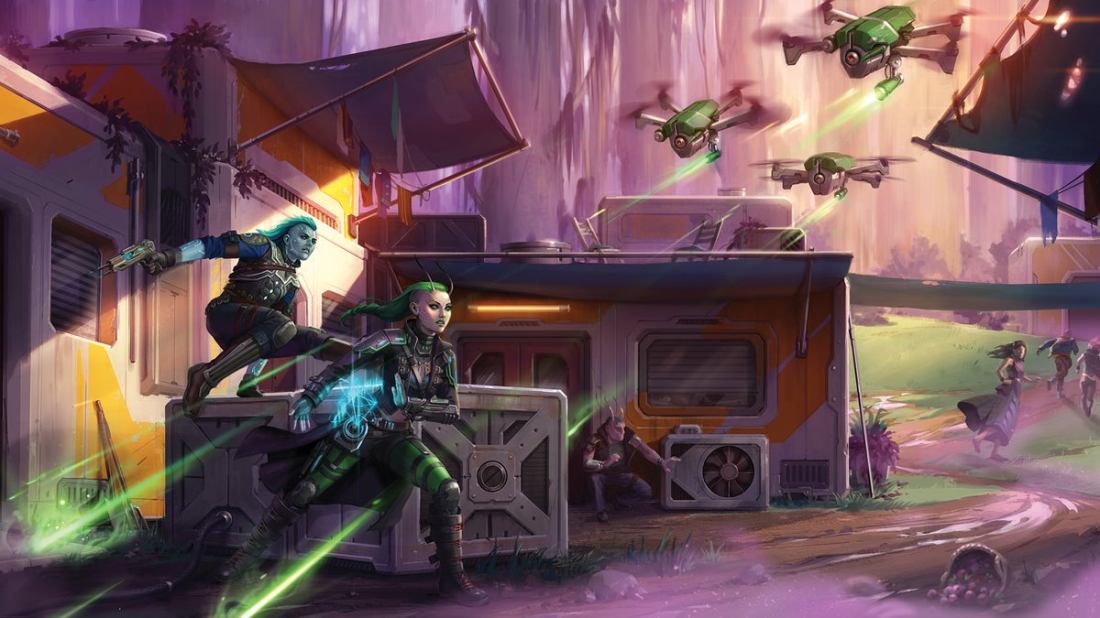
I adore Paizo’s Adventure paths. They’re a huge timesaver for busy GMs, and not just those who want to run a long pre-written campaign! You can easily pull out interesting scenarios from the APs. After that, you can rub off a few serial numbers. Slot them into your custom campaign with no one the wiser. I’ve written about this for other APs, and now it’s time for me to give Gatewalkers the same treatment.

Book One

Seven Arches

The book in medias res, with the crew approaching a town with a bit of a mystery. A curse that had killed any elf who entered the town’s perimeter, before a few weeks ago, would die instantly. The crew is there to do some clandestine tests to see what might have changed. This involves running around, dodging guards, and digging for more information. It could lead to the next scenario. Alternatively, it could lead to one custom for your campaign.

Potential hooks:

  • You’ve been hired by the Pathfinders to check out what might have changed at Seven Arches. They’d go themselves, but they’re a bit banned
  • The group stumbles into the town on their own while travelling. They realize something is off after they’re intensely interrogated to see if their crew includes an elf.
  • The group has some reason to check out the arches in town, and find out they’re fake!
  • Honestly, it’s a nice town for the group to run through, restock, and chat with locals. Paizo added some good details!

Greenleaf Forest House

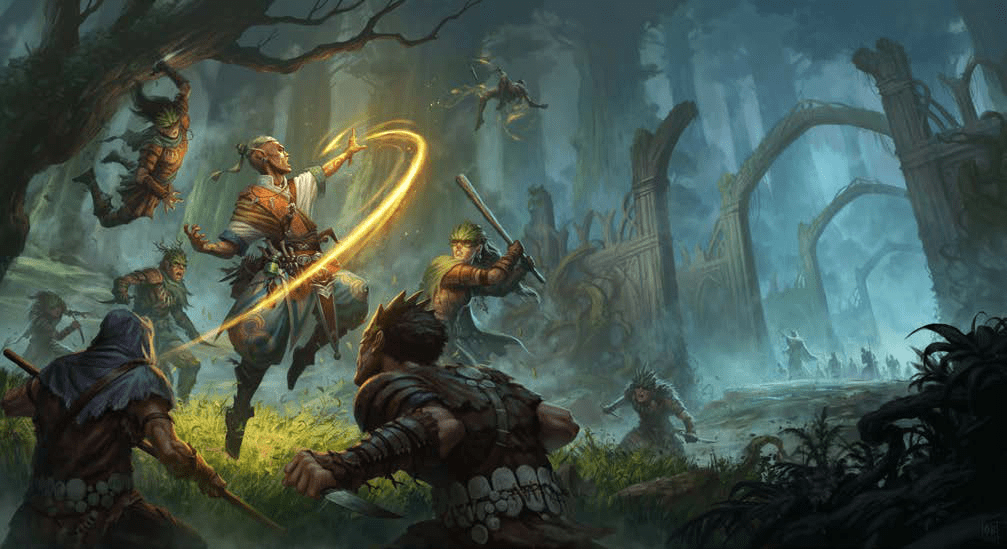
A dungeon IN THE TREES! This is a super fun and challenging ‘dungeon’ for low-level characters. A group of rogue druids have taken over a formerly friendly enclave and are causing problems. PCs will have to find a way to free their captives and drive out the interlopers while surviving nature’s wrath.

Potential hooks:

  • This can be a standard job posting during a regular campaign. It might be offered by one of the enclave members who managed to escape.
  • More amusingly, the players could be en route to meet the friendly druids. They don’t realize their contacts are all tied up in a closet.
  • They might stumble upon the druids while travelling. Initially, they might think the druids are nice. Then, they discover the druids’ plans to level the nearby town “for the good of nature.”

Kaneepo Invesgitation

The players find themselves trying to investigate a mystery in a town that, quite frankly, doesn’t want them around. This is a fun investigation that involves a bit of digging, a bit of charm, and a bit of fisticuffs, culminating in a portal to another plane. Because Kaneepo doesn’t show up in this investigation, you can easily swap him out with the BBEG of your choice. You could also import him into your game, since his connection to the overall Gatewalkers plot is fairly loose, and it’s easy to play him as a fey that just loves shit-stirring.

Potential hooks:

  • The group has tracked their current quarry to a small farming town.
  • The group stumbles into this odd town, and while most of the farmers ask them to move along, a sympathetic NPC begs them for help. Their friend, Hatria Pebblesworth, was recently killed, but no one wants to look into it.
  • Heck, go ahead an import Kaneepo into your campaign, since taking him down makes for a decent arc.

The Thinlands

While technically in the First World, this is a part of the plane that is bathed in black and white. Therefore, this could easily be plopped in the Netherworld (Legacy: The Shadow Plane) or in a particularly grim part of Golarion. As for the actual content of this section, it features a compact yet challenging ‘dungeon’ with a varied set of challenges. Some, players can charm their way through, some require some brainpower, and some require some form of violence. Also, due to the nature of how it’s written, it really needs to be done in one go, so players have the additional challenge of minding their resources. Annoyed that your players insist on resting every time they take a break? Throw this a them!

Potential hooks:

  • A local has been kidnapped, and his family is desperate to get him back (The final room has a hostage in it, so swap them for whoever is interesting)
  • Again, you can just add Kaneepo to your game! This plus the “Kaneepo Investigation” sections could easily fill a few sessions.
  • The players stumble onto the hideout and realize it may be corrupting the land around it, leeching color from an otherwise normal area.

Castrovel

Yes! The planet! The book features a gazetteer for running adventures on Castrovel, which could be used to kickstart a whole adventure on its own. If you want to keep it to something more guided, however, Book One has an interesting way of introducing the characters to life on the Elf homeworld. They start off in the wild, with no idea where they are (they think they’re still on Golarion), and they have to fight their way through a dense and dangerous jungle to get to the one sign of civilization they can see. I will say, as a GM, I loved watching the players argue about which part of the Mwangi they’d been teleported to until they finally realized what was going on.

If you’re worried as a GM that you might be stranding the players somewhere, don’t worry: This part of the adventure has a way for them to get back to Golarion.

This arc has three parts: Struggling through the wilds, some dungeon diving, and getting back. Because they’re fairly separate, you don’t have to run all three, and can handwave any connecting tissue fairly easily. While I loved all three sections, I’d say getting back was my favorite encounter, since it hops the players all over the solar system before dumping them where they need to be.

Potential hooks:

  • Running all three: A strange portal needs investigation! Stepping through, unfortunately, strands them in a strange land as the portal collapses as soon as they exit it.
  • Running all three: A trap sends them ‘away’ and they have to find their way back
  • Just the city and dungeon: The elves of the city need information about a ritual to protect their new settlement. Being academics, they really need some muscle to help them out.
  • Just getting back: The portal could be anywhere! Use it to give the party a shortcut from one place to another, but at a cost.

Book 2

While much of Book 2 revolves around an NPC trying to fulfill her destiny, I’ve found you can pretty much remove or downplay her role without changing the entire story. That makes Book 2 easy to mine from!

Skywatch

Skywatch is a town that has been mysteriously abandoned, and is now beset by those who would plunder what was left behind. It has a number of fun encounters, both social and fisticuffs (including fighting a piece of furniture that had me cackling as a GM). It could be an interesting place for a group of PCs to run into, or be hired to check out.

Potential hooks:

  • The party has been braving the wilderness for a while now, and could use a chance to restock. Pity that the town they’ve stumbled onto is in such disarray.
  • Word is that the formerly cloistered city of Skywatch is no longer sealed off from the rest of Golarion! The crew has been tasked with seeing what they were up to.
  • A group of researchers need to get up to the observatory in the center of town. Unfortunately, not only is the observatory surrounded by looters, but several members of their party have disappeared while attempting to scout.

Mermaid’s Tear

At one point, the Gatewalkers party needs to get across a lake, and ends up on a slightly-haunted ship that’s otherwise sea-worthy. Captain Adney was a favorite NPC for my group, and it made an otherwise colorless journey memorable. Acquiring the ship involves a few steps which can be handwaved, but I found the dungeon to be a nice one-session size. Also, you can’t have a haunted ship without some weird events while you travel, which are included in this arc.

Also, the ship being haunted and only functional while haunted makes it easy to remove from play, if you don’t want your players to have unlimited mobility.

Potential hooks:

  • Your players need to get across a body of water, but all the regular captains are either booked or unwilling to carry them. They hear a rumor about an ‘abandoned’ boat nearby that could be used if it proves seaworthy, though…
  • The Temple of the Water Lord can be run independently, and could be a great challenge for a group that wants to learn a particular ritual from the fey waiting at the end.
  • If you just want to run the seafaring parts, the crew has been hired to hunt down the Red Duchess, a Chelaxian vessel that’s gone rogue for unknown reasons. Previous parties have been sent to look into it, but haven’t returned, which is making the locals nervous.

Egede

A town that’s been taken over by religious zealots, with the potential for spawning a cult! In the AP, it’s easy for the PCs to blow past the plot, but it’s a fairly interesting encounter that can fall out multiple ways. Do they get the zealots to back down and realize the error of their ways? Do they play along? Or do they decide conversations are for commoners and solve their problem with violence? Depending on what they do, they might inspire some already unstable locals to form a following. While in the AP, this is meant to push them to move on, it could be the start of a bigger adventure.

Potential hooks:

  • Your players stumble into town to restock and rest and end up caught up in the local politics.
  • They’ve been hired by someone whose brother is being held for a ‘trial.’ Once the party is in town, they realize how deadly said trials are.
  • Post-hook: If they accidentally create a following, the PCs have to deal with a cult forming around their ‘miraculous’ accomplishments. Seriously, make it awkward.

Crossing the Scar

If you need your players to cross the wilds of Mendev or the Scar, this is a good chapter to grab. It includes not only random encounter tables, but also some unique encounters that feed into how damaged this region is, and a bug dungeon that had so many bugs. It does include an escort quest, but this can easily be removed or downplayed.

This is a great place for those who invested in Survival to shine, especially if they don’t have a chance to buy magical yurts beforehand.

Potential hooks:

  • A group of pilgrims have asked the group to guide them to a sacred site across the scar.
  • Reclaimers want to hire the party to find out what happened to some other members of their organization.
  • You can use Valmer’s Burrow on its own. Valmer has a habit of taking people back to his hidey hole, so if the party has a beloved NPC he could grab…
  • This section also includes some ruins that can be used on their own, allowing PCs who love investigation a chance to flex.

Book 3

Lepidstadt

Lepidstadt is the largest settlement in Ustalav, and makes for an interesting place for a party to set up camp for a while. I will say that if you want more details, you may want to check out books from the PF1 days. Rule of Fear and The Carrion Crown would be good places to start. Still, if you just need something to vibe off of, what’s in Book Three should suffice.

Potential hooks:

  • The party has to do some research at the local university, but quickly find out that the professors want rather gruesome favors before they’ll help.
  • The party has been hired to find a missing loved one, who was last seen heading into Ustalav with their wares. There’s also troubling rumors of cults and secret societies who are always looking for new members… or victims.
  • The council has hired the party to track down the Beast of Lepidstadt, a legendary monster of the region who is blamed in the recent murder of a rich merchant. Not everything is as it seems, though. Is the monster actually guilty? And why hire outsiders for this job?

Ritalson Manor

Ritalson Manor starts off as a nice break for a tired party, and slowly descends into a the realization that not only is their host an occultist murderer, but that they were lined up to be his next victims. My players loved it, since it offered a mix of research, social interactions, and mayhem. Though it ties in with the overall Gatewalkers plot, it wouldn’t be too difficult to scrub that off of the set-up. The other party could be from any faction friendly with the party, and the discoveries in the basement could tie into any larger plot.

Potential hooks:

  • Ritalson is a fellow Pathfinder who has invited the party to his manor for a small gathering of the minds. He’s been held up elsewhere, so they’re told to enjoy his manor until he arrives.
  • The party has been hired to look into the disappearance of a party of traveling academics. Rumors place them at Ritalson Manor, but the local law enforcement has been reluctant to act against such a pillar of society with no evidence.
  • The party stumbles upon the house deep in the wilds, and are surprised when they’re offered a chance to sleep in soft beds for free. A dark storm gathering to the west makes this a tempting proposal…

Abandoned temple

If you’re bouncing around somewhere cold and want a relatively small dungeon to explore, the Abandoned Temple could easily be slotted into your game. Once serving Findeladra, it’s infested with Blackfrost and creatures that fell to its taint long (or maybe not so long) ago. It also features a nice treasure at the end of it: An Explorer’s Yurt, which is indispensable when exploring hostile regions, or travelling with a bard who whines a bit much.

Potential hooks:

  • Scouts from a local town have gone missing, and the sister of one of them has begged the explorers to find them, or at the very least, what befell them.
  • A terrible blizzard has slammed into the party, forcing them to take shelter in the temple until it’s passed.
  • Do your players need to find some notes to push the campaign forward? Turns out, their quarry holed up in the temple for a while and may have left something behind…

Across the High Ice

This section was rather controversial for many GMs and players, but personally, I liked it. Yes, it’s grueling, but that’s what travelling across a frozen desert should be. It also has a number of interesting encounters, both for combat and setting the mood, that keeps it from becoming totally monotonous. A GM might will need to find a different shortcut if they want to completely scrub the Gatewalkers plot, but this can be done by halving the distance on the map.

Potential hooks:

  • The party is at point A. Their target is at point B. They need to hoof it.
  • The party triggers a teleportation trap and ends up at the Crown of the World. Thankfully, they stumble into a cache of gear right away, but they still need to figure out how to get home… (So, reverse the map)
  • The party has been asked by the Pathfinder Society to do some scouting for them. They’re sure to get a big payday, but they need to gather enough data to earn it…

The First and Last Temple

This temple in the Nameless Spires is the capstone of the AP, finally allowing the players to deal a metaphysical black eye to the stupid fish that caused all of their problems. It’s also a nice size dungeon that could keep a group of players busy for a session or two. It’s filled with fights, traps, and a few weird, otherworldly nerds who will happily talk and/or steal the party’s brains. There’s also a few places where a GM could drop clues for their own campaign, if they need a place to do a lore dump.

Potential hooks:

  • The BBEG the group has been following stayed here for several months, researching… something? Replace what’s on the murals with your own details.
  • Strange occurrences have been popping up around the Crown of the World, and the party is being paid to look into it.
  • A cosmos oracle has been besieged by visions of disaster, and is convinced the temple holds the key. Even better if you happen to have an oracle in your group…

Final thoughts

I thoroughly enjoyed running Gatewalkers as is, but I also understand that some GMs prefer to run their own thing, or aren’t interested in the overall plot. Even so, it offers a ton of things you can grab and reuse without ever stealing your players’ memories or making them amnesiac criminals.

Quest for the Frozen Flame AP: Book 3 Summary and GM Experience

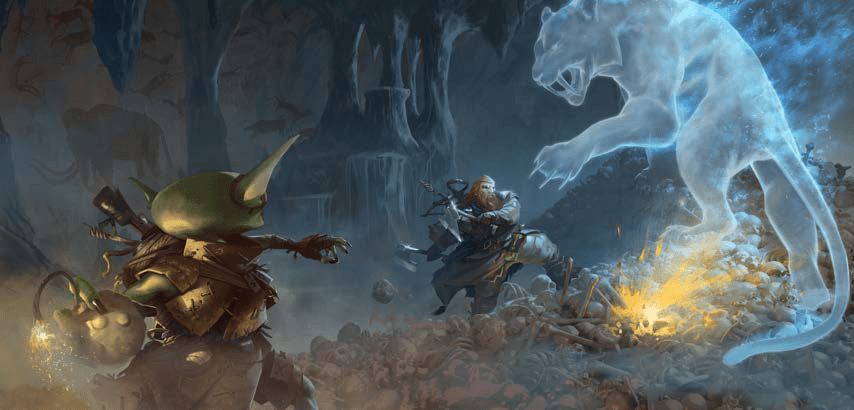
Every year, one of the talks at PaizoCon involves upcoming adventures. When they said they had an upcoming AP that involved megafauna, I squealed so loud I woke our dogs. Megafauna are awesome, especially if you can ride them, but in many campaigns, they’re simply not practical to keep around. If you’re wandering around the frozen tundra, though, they could actually be useful in most situations! I immediately started collecting players. As soon as I was able to read the first book, we got cracking, playing monthly sessions of 2-3 hours each.

Just over three years later, we finished book three, with the PCs having gone from minor players in a dying tribe to movers, shakers, and saviors of the great northern tundra.

Warning: I'll be gleefully spoiling the books past this point, so if you plan on playing in a Frozen Flame campaign, close this tab!

Summary of Book Three

From Paizo:

The Broken Tusks find sanctuary at last in the settlement of Hillcross, but invading frost giants quickly force the clan’s scouts to lead their mighty following’s defense against the siege and take on new titles. To put a stop to the slaughter, the newly named Mammoth Lords take the fight to their foes by riding their bestial mounts through the sucking muck of the Tamarnian Tar Forest. At the heart of these black woods, amid the ruins of a half-sunken crusaders’ castle, the heroes wield the sacred light of the Primordial Flame to defeat their ancient enemies once and for all.

The overall plot of book three revolves around not only keeping the Primordial Flame, but also removing its curse. The only lead they have in that department is to follow the path of the former Tusk who took it (Metuak), which is leading them towards Hillcross, a large, magically enchanted encampment used by the various tribes to rest and connect with each other.

The first chapter involves the Broken Tusks getting pulled into the politics and interpersonal dynamics of Hillcross. Besides having PC Glow, they also have a magical artifact that gains them a certain amount of attention. The quiet can’t last long, though, as Ivarsa and the Burning Mammoths finally track the crew down and begin an assault on Hillcross.

The PCs help repel the first assault, but realize they really need to continue on their quest. Leaving their tribe behind to help defend Hillcross, they make their way west into the Tamarnian Tar Forest, a land blighted by multiple evils. After some fighting (so much fighting) and meeting some allies, they finally make their way to the Metuak’s prison, Castle Grimgorge. There, they face down not only their tribe’s troubled past, but what remains of the Burning Mammoths.

How’d it go?

The players

My players continued to really enjoy this AP, getting into their roles as Big Damn Heroes every chance they could. They never missed a chance to recruit people to their following, and probably kept track of who they had better than I did. They also loved the final showdown with Pakano. I’ve run quite a few Adventure Paths, and never have my players hate anyone as much as they did Pakano. Some players might have cried foul for having to defeat an NPC twice, but mine relished the chance to put him down again.

No lie, their primary goal for going to Grimgorge was punching him in his stupid face again. Removing the curse was secondary.

Speed run

For this AP, I wanted to try a new way of speeding the AP up. While I have no issues with running APs as is, I also love playing around with them to see how tweaks can change how the content feels. In this case, I wanted to try doing a ‘speed run.’ Every time we started a new book, the players would be at the max level for that book. They wouldn’t level up again until the next book, when they would level up to the max for that book. So, for book one, they started at level three, for book two, they were level 8, and for book three, they were level 11.

I was delighted to see that my theory held. Combats early in the books sailed by, and became appropriate challenges by the end. They weren’t so powerful that everything was a cakewalk, but they did feel pretty darn powerful. One side-effect for this AP was that they didn’t hesitate to explore everything, since they had more time on their hands. A lower-level group would have had to rest more, meaning the time limit would have started bearing down on them, so they might have opted to skip swaths of the hexploration or some of the side-quests.

And yes, three years for three books seems like a long time, but we only played one two-hour session a month. According to my back-of-the-envelope math, that puts us at about the same rate as most APs. Had we been playing in non-speed mode, I have a feeling they would have skipped quite a bit to stay on track.

My thoughts

The biggest shock for me with this book was how hard the fight with Pakano and Ivarsa was. My players are ruthlessly competent, so they often curb-stomp boss fights. It proved to be a challenge, with PCs going down a few times. This was a good thing, though. The party hated Pakano with every fiber of their beings, so they relished a longer fight.

I really enjoyed running Hillcross and the politics there. It was a nice break from hexploration, and was a chance for the PCs to roleplay in a more open space.

Speaking of hexploration, while still good, it wasn’t as good as what was in Book 2. That’s not saying it was bad! Book 2 was Doublestuff Oreos, and Book 3 was original Oreos.

Finally, Book 3 is a great payoff for PCs who have invested in collecting a following. How many people they’ve gathered changes the outcome of the battle of Hillcross and how their tribe is viewed going forward.

Recommendations

ABP is still vital for this AP. Hillcross is he first major city the PCs run into, and they’re almost done with the AP at that point. If you don’t want to use ABP, make sure you have multiple crafters in the party and adequate downtime for them to get everyone geared up.

Also, by the time this book rolls around, you might have a group where every PC is mounted. Make sure everyone has read the rules on mounted combat, and that you’ve thought about how to potentially deal with mounts that can fly. This is important not only for battlemaps and how you represent them, but how they might skip encounters by going high. I’m a huge fan of players figuring out creative ways around problems, but I also like to be prepared.

The hexploration is set up differently in this book, with each hex requiring a different flat check and then a roll on another table. Set up a quick reference! I printed out all of the tables and taped them into my notebook so I wasn’t constantly paging back and forth in my PDF.

You also need to keep very careful track of lieutenants and following numbers. This changes the end of the book!

Finally, make the group consider who carries the Primordial Flame very carefully. It can’t be swapped around on a whim, and losing it sucks. While keeping hold of it isn’t that hard, generally, there are a few places in the AP where someone will attempt to take it. If the attempt succeeds, a PC could be in for a world of hurt for a while.

Who is this AP for?

As much as we all loved this AP, it won’t be for everyone. It’s one of those gems where some groups will dive into it, and others will fight it every step of the way. I would recommend it for groups where:

  • The players are into wilderness survival. Though the AP doesn’t force the issue often, a GM could easily build it into their hexploration.
  • Someone is really into crafting. Because there are almost no cities, the party will be reliant on crafting to gear up. This could be a player’s moment to shine!
  • The players enjoy finding non-violent solutions to encounters. This AP is rich with situations where a bit of roleplay can earn long-lasting rewards.
  • The players love exploration. Every book features a section with a hex map that could easily be expanded to add PC specific encounters along the way, if a GM wants.

So who isn’t it for?

  • Lone wolf groups. This AP assumes that the players will build a following over the three books. Failing to recruit (or even striking off on their own) can make some encounters more difficult and lead to a less satisfying ending overall.
  • Groups who prefer city adventures. There’s only two of them, and one of them, you’re sneaking around and not doing a lot of shopping or galivanting.
  • A group that is motivated by loot and gold, and not by causes. Seriously, there’s not a lot of loot in this adventure, and the reason for doing things boils down to “It’s the right thing to do” or “This will help the tribe.”

That said, I think it’s a fun AP for a group who is willing to go all-in on the premise, and has a gratifying dénouement for those who make it all of the way through.

Against the Aeon Throne: Book 1 – GM thoughts

Ages ago, I grabbed a good chunk of the Starfinder RPG off of Humble Bundle. As a system, it’s always fascinated me: Magic and sci-fi with a healthy sense of humor mingled with world-shattering threats to keep things interesting. When my Abomination Vaults game ended, I asked my pool of players if anyone might be interested in magic and guns in space.

I got an enthusiastic response. The players were all experienced with RPGs, with everyone having experience with Pathfinder (some 1e, some 2e, some both). Only one player had ever played Starfinder, though, so we were still readying ourselves for a learning curve.

The party:

  • Trox Nanocyte
  • Vesk Vanguard
  • Kitsune Witchwarper
  • Dirindi Operative
  • Human Mechanic + his artillery drone
  • Lashunta Technomancer
  • Lashunta Envoy
  • Kasatha Mystic

Yes, it’s a large party, but we operate on a quorum system. If four players can make it, we play, and assume the other PCs are off doing something else. So far, though, games have hit at least 80% attendance, so we’ve still had a large party on average!

Thoughts on moving to Starfinder 1e

First off, I’ll say that everyone in the game has loved Starfinder, and I’m kicking myself for not starting a game sooner. This fun world has been sitting on my shelf for years!

There have been a few hiccups that, while not insurmountable, would be worth considering for any other group looking to try SF1e out.

  • Experience is a double-edged sword. The group is made up of highly experienced players, but sometimes this tripped us up. SF1e rules are similar to PF1 and PF2, but they’re not the same. The first few sessions had us mixing in rules from the Pathfinder systems at random until we got serious about looking everything up.
  • Starship combat threw us for a loop. I’m sure an experienced group could have tackled the few starship combats in Book One in under an hour. We took an embarrassingly long time. For book 1, I wanted to use the standard rules, but moving forward, I may move to the cinematic system from Starfinder Enhanced.
  • Some habits needed to change. Loot is less valuable in SF1e. If you’re not going to use it, you should probably leave it. Also, one cannot get by just swinging a vibroblade. You need a gun in space.
  • Encounter balance is… different? Because our group was large, I thought I’d rebalance the encounters so that everyone would get a turn. Except, when I ran the numbers through a calculator, it turned out I didn’t need to adjust anything. I still need to look into how the system is balanced, but in practice, the encounters were perfectly fine without adjustment.

Thoughts on Book 1

Spoilers ahoy after this point! 

Dear lord, this book moves fast. Looking at our recordings, it took us 19 hours to finish book 1. Had we been more experienced, I’m sure that would have been closer to 15. A book of an AP usually takes us closer to 24 hours. Some might say that having a larger group made it move faster, but I’m not sure about that, since it also slowed us down (more abilities to look up, more pauses to ask about a mechanic, etc).

Also, this AP has a much slower leveling curve than others, which has been a boon for a new group. You only hit three at the end of book 1, while other first books have you ending at 4. I have to say, I was impressed with how much the crew could do at super low levels, so I’d say this is system where you probably don’t want to skip the early levels with newish players.

That said, I do feel like Against the Aeon Throne is a good candidate for a speed-run. You’re gated between books, so players can’t sequence-break the encounters. The low levels mean the players wouldn’t be getting too much of a power boost, but they could churn through some encounters faster, and have slightly better odds of accessing some lore and paths that are locked behind skill checks. It could turn the AP into something closer to an adventure if your group isn’t looking to invest in a long-term campaign.

I’ll probably be back here soon with thoughts on book two, because we’re darn close to finishing part two. Like I said, it moves FAST.

The Big Book of Screamsheets

A few months ago, my VTM group, having hit peak chaos that you can achieve in V5, transitioned over to Cyberpunk Red. I have to say, I’m thoroughly enjoying the system, though I was distressed at how quickly I ran through the pre-written one-shots (called Screamsheets in the CPR ecosystem). For those not in the know, a screamsheet is a one-page sheet that mimics a local newspaper, often with a supplementary adventure to go with it. They’re an awesome way to kick off a session by giving the players something to look over and research while you get the last of your GM bits and bobs in a row.

Around the time I ran out of screamsheets, I was reading The Big Book of Cyberpunk for inspiration, which is a collection of over a hundred cyberpunk short stories. I realized that quite a few of them would make decent adventures on their own if you ripped the protagonists out and plopped the crew in. Thus, a new project was born: The Big Book of Screamsheets!

(Note: I’m calling it the “Big Book of Screamsheets” as an homage to the inspiration, not as a promise to publish 100+ screamsheets.)

Each screamsheet is inspired by a story from The Big Book of Cyberpunk. Reading the story isn’t required for running the sheet, and ‘inspired’ may be doing some heavy lifting. Sometimes, I lift the whole plot. Sometimes, I just take an element that I found to be interesting and expand on it. Also, because the story’s title could be a spoiler, I only include it in the GM notes at the end.

A bit about my style

Because I know my players will grab onto any potential hook like a terrier with a stolen bone, I don’t tend to put red herrings in my games. My screamsheets reflect this, with each story leading to uncovering a part of the underlying plot. Even in games that start with the crew getting the hook directly, the stories will help them uncover clues as to what the heck is going on. Each story has their own set of skills that can be used for research, as well as what information certain DVs will get them.

I also tend to take an ‘all roads lead to Rome’ perspective when it comes to plot: There are many ways to get pulled in, but everything will lead to one final resolution. That said, there isn’t one given outcome assumed. While one group may negotiate with words, another might use guns, and that’s perfectly fine.

When it comes to combat, I give some guidance as to how many combatants, but nothing is set in stone. Crank up the heat as needed.

Finally, I have a section on ways the crew could get paid, though not how much. I leave that to the GM since they know how much they want their players to feast or starve.

The Screamsheets!

Enough chatter! Let’s get to the screamsheets!

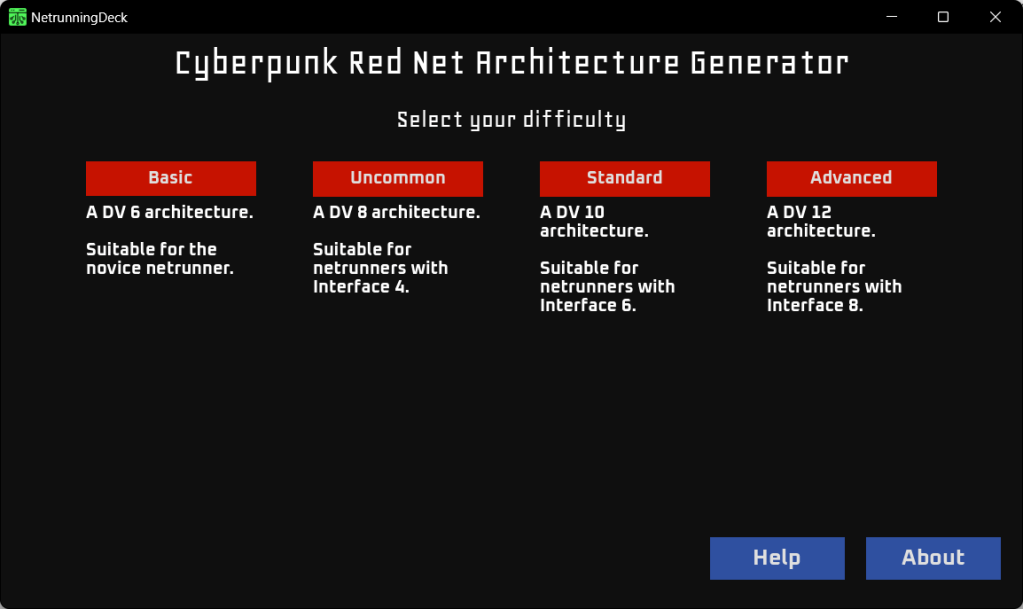
New Tool: The Net Architecture Generator for Cyberpunk Red!

When new coders ask me about ideas for personal projects, I always tell them to solve the little annoyances in their lives. Maybe it’s a template engine for sending out repetitive emails. Maybe it’s a script that helps you clean up messy spreadsheets. Or, in my case, it’s a bunch of little tools to help me run my tabletop games.

I recently started co-running Cyberpunk Red games, and I realized I was choking when it came to giving our poor netrunner something to do. Red has absolutely made netrunning during combat feasible, but it still requires a different sort of prep than it does for the meatbags in the group. Enter the Net Architecture Generator!

NetArch landinging page

How does it work?

  1. Launch the app (of course).
  2. Select the difficulty. “Interface” is the Netrunner’s Role Ability. An arch that’s too hard for a netrunner could easily fry them, so be careful about tossing them into the deep end.
  3. Click “Generate Floors” (the button won’t appear until you’ve selected a difficulty).
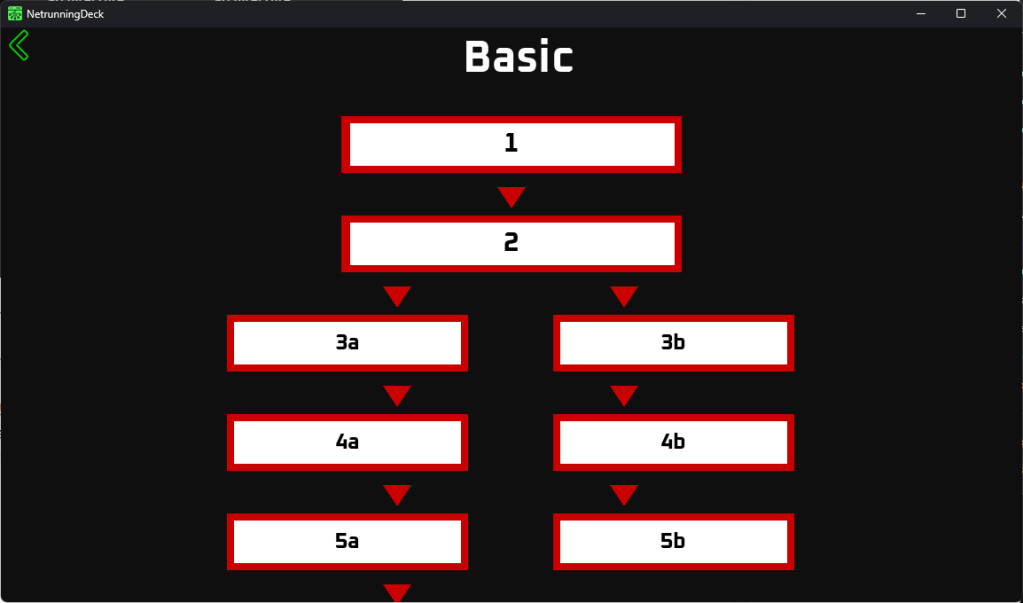
  4. To reveal a floor, click on it. If you want to hide it again due to a mis-click, left-click on it. Scroll down or use the arrow keys to show the rest of the architecture.
  5. Click on the green arrow to go back, if you want to select a different difficulty.
A Basic NetArch with no floors revealed yet

What doesn’t it do?

According to the rules in CPR, an arch can branch multiple times. I made the maximum number of branches one, because I was under a bit of a time crunch. I wanted to test it out in an actual game, and I also had another project I wanted to get back to. I may update it to have more branches in the future, but so far, one branch meets my needs.

Also, due to said time crunch, the entire arch is visible at the start. This is fine if the GM is narrating the arch, but it isn’t ideal if the player can see the app. This is something I intend to update at a future date, although I haven’t found it to be a significant issue in games.

What is it written in?

Godot! For those who don’t know, Godot is a free and open-source game engine. I’ve been toying around with it since the Unity debacle, and I adore it. Though I could have written this in a number of other languages, I’ve been trying to push myself when it comes to using GDScript.

How do I get it?!

If you’re on Windows (or are running WINE), here’s an executable!

If you’d prefer to run it through a browser, I did an HTML5 export. However, be warned, it’s a tiny bit wonky.

I found a bug!

I’m not shocked, since this was something I slapped together during lunch breaks and while waiting for dinner to finish. Drop me a line via my contact page, and I’ll look into it.

Can I contribute?

Sure! I’m not the fastest one to accept merge requests, but I welcome all well-intentioned updates. Just don’t judge my code too harshly. This was a ‘get it done’ project, not a ‘hang in a museum’ project.

Gatewalkers AP: Book 3 Chapter 1 Recap and GM Insights

Over on D20Saves, I’m running Gatewalkers, one of the latest APs from Paizo! From the official website:

After they walked through that glowing gateway, nothing was ever the same. A band of characters become paranormal investigators to determine the cause of a global amnesic episode. Their quest takes them to lands near, far, and outside this reality altogether. Along the way, the characters meet fellow “gatewalkers,” defeat alien monsters, and explore strange realms touched by the Missing Moment. And when it comes time to learn the grim truth of what happened to them on that fated summer night, what then?

Warning: The first part of this blog will cover what happened in the stream, so there are spoilers for the end of Book Two. Part two will include my thoughts as a GM, so there are major spoilers for the AP overall.

Check out the playlist here if you want to watch the previous episodes.

Recap

In this chapter, the PCs finally made it back to Ustalav! In the town of Lepidstadt, they made a beeline to Dr. Ritalson’s manor, only to find that they had just missed him. Not to worry, though! The staff invited them to relax for a few days and recuperate from their journey, and perhaps even talk to some of their fellow Gatewalkers who had arrived just before them.

Of course, the gang decided to do some breaking and entering instead.

To be fair, it was clear that something was off in the mansion, which lead to them finding a basement filled with horrors. They realize that Ritalson had not only been spying on various Gatewalkers in their dreams, but also killing them and using their memories to increase his own knowledge and access to power.

They ran off to confront him before he could return, knowing that he is no longer their biggest problem. Ritalson had been working for someone… Osoyo.

Jorge, Don, Ricardo, James, and Daton: I love you all, but you need to LEAVE this post now! Spoilers ahead!

GM thoughts

Honestly, the biggest danger in this chapter is the players themselves. If they’re not suspicious of Ritalson by now (and good lord, they should be), and they take the week to chill out, they could very well end up with their brains in a jar. Hey, at least there’s a new party upstairs they could take over…? But seriously, if your players haven’t twigged to the good doctor being kinda sus, drop some hints in their lap to get them looking around.

The ‘dungeon’ of the chapter was also quite good, and perfect for ripping out and adding to your own campaign. It’s rife with places where you can add in your own plots, and if you’ve needed a place to get some infodumps out of the way, there’s a place to find heap of journals and research. You would just need to update two rooms to fit your campaign, unless your main baddy is also a big psychic whale.

Speaking of looking around, I loved the investigation in this chapter. There are so many clues to find if the players are keen to dig for them. My players aren’t even done yet! Some of the clues are housed in books that they managed to take with them, so they’ll be doing a lot of reading on the road.

Looking forward

We have the big trek over the ice! I think I’ll be pre-rolling most of the encounters to streamline my planning and dead air on the stream. Also, I want to make sure they have the encounters that will hit home the hardest, so… maybe those dice are going to be a bit loaded.