Screamsheet: Jailhouse Blues

“Jailhouse Blues” is a Screamsheet that should take no more than one session to complete. It’s a part of The Big Book of Screamsheets project. It’s loosely connected to Tainted Pool, but can be used independently as well.

Player Information

A cohort has managed to land himself in the clink, and you might be the only ones who can get him out before he gets disappeared. You have some unexpected allies, but a tight timeline to get the job done.

Features

  • Non-combat solution (potentially)
  • Chase (potentially)
  • Social interactions
  • Stays in town
  • Multiple solutions

Screamsheet: Tainted Pool

“Tainted Pool” is a one-shot Screamsheet that should take no more than one session to complete. It’s a part of The Big Book of Screamsheets project.

Player Information

Has everyone in Night City lost their minds? Random citizens are pulling off heists, random raves are disrupting mid-day traffic, and rockerboys are getting attacked in broad daylight in the middle of the university campus. The crew should probably figure out what’s gotten into everyone and how they can get paid for dealing with it.

Features

  • Combat
  • Investigation
  • Social interactions
  • Stays in town
  • All roads lead to Rome

Screamsheet: Entrance Exams

“Entrance Exams” is a one-shot Screamsheet that should take no more than one session to complete. It’s a part of The Big Book of Screamsheets project.

Player Information

When your favorite bartender calls in a favor, it’s probably a good idea to do it. Besides, how hard can tracking down a few stupid kids be in Night City? It’s finals season, so it’s not like they could have gone far…

Features

  • Combat
  • Investigation
  • Social interactions
  • Stays in town
  • Linear plot

Note: Due to some of the themes in this screamsheet, the GM should read it fully before running it.

Screamsheet: When the Lights Go Down in the Badlands

“When the Lights…” is a one-shot Screamsheet that should take no more than one session to complete. It’s a part of The Big Book of Screamsheets project.

Player Information

Sometimes, you find the gig. Sometimes, the gig finds you. When rent is due and you’re out of kibble, who can be picky? Besides, it has to be good karma to help out some choom stuck out in the Badlands…

Features

  • Combat
  • Investigation
  • Social interactions
  • Badlands / Vehicles
  • Linear plot

Screamsheet: The “It” Girl

“The ‘It’ Girl” is a one-shot Screamsheet that should take no more than one session to complete. It’s a part of The Big Book of Screamsheets project (the first one!).

Player Information

It’s a quiet evening in NC. Gangs seem to have taken a holiday, no one’s agent is buzzing with potential gigs, and even the screamsheets are full of filler. Great for NC citizens, but bad for business. It’s so bad, the crew has resorted to looking at the lifestyle section to find some way to get work…

Features

  • Combat
  • Investigation
  • Social interactions
  • In-town antics
  • All roads lead to Rome

The Big Book of Screamsheets

A few months ago, my VTM group, having hit peak chaos that you can achieve in V5, transitioned over to Cyberpunk Red. I have to say, I’m thoroughly enjoying the system, though I was distressed at how quickly I ran through the pre-written one-shots (called Screamsheets in the CPR ecosystem). For those not in the know, a screamsheet is a one-page sheet that mimics a local newspaper, often with a supplementary adventure to go with it. They’re an awesome way to kick off a session by giving the players something to look over and research while you get the last of your GM bits and bobs in a row.

Around the time I ran out of screamsheets, I was reading The Big Book of Cyberpunk for inspiration, which is a collection of over a hundred cyberpunk short stories. I realized that quite a few of them would make decent adventures on their own if you ripped the protagonists out and plopped the crew in. Thus, a new project was born: The Big Book of Screamsheets!

(Note: I’m calling it the “Big Book of Screamsheets” as an homage to the inspiration, not as a promise to publish 100+ screamsheets.)

Each screamsheet is inspired by a story from The Big Book of Cyberpunk. Reading the story isn’t required for running the sheet, and ‘inspired’ may be doing some heavy lifting. Sometimes, I lift the whole plot. Sometimes, I just take an element that I found to be interesting and expand on it. Also, because the story’s title could be a spoiler, I only include it in the GM notes at the end.

A bit about my style

Because I know my players will grab onto any potential hook like a terrier with a stolen bone, I don’t tend to put red herrings in my games. My screamsheets reflect this, with each story leading to uncovering a part of the underlying plot. Even in games that start with the crew getting the hook directly, the stories will help them uncover clues as to what the heck is going on. Each story has their own set of skills that can be used for research, as well as what information certain DVs will get them.

I also tend to take an ‘all roads lead to Rome’ perspective when it comes to plot: There are many ways to get pulled in, but everything will lead to one final resolution. That said, there isn’t one given outcome assumed. While one group may negotiate with words, another might use guns, and that’s perfectly fine.

When it comes to combat, I give some guidance as to how many combatants, but nothing is set in stone. Crank up the heat as needed.

Finally, I have a section on ways the crew could get paid, though not how much. I leave that to the GM since they know how much they want their players to feast or starve.

The Screamsheets!

Enough chatter! Let’s get to the screamsheets!

New Tool: The Net Architecture Generator for Cyberpunk Red!

When new coders ask me about ideas for personal projects, I always tell them to solve the little annoyances in their lives. Maybe it’s a template engine for sending out repetitive emails. Maybe it’s a script that helps you clean up messy spreadsheets. Or, in my case, it’s a bunch of little tools to help me run my tabletop games.

I recently started co-running Cyberpunk Red games, and I realized I was choking when it came to giving our poor netrunner something to do. Red has absolutely made netrunning during combat feasible, but it still requires a different sort of prep than it does for the meatbags in the group. Enter the Net Architecture Generator!

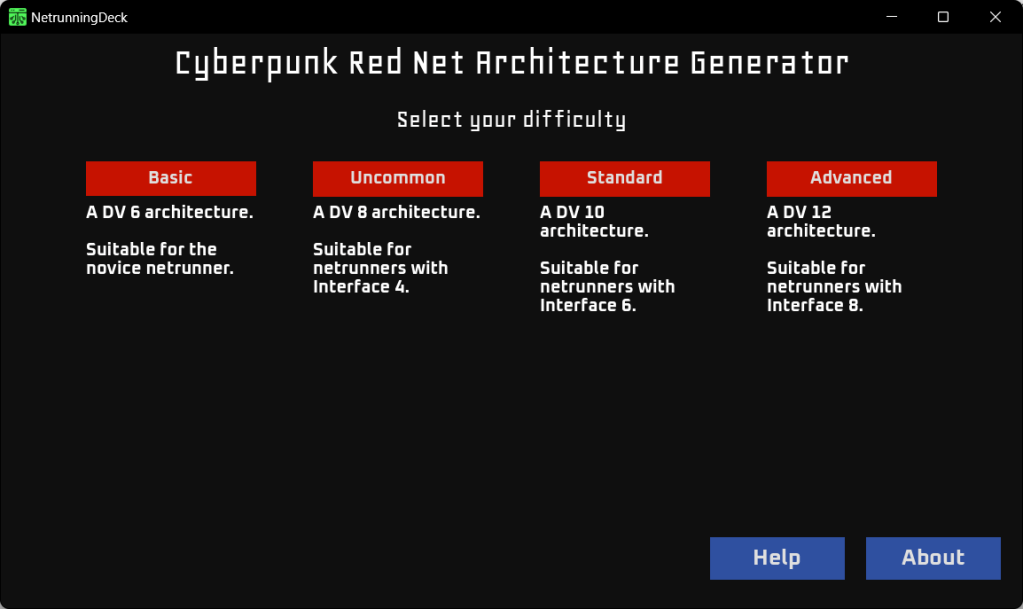
NetArch landinging page

How does it work?

  1. Launch the app (of course).
  2. Select the difficulty. “Interface” is the Netrunner’s Role Ability. An arch that’s too hard for a netrunner could easily fry them, so be careful about tossing them into the deep end.
  3. Click “Generate Floors” (the button won’t appear until you’ve selected a difficulty).
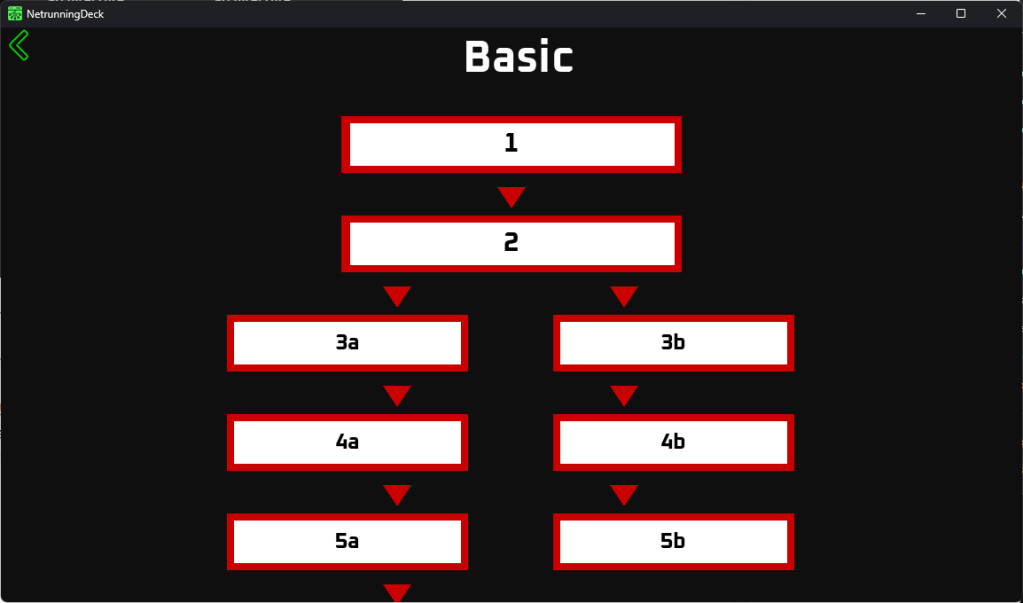
  4. To reveal a floor, click on it. If you want to hide it again due to a mis-click, left-click on it. Scroll down or use the arrow keys to show the rest of the architecture.
  5. Click on the green arrow to go back, if you want to select a different difficulty.
A Basic NetArch with no floors revealed yet

What doesn’t it do?

According to the rules in CPR, an arch can branch multiple times. I made the maximum number of branches one, because I was under a bit of a time crunch. I wanted to test it out in an actual game, and I also had another project I wanted to get back to. I may update it to have more branches in the future, but so far, one branch meets my needs.

Also, due to said time crunch, the entire arch is visible at the start. This is fine if the GM is narrating the arch, but it isn’t ideal if the player can see the app. This is something I intend to update at a future date, although I haven’t found it to be a significant issue in games.

What is it written in?

Godot! For those who don’t know, Godot is a free and open-source game engine. I’ve been toying around with it since the Unity debacle, and I adore it. Though I could have written this in a number of other languages, I’ve been trying to push myself when it comes to using GDScript.

How do I get it?!

If you’re on Windows (or are running WINE), here’s an executable!

If you’d prefer to run it through a browser, I did an HTML5 export. However, be warned, it’s a tiny bit wonky.

I found a bug!

I’m not shocked, since this was something I slapped together during lunch breaks and while waiting for dinner to finish. Drop me a line via my contact page, and I’ll look into it.

Can I contribute?

Sure! I’m not the fastest one to accept merge requests, but I welcome all well-intentioned updates. Just don’t judge my code too harshly. This was a ‘get it done’ project, not a ‘hang in a museum’ project.