Against the Aeon Throne: Book 2 – GM thoughts

Ages ago, I grabbed a good chunk of the Starfinder RPG off of Humble Bundle. As a system, it’s always fascinated me: Magic and sci-fi with a healthy dose of humor mingled with world-shattering threats to keep things interesting. When my Abomination Vaults game ended, I asked my pool of players if anyone might be interested in magic and guns in space.

Here’s where I’d normally say “We just finished book two, so I wanted to share my thoughts on it.” However, I’m running super late, so we’re actually half-way through book three. Time flies when you’re firing blasters and taking out the space trash! If you’re interested in my thoughts on book one, you can read them here.

The (very big) party

The party is still huge. Most games, we blasted past quorum. The crew consists of:

  • A Trox Nanocyte
  • A Vesk Vanguard
  • A Kitsune Witchwarper
  • A Dirindi Operative
  • A Human Mechanic + his artillery drone
  • A Lashunta Technomancer
  • A Lashunta Envoy
  • A Kasatha Mystic

Normally, when I over-recruit, I have a few people who drop for various reasons. This time, nothing major came up, so many games we essentially had a double party running around. Strangely, this had me nudging encounters rather than doubling them due to how Starfinder math works (and knowing that players would feel more comfortable acting less optimally). I think it also made space combat more comfortable, since the party had such full coverage. If they were down to four PCs, they’d have to run around a bit more or make some difficult choices.

Still, I think if I have a huge party next time, I’ll just split it into two games. They can race each other! Winner gets some paper crowns or something.

Thoughts on the AP so far

Holy cow, this AP moves fast. As I said, we’re halfway through book three at this point. While having a smaller party might have slowed things down a bit, I don’t think it would be by that much. After all, I’ve been adjusting numbers, and combats with many PCs will take longer in real time just because it’s a lot of meatbags thinking over their options. Also, part 1 of book 2 is super brief: Basically, a voicemail and meeting up with a travelling salesman.

Thoughts on Book 2

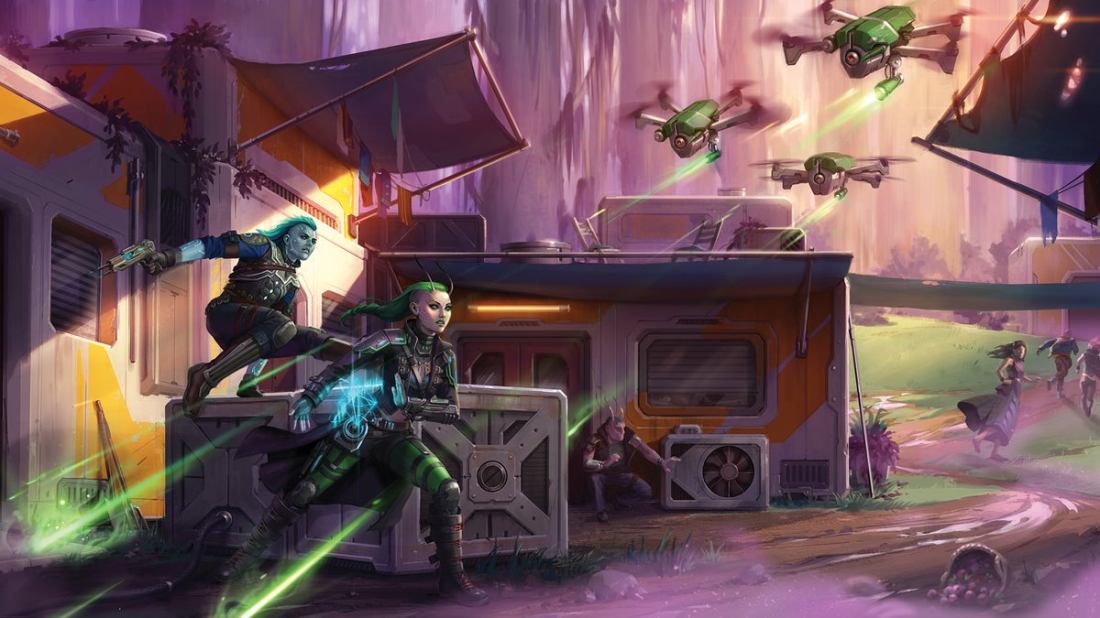
This book has a lot of character. The crew lands on the less-than-legal Outpost Zed and has to charm / threaten / shoot their way into figuring out the way forward. While there’s violence to be had, there’s also a bunch of fun NPCs to interact with, both for gear and for information. This outpost could be a game-ender, though, if your players are murderhobos, since they really do need the help of the locals to move forward with the plot. Heck, if you have a group that only murders, I’d warn you away from this AP, where talking rather than shooting is the only way to connect distant plot points.

The jailbreak can be brutal, which feels fair. I mean, it’s a jailbreak, not a trip to Absalom Mall. Players can sneak in, but chances are good that they’ll be tripped up at some point, which leaves enemies behind them as well as in front of them. My group got tripped up about mid-way through and ended up with combatants on every side, which was a wild ride.

Overall, the first part being sparse isn’t a huge deal, because the rest of the book is absolutely packed with stuff to do. I have a feeling the chapters were split up like they were because it would have been awkward to break up huge set-pieces.

Looking forward (kind of)

As I said a few times now, we’re halfway through book three, so there isn’t much ‘forward’ to consider. I will say that book 3 has way more combat, and really has the players itching to punch some Azlanti. It doesn’t hurt that some of my players are also being run through Ruins of Azlant, where they’re getting increasingly annoyed by these purple-eyed jerkfaces.

A Year of Micro-Reviews: 2025

I read quite a bit. I find it’s good for my mental health, and the best way for me to both kick off and end my day. I did this last year and enjoyed it, so once again, here are some micro-reviews of what I read this year by category.

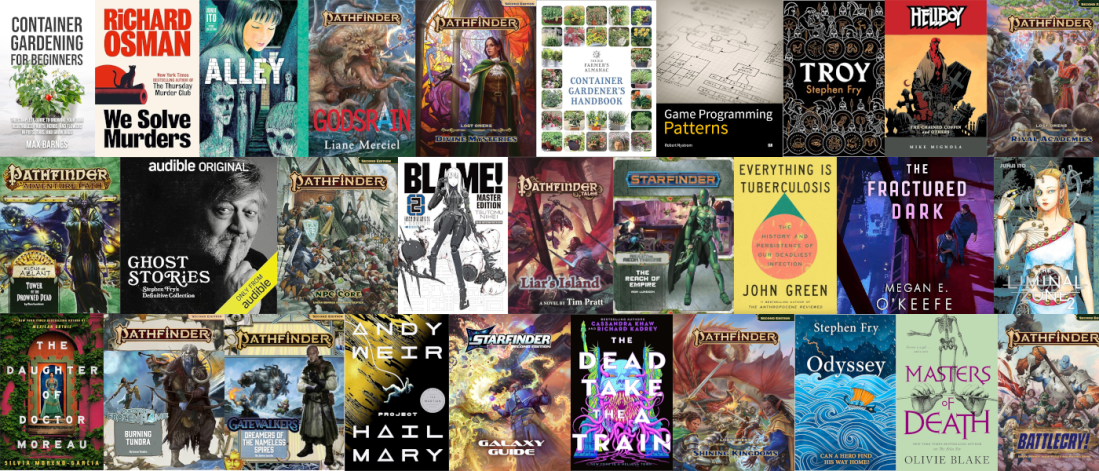
RPG books

Pathfinder 2e Lost Omens Divine Mysteries by Misha Bushyager Et al. A super dense review of not only the gods of Golarion, but how divinity works. Maybe. Our nosoi guide is a bit fuzzy on some points, and gets distracted thinking about which gods have had secret make outs.

Pathfinder 2e Rival Academies by Sharang Biswas Et al. A review of some of Golarion’s schools of magic. The biggest surprise for me was the number of references to previous Adventure Paths. Also, the Convocation could be an awesome arc for so many campaigns.

Ruins of Azlant: Book 5 (Pathfinder 1e Adventure Path). In theory, a mega-dungeon underwater. In practice, my players chewed through almost all of it like paper, and short-circuited the last chapter. Still, a ton of fun!

Pathfinder 2e NPC Core by Raychael Allor. Books like this are such a great GM resource. I used the PF1 NPC Codex all the time to fill random slots without building a whole character on the fly.

Gatewalkers: Book 3 (Pathfinder 2e Adventure Path). I ran this for a stream, and wrote about it here. A (welcomingly) weird end to a weird AP that was a ton of fun to run.

Quest for the Frozen Flame: Book 3 (Pathfinder 2e Adventure Path). A really gratifying end for the AP, which I wrote about here.

Against the Aeon Throne: Book 1 (Starfinder 1e Adventure Path). I wrote about this book here.

Shining Kingdoms (Pathfinder 2e Lost Omens) A tour of the ‘main’ kingdoms in Golarion, with lots of hooks and NPCs for a GM that wants to craft a campaign on their own.

Galaxy Guide (Starfinder 2e) The first Starfinder 2e book! The most interesting thread to track was how the birth of a new elder god is messing up everyone’s Friday.

Interface RED Vol 4 (Cyberpunk Red). I love that R. Talsorian collects all of their free releases into a PDF. I’m also terrified that my players will read this and decide that they absolutely need a Punknaught.

Against the Aeon Throne: Book 2 (Starfinder 1e Adventure Path). This AP moves so freaking fast. I felt like I blinked and a whole book was done. I still need to write about this one, apparently?!

Battlecry! (Pathfinder 2e Rulebook) It’s much, much more than the two classes. There’s lots of campaign options for running a game during a war, which I now kind of want to do.

Starfinder Player Core (Starfinder 2e) It’s here! For anyone wondering if they need to get this if they have PF2’s Player Core, I’d recommend it. While many of the rules are reprints (as they should be), there’s lots that’s unique to the SF2 system.


Fiction

Godsrain by Liane Merciel. Pathfinder books are back! And it had the Iconics in it! I hope they continue this line!

Liar’s Island by Tim Pratt. A Pathfinder Tales book, the second in the Liar series. A conman and his magical sentient blade: The pairing you didn’t know you needed in your life.

We Solve Murders by Richard Osman. Hey, the tall guy I see on British panel shows wrote a book! And it’s good!

Troy by Stephen Fry. Fry’s takes on antiquity are some of my favorites.

The Daughter of Doctor Moreau by Silvia Moreno-Garcia. A retelling of the classic from the perspectives of the daughter and a very grumpy majordomo, set in 19th-century Mexico.

Project Hail Mary by Andy Weir. Proof that hard sci-fi can also be hilarious and accessible. I knew we were in for a different kind of ride when the phrase “butt tube” featured heavily in the first chapter.

The Fractured Dark by Megan E. O’Keefe. Book two of The Devoured Worlds trilogy. You start looking sidelong at mushrooms after reading this.

The Dead Take the A Train by Cassandra Khaw, Richard Kadrey. More brutal than what I usually read, and I could take that. What I couldn’t take was a protagonist that kept choosing the absolute worst option when much better options were, like, right there. And sometimes more convenient.

Odyssey by Stephen Fry. The last of his Greek series, and as always, amazing. Also, was not expecting a rumination on GenAI in the afterword.

Masters of Death by Olivia Blake. Definitely an interesting read that didn’t go where I expected. Sometimes the cast of characters was a bit larger than it felt like it needed to be, but it all got tied together in the end.

Macbeth by William Shakespeare (Folger Library Edition). Seriously, if you’ve never picked up a Folger edition, do it. They’ve been my favorite since I was in braces. They’re cheap, portable, and have definitions and notes on the left-hand page.

The Bound Worlds (Book 3 of The Devoured Worlds) by Megan E. O’Keefe. A super gratifying end to the trilogy, and it really kept me guessing until the end.

Moonflower Murders by Anthony Horowitz. An old school murder mystery that still plays with the usual tropes, and I can’t say more than that because, you know, mystery.

All Systems Red by Martha Wells. A re-read before I finally get around to watching the show.

Lady Macbeth by Ava Reid. If you’re looking for a faithful retelling of Macbeth, but from a different perspective… this isn’t really it. It keeps the structure of the story, but it’s its own thing. Enjoyed it, though the ending felt a bit flat.

Nightglass by Liane Merciel. YOU KNOW A BOOK IS A LOT WHEN YOU THINK THANK GOD THEY’RE IN THE DEVIL WORSHIPING COUNTRY NOW BECAUSE THINGS WILL CALM DOWN NOW. But it really made me want to play someone who escaped from Nidel…

Everyone This Christmas Has a Secret by Benjamin Stevenson. Once again, super twisty, super fun, and Aussie as fuck.

The Portable Beat Reader by Ann Charters. I picked up a copy of this way back in the 90s, and it lived in my backpack all through high school. I lost it at some point in my 20s, and it took me this long to finally find it again. If you can grab a copy, it’s a great collection of beat poets and writers, along with mini bios and some history along the way.


Short story collections

Ghost Stories: Collected by Stephen Fry. A collection of classic horror stories that I probably would have skipped, had they not been expertly narrated by Stephen Fry. Side note: I no longer feel bad about what happened to Ichabod Crane. Disney definitely scrubbed some details from that particular story.

Burning Chrome by William Gibson. Ten short stories that helped shape the rest of the Sprawl series (which I only just learned had an actual name).


Graphic Novels and Manga

Alley by Junji Ito. A collection of fever dreams that leave you vaguely unsettled and swearing off of NyQuil.

Hellboy, Vol. 3: The Chained Coffin and Others. I do love me some Hellboy, and I’ll die mad that the movie franchise died off.

Blame! Vol 2 by Tsutomu Nihei. Things continue to go both poorly and confusingly amid really baller backdrops.

The Liminal Zone 2 by Junji Ito. Things that are no longer okay: Dust, pulleys, childhood mentors, turtles.

Strangers in Paradise Vol 3. Volume 1: Hey, being in your 20’s is complicated, but you can get through it with friends! Volume 2: Okay, maybe you should get your crap together, because this is getting messy. Volume 3: WHY IS EVERYTHING ON FIRE WHY ARE YOU ALL LIKE THIS PLEASE GET THERAPY HOLY SHIT

Blame! Vol 3 by Tsutomu Nihei. Still gorgeous. Still haunting. I still have no idea what’s happening here. I mean, yes, I get the broad strokes, but there’s a lot of me just rolling with it.


Non-fiction

Container Gardening for Beginners by Max Barnes. New potential obsession, unless my deck is too shady.

The Old Farmer’s Almanac Container Gardener’s Handbook by Old Farmer’s Almanac. My hope was growing that maybe I can actually make vegetables happen.

Game Programming Patterns by Robert Nystrom. Legit my favorite book on coding, and the only one I’ll go back and reread now and then.

Everything is Tuberculosis by John Green. A gripping and fast read about the world’s most deadly disease. Seriously, I finished this in record time.

Grow Food Anywhere by Lucy Chamberlain. I swear, I will grow something I can eat in the next year if it kills me.

Kindle Scribe: A Game Changer for Reading TTRPG Books

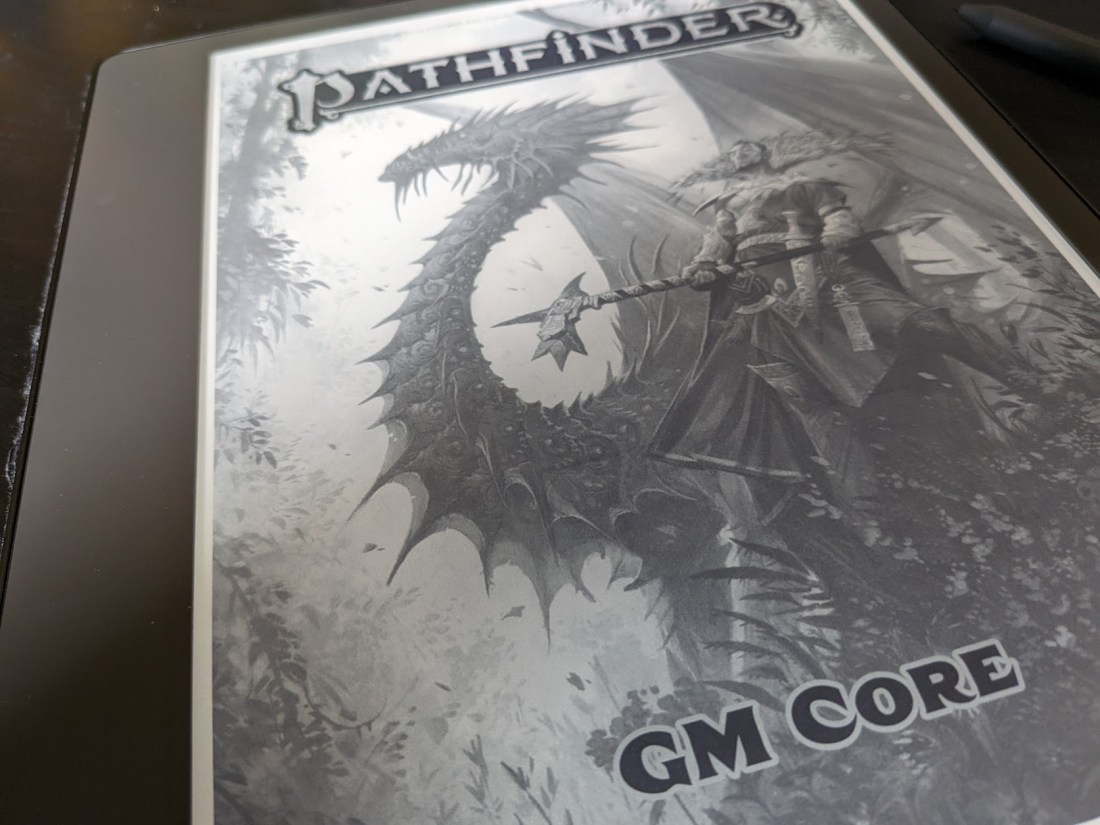
I spent a good part of last year dithering over whether I wanted to buy a Kindle Scribe or not, mostly for reading TTRPG books. I searched for anyone who had used theirs in the same way, but came up empty. Finally, an upcoming trip and a sale tipped the scales, and I bought one. So, in the interest of being the change you want to see in the world, I’m going to write the post I wish I had been able to find.

Why the Scribe?

Why did I hone in on the Scribe versus any other option?

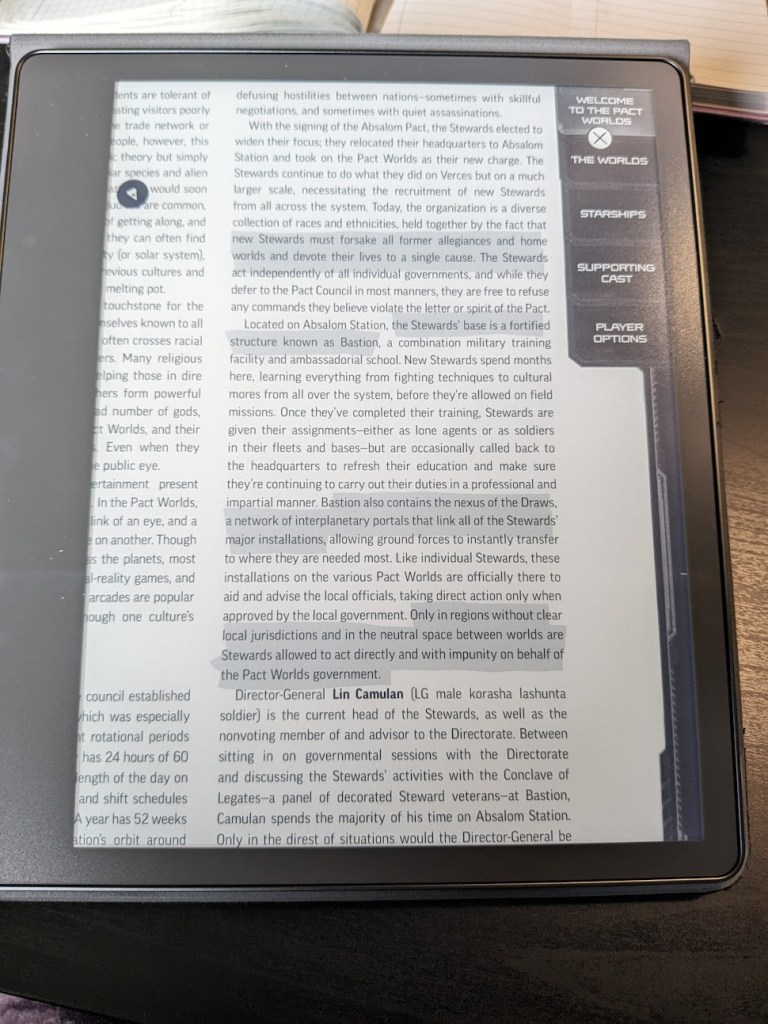
My Kindle with Starfinder Pact Worlds, minimized, loaded, showing highlighting and zoom

Large format. The larger screen works super well for PDFs and image-rich documents. You can technically read PDFs on the smaller Kindles, but it really doesn’t work well for heavily formatted documents.

Highlighting and notes. With RPG books, I have to highlight as I go. Even if I never go back and reference it in that format, it keeps me focused. Otherwise, I tend to space out, thinking about a rule or bit of lore I just read and how I could use it.

Paper-like surface. I read a few books on my iPad, but I found I really didn’t like reading on the glossy, bright surface. I got through the books, but after a few, I decided it wasn’t my bag. I also tried printing out a few PDFs, and while this worked a lot better for me, my tree hugger soul screamed at all of the wasted paper. I ended up binding the books so it wasn’t a complete loss, but I’d really love to not get glue everywhere again.

No distractions. I do read PDFs on my computer regularly, but I’ll be the first to admit that I can get distracted when the whole world is one alt-tab away. This is fine with prepping APs, but for bigger books, I’d prefer to stay focused.

Weight. It’s so light! Like, stupidly light, even with the nice cover! And it’s still small enough to fit in one of my bigger purses with ease. I recently went on a cruise, and I barely noticed it in my bag. My paperbacks weighed more!

Zoom. You know what you can’t do with paper? Zoom in. As my eyes age, this is becoming more and more important for taking in information quickly. It’s easy to waste too many cycles squinting.

Backlight. Light is also important for aging eyes. Sometimes, finding a lamp is inconvenient.

Downsides

As always, it’s not all kittens and sunshine.

PDF size. You have to minimize RPG PDFs if you want them work on the Scribe. Technically, they’re not over the limit as is, but the Scribe will start to choke. You can do this for free on various websites (Adobe, I love PDF, Small PDF), but it’s still annoying to have an extra step.

Sideloading. If you want your PDF on your Scribe, you might have to use an Amazon service. Technically, you can sideload, but I’ve had better luck using the Email to Kindle service. It’s free, but it still makes me slightly nervous, since it’s possible for services to get shut down.

Amazon ecosystem. The elephant in the room: You’re feeding the Amazon beast. For some people, this is a deal breaker, even if you never buy one of their ebooks.

Cost. It’s cheaper than other options, but it’s not cheap, especially if you’re getting it for just one purpose. And you’ll want to get a cover as well for protection and pen storage, and they can get spendy.

Greyscale only. It’s crisp, but it’s still grey. There’s rumors of a color Kindle coming, but friends, I have been reading those rumors for a good decade now. Don’t hold your breath.

Notes. This is a weird one… You can generally takes notes on the Kindle, but if you’re working on a personal PDF, this function is greyed out. So while you can write on the page, you can’t use the sticky notes feature.

Final thoughts

I love my Scribe, and don’t regret it, even if it was an expensive purchase. It revolutionized how many RPG books I could get through, since I was no longer squinting at tiny print or limiting my reading to when I had decent light and a comfortable reading position. I’m on my sixth RPG book of 2024, which is more than I’d read several years COMBINED. Also, I can highlight, which I’m loathe to do with a $60 physical book.

FYI: You know that warning people put on their blogs about affiliate links and possible kickbacks? I’m not a part of that program because I’m not cool enough.