
A while ago, I posted about running Quest for the Frozen Flame, a Pathfinder 2e Adventure path. This past month, we finished book 2! In the interest of making the blog posts I wish existed, I wanted to do a rundown of the book from the GM perspective.
Warning! Past this point, there be unfettered spoilers for the Frozen Flame AP, including some for book 3. If you’re a player who hasn’t finished the AP yet, close this tab!
Book 2 Summary
Overall summary from Paizo:
In the brutal tundra of the Realm of the Mammoth Lords, only the hardiest folk have what it takes to withstand unsparing weather, track down big game, and fight back hostile followings. The Broken Tusk following has survived another winter, but a new year just began, and signs of danger foretell a year unlike any before.
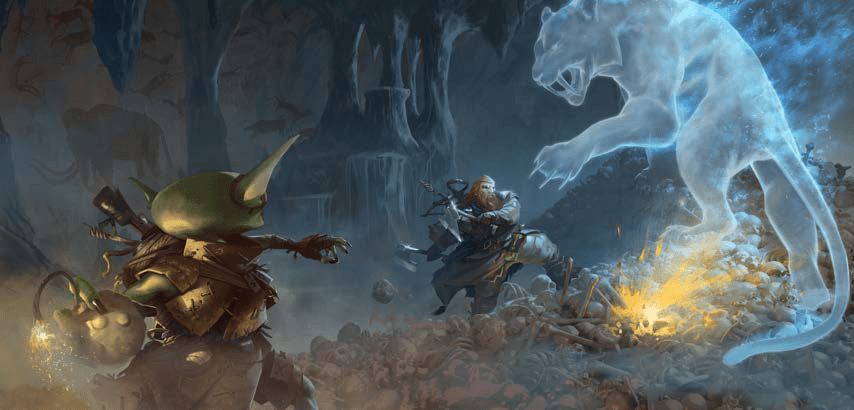
This book opens with the tribe navigating a set of caves. The path behind them is blocked after the closing events of book one, so the only way forward is through them. The group is tasked with clearing a path to the exit for the tribe, which contains many vulnerable members who can’t fight or navigate traps.
No Paizo AP is complete without a dungeon, and I’m pleased to report that these caves were quite a bit of fun to navigate. They had a mix of fights, terrain, traps, and even social interactions that made them feel more alive than Diablo-style ‘kill all the things to proceed.’
The group eventually gets the tribe through, finding themselves in a valley that’s been ‘lost’ to Golarion for some time, and is being ruled over by a white dragon who wields the Primordial Flame. If you like hexploration, you will love this chapter. The goal here is to build your tribe’s number along with your reputation so that you have the manpower you’ll need to take back your tribe’s stolen artifact.
Finally, the players come to the glacial palace that houses the mad white dragon. A town at the foot of the palace, though, holds people badly in need of liberation. Depending on how much word has spread of your deeds, they may or may not help you with the final assault.
How’d it go?
The players seemed to enjoy this book quite a bit. They really got into the idea that they had to recruit new tribe members as well as spread their reputation throughout the land. Also, being a team of completionists, they were more than happy to clear a pretty sizable hex map. They also seemed to appreciate the mix of social and combat encounters, since we absolutely have some PCs who are more geared towards being faces than fighters.
Speed run update!
With this AP, I wanted to try an experiment with leveling. Rather than leveling up with XP or by milestones, when starting a new book, the players were asked to level for the max level for that book. So, for this book, they were level 7 throughout.
As predicted, this made the first half of the book fly by, with the end of the book feeling like it was an appropriate challenge. What was interesting here was that the book didn’t seem to take less time (at least, by the numbers), but I think the trade-off for this book was different. Rather than moving faster, the players were extremely thorough, tackling every last hook they ran into. If we were running this at a ‘standard’ speed, I could see it taking way longer than a normal Paizo book. That, or players would be more picky about what they explore. In theory, there is a time limit for them to escape the valley, but this didn’t come into play with them being higher level. Had they been a more appropriate level, I think they would have felt the crunch.
I still think this method works well for this particular AP, if you’re limited on time but don’t want to pull encounters.
My thoughts
I absolutely loved the hexploration for this book. If you’re planning some hexploration in your game, pick up this book and check out how they did it. Lots of the hexes connect to each other, plot-wise, and there’s a great mix of encounters, from curiosities to social to combats. The fact that there was a solid reason to explore was the cherry on top of the sundae.
Now, don’t get me wrong: The caves and the liberation of Lubya were awesome too, but the hexploration was really where the players got to lean into being Big Damn Heroes and forging their way. It’ll be the thing I probably think about when I think back on this book in the future.
My recommendations
Spreadsheet. Holy crap, you need something to track the reputation and following. Encounters will sometimes give rep, followers, or both, and it’s painful to go back and figure out how much the players have gained over the last few sessions. Make a spreadsheet and update it diligently.
Calendar. I didn’t need this, but if you’re running this at a normal pace, you need to keep track of days! I’d recommend adding it to the hex map, since that’s where most days will advance.
Show their progress. On the splash screen, I gave players an abstracted way of tracking their reputation. Fair warning, though: The needle won’t move much until they’re past the midway point of the hex map. I reminded them that they simply hadn’t encountered enough people to get the rumor mill started.

Don’t rush! The players will know what direction their goal is in pretty early on, and will pinpoint the exact hex not long after. Encourage them to take their time and build up their reputation and following! That’s where all of the story is, and if they show up known with a small following, it could be painful.
Next book!
Not going to lie: I’ll miss the hexploration. There’s some, but it’s not nearly as robust as what Lost Mammoth Valley has. I still think the book will be fun, though, with lots of chances for the group to act like Big Damn Heroes of their now huge tribe.
Hillcross looks like it’ll need some careful management, but it’s been a while since I read the book. Time to go refresh myself, I guess.
The thing I’m most excited about? One last encounter with Pakano. Seriously, I’ve run a lot of Pathfinder, and I’ve never had players hate someone so thoroughly.
 Katie Plays Games