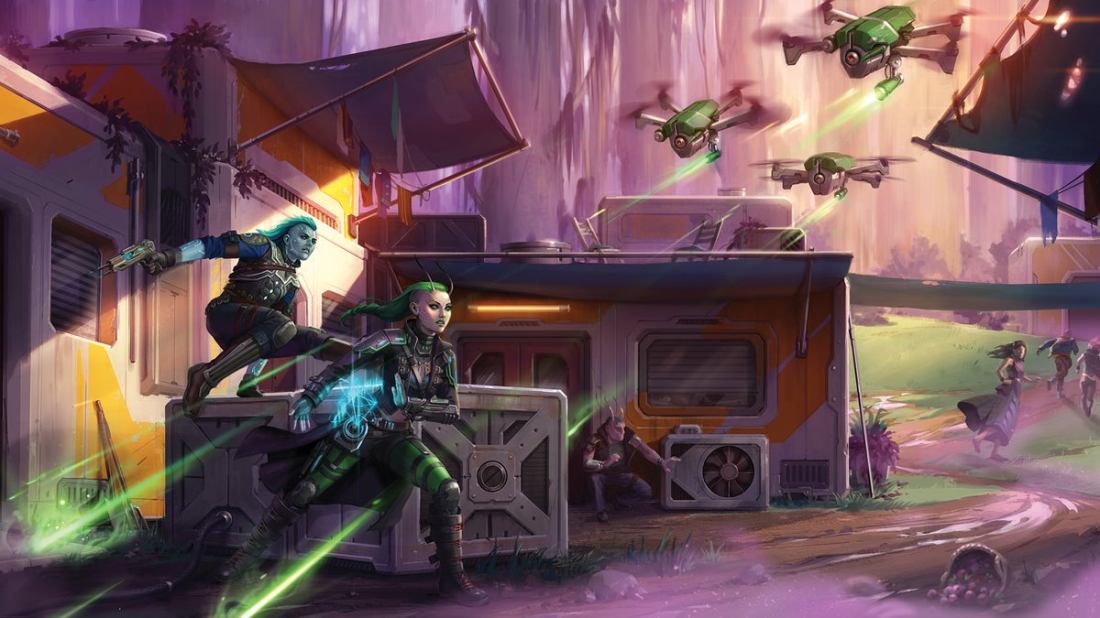
Against the Aeon Throne: Book 1 – GM thoughts

Ages ago, I grabbed a good chunk of the Starfinder RPG off of Humble Bundle. As a system, it’s always fascinated me: Magic and sci-fi with a healthy sense of humor mingled with world-shattering threats to keep things interesting. When my Abomination Vaults game ended, I asked my pool of players if anyone might be interested in magic and guns in space.

I got an enthusiastic response. The players were all experienced with RPGs, with everyone having experience with Pathfinder (some 1e, some 2e, some both). Only one player had ever played Starfinder, though, so we were still readying ourselves for a learning curve.

The party:

  • Trox Nanocyte
  • Vesk Vanguard
  • Kitsune Witchwarper
  • Dirindi Operative
  • Human Mechanic + his artillery drone
  • Lashunta Technomancer
  • Lashunta Envoy
  • Kasatha Mystic

Yes, it’s a large party, but we operate on a quorum system. If four players can make it, we play, and assume the other PCs are off doing something else. So far, though, games have hit at least 80% attendance, so we’ve still had a large party on average!

Thoughts on moving to Starfinder 1e

First off, I’ll say that everyone in the game has loved Starfinder, and I’m kicking myself for not starting a game sooner. This fun world has been sitting on my shelf for years!

There have been a few hiccups that, while not insurmountable, would be worth considering for any other group looking to try SF1e out.

  • Experience is a double-edged sword. The group is made up of highly experienced players, but sometimes this tripped us up. SF1e rules are similar to PF1 and PF2, but they’re not the same. The first few sessions had us mixing in rules from the Pathfinder systems at random until we got serious about looking everything up.
  • Starship combat threw us for a loop. I’m sure an experienced group could have tackled the few starship combats in Book One in under an hour. We took an embarrassingly long time. For book 1, I wanted to use the standard rules, but moving forward, I may move to the cinematic system from Starfinder Enhanced.
  • Some habits needed to change. Loot is less valuable in SF1e. If you’re not going to use it, you should probably leave it. Also, one cannot get by just swinging a vibroblade. You need a gun in space.
  • Encounter balance is… different? Because our group was large, I thought I’d rebalance the encounters so that everyone would get a turn. Except, when I ran the numbers through a calculator, it turned out I didn’t need to adjust anything. I still need to look into how the system is balanced, but in practice, the encounters were perfectly fine without adjustment.

Thoughts on Book 1

Spoilers ahoy after this point! 

Dear lord, this book moves fast. Looking at our recordings, it took us 19 hours to finish book 1. Had we been more experienced, I’m sure that would have been closer to 15. A book of an AP usually takes us closer to 24 hours. Some might say that having a larger group made it move faster, but I’m not sure about that, since it also slowed us down (more abilities to look up, more pauses to ask about a mechanic, etc).

Also, this AP has a much slower leveling curve than others, which has been a boon for a new group. You only hit three at the end of book 1, while other first books have you ending at 4. I have to say, I was impressed with how much the crew could do at super low levels, so I’d say this is system where you probably don’t want to skip the early levels with newish players.

That said, I do feel like Against the Aeon Throne is a good candidate for a speed-run. You’re gated between books, so players can’t sequence-break the encounters. The low levels mean the players wouldn’t be getting too much of a power boost, but they could churn through some encounters faster, and have slightly better odds of accessing some lore and paths that are locked behind skill checks. It could turn the AP into something closer to an adventure if your group isn’t looking to invest in a long-term campaign.

I’ll probably be back here soon with thoughts on book two, because we’re darn close to finishing part two. Like I said, it moves FAST.

Embarking on a new Starfinder RPG Adventure: Against the Aeon Throne

After eyeballing the Starfinder RPG for a good many years, I’ve decided to pull together a game! The stars (HA!) are aligning on several fronts. One monthly game is ending. I’ve managed to collect most of the books through Humble Bundle. I’ve been slowly tackling reading them. Also, with Starfinder 2e coming out, we want play something in space, but the official system won’t be out until 2025. And even when it comes out, it’ll be a while before the core books are all released. So Starfinder 1e it is!

Note: This post is spoiler free, so my players can feel free to read it. This won't hold true for anything else in the series.

Choosing an AP

Starfinder has so many good options when it comes to Adventure Paths. All of the themes sound amazing, from the incredibly creepy to freaking Pacific Rim. I couldn’t find one that my players wouldn’t want to play in. I decided that, if all options were great, I should probably optimize for saving on money and effort. Only one AP fit the bill: Against the Aeon Throne. I already own the PDFs, and the AP is offered as a module by Roll20. It’s also low-level, which works for a group still getting a handle on the rules.

Also, reading over the reviews from more experienced players, it looks like it’ll be a good introduction to the Starfinder universe. None of my players have played much Starfinder, and I’m fairly certain none of them have cracked the book past being able to make their character. (Love y’all, but you know it’s true). This will allow me to drip feed lore to them rather than hitting them with a firehose.

Prep so far

I’ve read through book one using my usual laborious highlighting method. I’ve also read through a few other Starfinder books, including the CRB. It helps that the Starfinder books are written in an accessible and fun voice, so they read a lot faster than some drier RPG books might.

I’ve also gone through Roll20’s module for the first book. Tip to others: Even if your VTT has a module for your AP, make sure to go over the lighting and creatures. For me, this module was created before a few new features were deployed, so I had to add them in. Also, modules tend to only include maps from the AP, so I needed to go dredge up a few more.

Finally, I’ve been listening to Androids & Aliens from The Glass Cannon Network to get a feel for how combat flows. I know to take any Actual Play with a grain of salt (including a group that is learning the system as they go), but so far, it seems to be a decent representation of how the game works. Also, it’s a fun group and a super creepy AP (they’re running Dead Suns, which was on the short list).

Recruiting

If there’s any place where I’m going to get screamed at, it’s here, but hear me out.

Most of my monthly games are run on a shared Discord server, where we’ve taken to gathering so we can optimize boosts. There’s around two dozen of us on there, playing a wide range of games and systems. When I knew I’d be starting a new game, I put out the call… and ended up with a VERY full roster. Right now, I have eight interested players, which is high even for my ‘over-recruit and sort it out later‘ self. I know, I know, I should be grateful that this is the problem I have, but still, I know it’ll pose some interesting complications when it comes to things like ship combat and modifying encounters.

My theory is that once the game starts, some people will have to drop, some will show up for some sessions, and I’ll have a core who will be at every game. Until we hit homeostasis, I guess I’ll have a more chaotic crew than normal. At least there’s a ship where I can stow them?

Concerns

My biggest concern, of course, is that we’re kicking off a new system. Even with a group of experienced players, this can cause growing pains. Heck, I’d say there’s a few more issues when it’s a seasoned group. Rules are confused with other systems, and there’s the temptation to say “I know how X works, I’ve been doing this for decades!” I’ll probably set a table rule that, until we have a handle on the rules, we really do need to look up EVERYTHING as we go. It will slow down play, but I’ve found the rules you look up at the table stick better than the ones you say you’ll look up later (and never do).

Space combat also has me concerned. I haven’t quite got my head wrapped around it, and the APs don’t let you avoid it. For now, we’re using the base rules rather than the ruleset in Starfinder Enhanced, but that might change at some point.

It’s also a game with quite a few players in a system I’m not 100% confident in, so I’ll have to get used to adjusting combats. Here’s to hoping their CR system works as it should! I’ve become spoiled by the numbers ‘just working’ in Pathfinder 2e, but I have enough experience with tweaking Pathfinder 1e combats to carry me through. Hopefully.

Thoughts?

If any more experienced Starfinder players have thoughts or suggestions, I’m all ears, since we’re still collecting resources and learning.

Kindle Scribe: A Game Changer for Reading TTRPG Books

I spent a good part of last year dithering over whether I wanted to buy a Kindle Scribe or not, mostly for reading TTRPG books. I searched for anyone who had used theirs in the same way, but came up empty. Finally, an upcoming trip and a sale tipped the scales, and I bought one. So, in the interest of being the change you want to see in the world, I’m going to write the post I wish I had been able to find.

Why the Scribe?

Why did I hone in on the Scribe versus any other option?

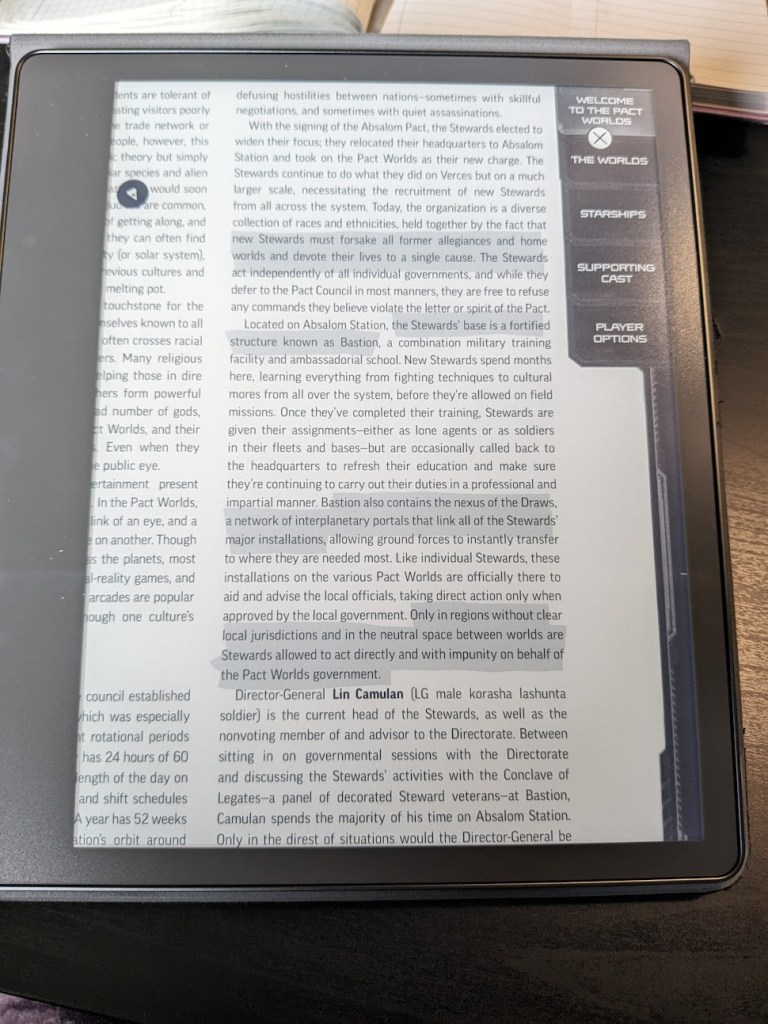
My Kindle with Starfinder Pact Worlds, minimized, loaded, showing highlighting and zoom

Large format. The larger screen works super well for PDFs and image-rich documents. You can technically read PDFs on the smaller Kindles, but it really doesn’t work well for heavily formatted documents.

Highlighting and notes. With RPG books, I have to highlight as I go. Even if I never go back and reference it in that format, it keeps me focused. Otherwise, I tend to space out, thinking about a rule or bit of lore I just read and how I could use it.

Paper-like surface. I read a few books on my iPad, but I found I really didn’t like reading on the glossy, bright surface. I got through the books, but after a few, I decided it wasn’t my bag. I also tried printing out a few PDFs, and while this worked a lot better for me, my tree hugger soul screamed at all of the wasted paper. I ended up binding the books so it wasn’t a complete loss, but I’d really love to not get glue everywhere again.

No distractions. I do read PDFs on my computer regularly, but I’ll be the first to admit that I can get distracted when the whole world is one alt-tab away. This is fine with prepping APs, but for bigger books, I’d prefer to stay focused.

Weight. It’s so light! Like, stupidly light, even with the nice cover! And it’s still small enough to fit in one of my bigger purses with ease. I recently went on a cruise, and I barely noticed it in my bag. My paperbacks weighed more!

Zoom. You know what you can’t do with paper? Zoom in. As my eyes age, this is becoming more and more important for taking in information quickly. It’s easy to waste too many cycles squinting.

Backlight. Light is also important for aging eyes. Sometimes, finding a lamp is inconvenient.

Downsides

As always, it’s not all kittens and sunshine.

PDF size. You have to minimize RPG PDFs if you want them work on the Scribe. Technically, they’re not over the limit as is, but the Scribe will start to choke. You can do this for free on various websites (Adobe, I love PDF, Small PDF), but it’s still annoying to have an extra step.

Sideloading. If you want your PDF on your Scribe, you might have to use an Amazon service. Technically, you can sideload, but I’ve had better luck using the Email to Kindle service. It’s free, but it still makes me slightly nervous, since it’s possible for services to get shut down.

Amazon ecosystem. The elephant in the room: You’re feeding the Amazon beast. For some people, this is a deal breaker, even if you never buy one of their ebooks.

Cost. It’s cheaper than other options, but it’s not cheap, especially if you’re getting it for just one purpose. And you’ll want to get a cover as well for protection and pen storage, and they can get spendy.

Greyscale only. It’s crisp, but it’s still grey. There’s rumors of a color Kindle coming, but friends, I have been reading those rumors for a good decade now. Don’t hold your breath.

Notes. This is a weird one… You can generally takes notes on the Kindle, but if you’re working on a personal PDF, this function is greyed out. So while you can write on the page, you can’t use the sticky notes feature.

Final thoughts

I love my Scribe, and don’t regret it, even if it was an expensive purchase. It revolutionized how many RPG books I could get through, since I was no longer squinting at tiny print or limiting my reading to when I had decent light and a comfortable reading position. I’m on my sixth RPG book of 2024, which is more than I’d read several years COMBINED. Also, I can highlight, which I’m loathe to do with a $60 physical book.

FYI: You know that warning people put on their blogs about affiliate links and possible kickbacks? I’m not a part of that program because I’m not cool enough.

Starfinder: Why get into 1e NOW?

Next month, Starfinder Enhanced drops, which looks like it will be the last book for Starfinder 1e. Starfinder 2e is on the horizon, with the playtest dropping in August 2024. I just started getting into Starfinder, which has led to some people asking me if I will hold off until 2e drops. Isn’t it a waste of time to get into a system that’s ending?

Nope! Because, in my opinion, this is the BEST time to get into a new system. I even have some experience in this, as one of the people still playing Pathfinder 1e when 2e came out. I found advantages to staying in both ecosystems.

History

I’m a long-time Pathfinder 1e player. I jumped on the Paizo bandwagon when D&D 4e happened (they were still 3.5), and when they released a completely new system, my group immediately adopted it. While I’ve played in other systems, most of my regular games have been PF1e.

When 2e came out, I was invited to co-run a West Marches game, with the only restriction being that it had to be in Pathfinder 2e. This led to me playing both systems simultaneously, which is something that, four years later, I still do. My home game is mostly 1e, and the other games that have popped up are mostly 2e.

Benefits of playing a ‘complete’ system

When 2e came out, I had some people wonder if they should even bother with 1e. I encouraged them to give it at least a look, especially given that all of the rules are online. Here are some of the reasons I gave them:

It’s a content wonderland. A system that’s complete has an incredible amount of content: Classes, feats, spells, items, lore, and even adventures! Third parties have added to the pile for years, giving you incredible depths to plumb. For any idea you have, there’ll be enough material to bring it to life.

Time also has the benefit of answering all the questions. Find a rule that seems vaguely worded? Chances are good that someone had the same question five years ago, posted about it, and the matter was settled, sometimes by a Paizo dev. While playing PF1, it was rare for us to find an issue that hadn’t been settled several times, sometimes even in an errata.

And those questions? They’re asked and answered by a stable community. Even if you’re not someone who dips your toes into the social side of your hobby, there are benefits to a system with a robust group of people supporting it. They answer questions and create content for the games, like redrawn maps, character art, web-based tools, and many shared spreadsheets. And hey, if you want to be social, there will always be people looking for games, so you have a ready population of people who are already down to roll.

There are also stable tools for older systems. The roughest time with a new tool is when changes are fast and furious in the first few months. With a complete system, most bugs have been ironed out, and no new content is coming down the pike to throw the codebase into disarray.

Finally, this one is timely, but the Humble Bundles that come out will be so good during the transition. If you want to grab the books (and it’s not like books go bad), the next year or so will be the best time to grab them. There were at least two PF1 bundles during the 2e transition, and it was a wild amount of content for under $50. I know Starfinder has already had one bundle, and I expect there to be more.

Benefits of playing an ’emerging’ system

There are a lot of upsides to playing a complete system, but what about a new one? Should you bother jumping on the bandwagon early or wait? I don’t regret playing PF2 from the second the Core Rulebook dropped, and I’ll probably play SF2e as it comes out as well.

The most obvious benefit? It’s new! New things are exciting, and getting caught up in the hype train is fun. There’ll be tons of streams and videos combing over every arcane detail, and it’s fun to chill with your friends and go over the freshly-dropped PDFs. Excitement, for it’s own sake, can be a good thing!

Also, excitement means a new crop of players coming in. There’s nothing like a fresh start to a system to pull in a player who was getting bored with their current TTRPG. I’m always looking for new people to game with, and it’s fun to get people who aren’t in my current bubbles.

It’s also less to take in all at once. I’ve been in a game where I was dumped into a huge system, and I spent most of it floundering unless I had someone experienced to hold my hand. It takes time for me to get my head around how a system works, and I know I’m not alone in that. Only one book means you can dive in deeply without the ever-present worry of the OTHER twenty books you need to look through.

Also, because releases are staggered, you have time to get used to all the options! Those of us who were there at the start of Pathfinder 2e had six months between the first two books (the Core Rulebook and the first Bestiary) and the Advanced Player’s Guide. That is a LOT of time to get familiar with the base rules, understand how feats interact, and figure out which spells work best with which styles. This gave us a solid knowledge base to work off of with later releases.

But wait!

Won’t I get confused?! Look, I won’t lie: Getting rules mixed up happens. It happens less often than you’d think, though. I run both PF1 and PF2 every month with players in both games, and we might see someone get tripped up once every other session. Even then, it’s easy to shrug off, fix whatever plan they had, and move on with the game.

How do I choose?! I mean, I just kept playing both, but I get that not everyone has free time or a large pool of people to pull from. If I had any suggestion, it would be to look at the APs that interest you and play that system since conversion can be a lot of work. If you’re not playing an Adventure Path and not leaning one way or another, I’d veer toward the older system. A system that’s been around for a while has so much history. That history saved my first AP-based campaign! It’s also helped answer off-the-cuff questions during a session in seconds because someone else posted about that exact thing five years ago.

Whichever way you go, though, you’re sure to have a good time, and I can’t wait to see more people diving into Starfinder 1e and 2e, myself included.

Falling in love with Starfinder

Yeah, yeah, I know. I’m a few years late to this. Starfinder has been out for a hot minute (and may even be due for a version 2 in the next few years). It’s one of those systems that’s always flittered around the periphery of my awareness. I vaguely knew it as “Pathfinder in Spaaaaaaace,” but never looked any deeper.

I did grab a Humble Bundle or two, because I have a problem, but it was more because it was too good a deal to pass up, and I love Paizo. Recently, though, those PDFs have gone from collecting digital dust to being actively perused, as I consider diving in.

Why now?

A little bit of timing, and a little bit of needing something to spice up my RPG life.

My home game runs Pathfinder 1e. Specifically, we run Adventure Paths because we’re all busy professionals with schedules that can get wild at random times, so having a published adventure gives us something to fall back on. We swap around being GMs, with each of us claiming a different AP well in advance. While I love APs… I’ve come to the end of APs I want to run.

I’ve also played a lot of fantasy in the past two decades, and a moderate amount of modern. I’ve barely touched sci-fi, though, and I feel like it’s time.

Why Starfinder? Why not [insert system here]?

People have been trying to get me to play Star Wars for years, and I always have to turn them down. I know I’ll get flack for this, but I just don’t like Star Wars. The movies are good, I enjoyed reading the Thrawn Triology, but that’s about as much as I want to engage with the universe.

I’d love to play Cyberpunk, but I really really want to play in Spaaaaaaaaaace, not on dystopian Earth. I won’t turn down a campaign (one is even on the horizon), but it’s not what I want to run.

With Starfinder, I’m already somewhat familiar with the system (especially since it’s a blend of Pathfinder 1e and 2e rules) and the world (at least, what’s left of it), but it’s different enough to be interesting. Like, they removed a whole planet and a swath of time! There’s cool new species to play around with! SPACE COMBAT!

Also, it has Adventure Paths. Again, during my hectic times, I really need a plot structure to fall back on so I don’t end up burnt out. They also help get me and players on the same page, since it’s well-known what themes each AP covers. No one’s going to show up to the Firefly-like game expecting Starship Troopers.

How deep am I?

I read through the Beginner Box and ran it over on D20Saves.

Uploaded on my back-up channel

I highly recommend starting with reading the Beginner Box, because it gave me a great base for diving into the core books. True, it’s a streamlined version of the rules, but the overview helped me get situated quickly.

Now, I’m making my way through the CRB, which is shockingly readable for a rulebook. It has a great blend of humor and getting to the point which is making it a joy rather than a chore.

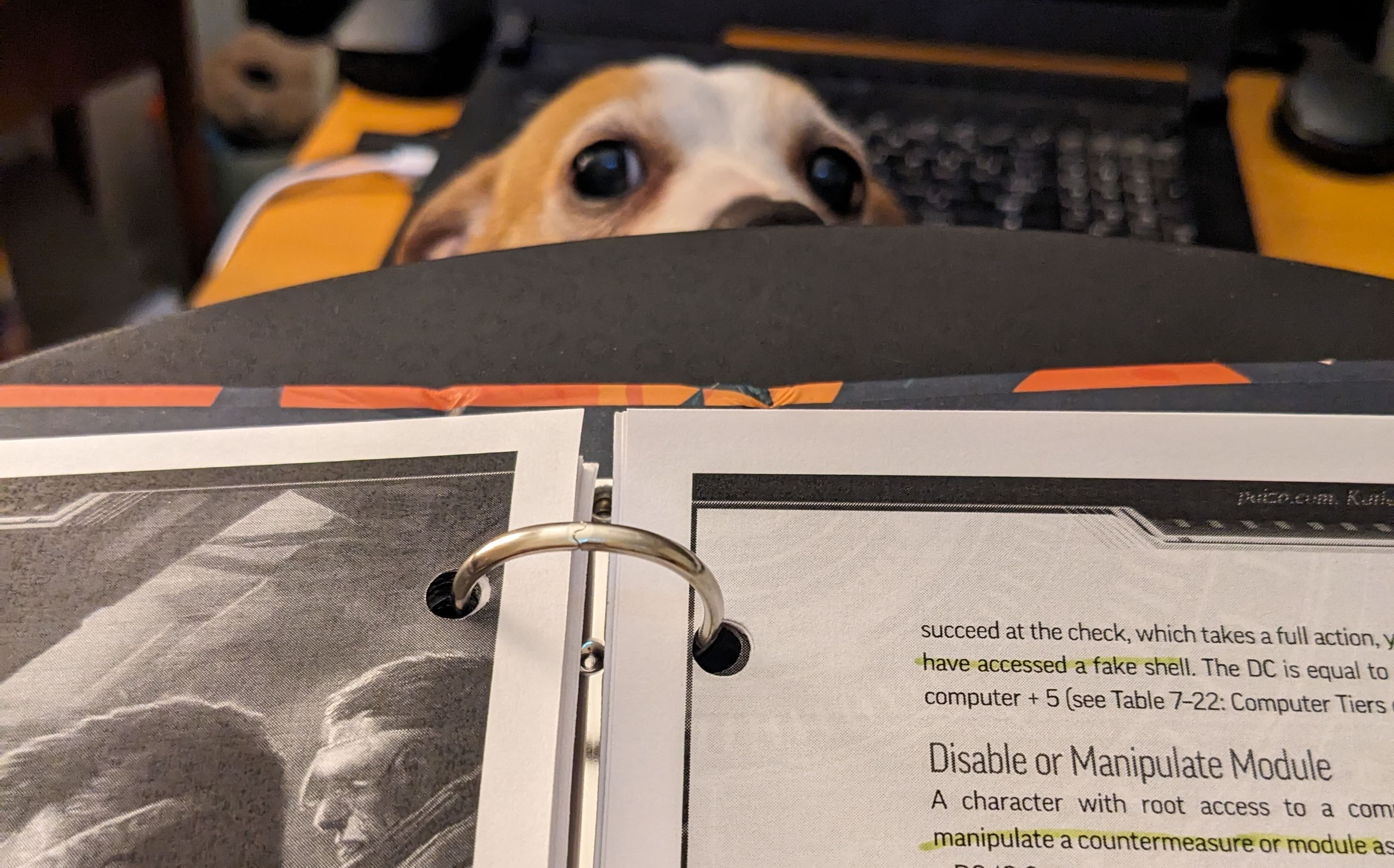
A dog peering over an open copy of the Core Rulebook.
Chloe was less than thrilled with losing access to my lap every morning.

Reading a rulebook from front to back is unusual for me. Normally, I read what I absolutely have to in order to create a character, and then look up things over time. Eventually, the whole book gets read, but it takes some time.

So, what next?

My home game group has agreed to run through Into the Unknown, which looks like a great intro for experienced players. After that, I still have to finish my PF1 AP (we’re on Book 4 of Ruins of Azlant), but after that, I have a decision to make:

  • Against the Aeon Throne has the benefit of already being in Roll20, so this cuts my prep time in half.
  • Fly Free or Die sounds like something my players would love, since we usually end up being a bunch of morally gray weirdos on our own.
  • I already own Dawn of Flame, so I might as well use it…

Honestly, all of the APs sound fun, so it’s likely going to be a tough choice. It’s one I’m looking forward to!