Council of Thieves: Book 2

The background

After getting back in the GM saddle with Book 1 (pw: council if it’s still protected), I decided to immediately get into book two.

From Paizo:

To banish the monstrous shadows that stalk Westcrown by night, the PCs go undercover, joining the city’s chaotic theatrical community in an elaborate plot to infiltrate the estate of the decadent lord-mayor. Yet theater life turns deadly when they become players in a spectacle no actor has ever survived. Can the PCs endure their debut performance in a city where an actor’s first big hit is often his last?

What I changed

Before the book

Since the PCs were taking an interest in the rebels, I decided to go with the implied suggestion that they should train up the lower level characters. I stuck with what I felt they could reasonably train, so we didn’t end up with a monk, druid, or barbarian. Before the first session, I sent out a list of what everyone had trained as.

My plan is to keep the rebels three levels behind the PCs with the assumption that they’re going out on their own missions. I’ll probably stop them all at some point, since there’s only so much experience you can get running around the city.

I also leveled up Janiven and Areal a bit, with both of them staying a level ahead of the PCs. At level five, however, I’ll probably only continue leveling Janiven (since that’s who they always bring along).

The rehearsals

Because one of my players was part of a theater troop, I ended up moving the rehearsals there. In story, this was because his sister (a bard), disapproved of his auditioning for a murder play and wanted to keep an eye on the production.

I decided to change the benefits for befriending cast members. I felt like the long-term benefits wouldn’t be clear to the players, so I switched some of them to short-term benefits. For befriending one of the actors (and consistently interacting with them), they got a re-roll on a performance check (basically, stealing the Advantage system from 5th Edition) or a bonus on their next perform check.

I also extended the hours that the actors were available by removing curfew for them. In game, the actors were allowed to retire to a bar to relax and socialize, and the mayor made sure they were escorted home afterwards.

As a bit of flavor, I had Yakopulio run a betting pool on who would survive the play. The players ended up betting on themselves, earning them a tidy sum after they all survived.

The play

For the play, I upped the reward amount since it seemed a bit low for such key roles (and because they had been creative about drumming up business for the play). I also played fight music from Oblivion for each scene (when I remembered), which helped set the mood.

Pre-Cornucopia

I ended up modifying the Cornucopia the most. One of the reasons I did this was because one of the PCs scolded Janiven (their fourth actor) for spending too much time dealing with rebel business and not focusing on the play. I had been keeping Janiven in the background in order to keep the spotlight on the PCs, with the excuse being that she was coordinating information gathering on the Mayor’s mansion and the Knot.

So, I had Janiven ‘hand off’ the duties to Yakopulio, meaning that the players now expected something concrete. After the play, Yakopulio came up with a few things:

  1. She could get one person on the inside as staff. Guards positions were already filled, but she could get a servant, groundskeeper, or stablehand in. She also nixed several people right off the bat: Tarvi (since she mingles with nobles, she’d be recognized), Areal (he’s known as a cleric and would stand out as a servant), Sclavo (since he works in court), and herself (since she’s setting up the deal).
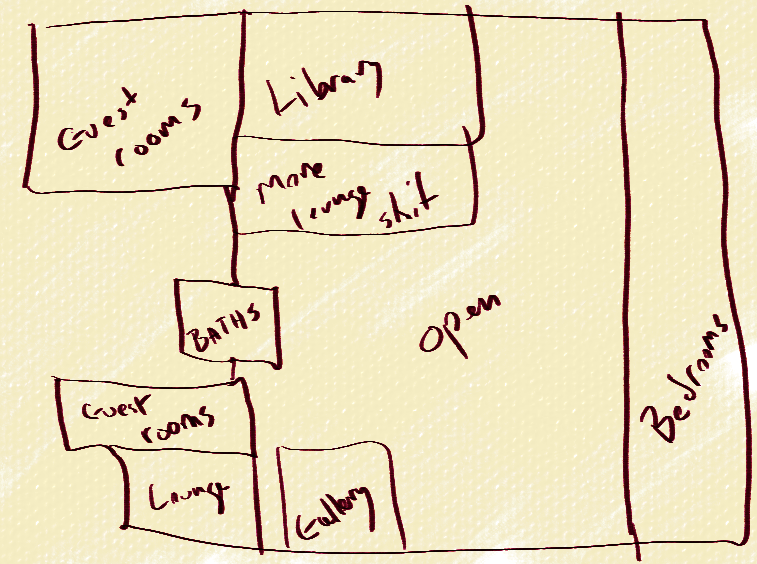
  2. She gave them a very rough map of the interior of the mayor’s mansion (below). Because she was getting this information verbally, the map is extremely rough. The attic wasn’t included because her informant (a former servant) wouldn’t have been allowed up there.
  3. She got a list of prominent nobles and dug up some information on each. Tarvi and Sclavo added their own thoughts on them.
  4. She got them a list of courses (which was kind of pointless, but I felt added some flavor).

Yakopulio’s beautiful maps:
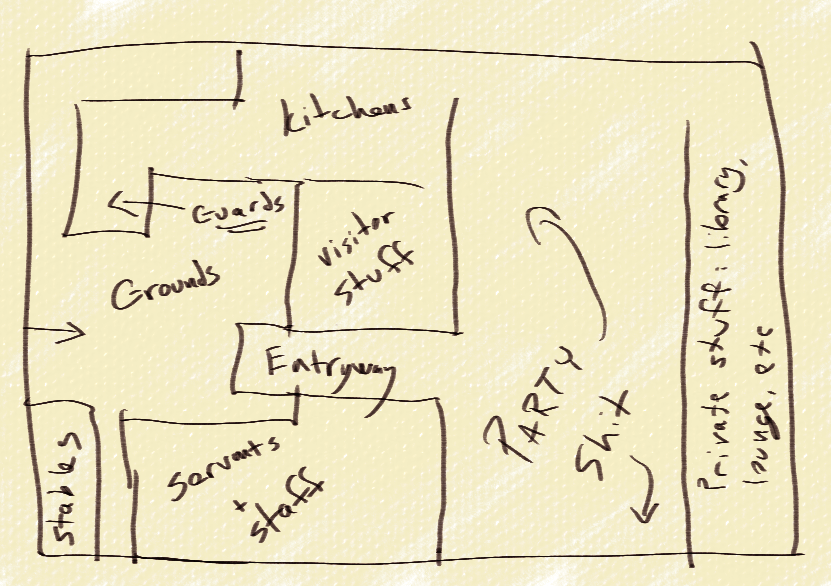
firstfloorsecond floor

The players ended up picking Fiosa as their insider (her background as a servant made her more invisible). They also ended up bringing Tarvi as a ‘date.’ Tarvi served as a boost to any social checks, and Fiosa could have been used as a distraction / information gatherer (though they didn’t end up using her). They also would have been fine with going into the Knot, though the party ended up asking them to stay behind and leave at dawn with the other guests.

The Cornucopia

I kept the basic structure of the Cornucopia the same, but I realized quickly that the players were attempting to talk to the same people over and over again, which made sense. Wouldn’t someone have more than one piece of juicy information?

I decided to go ahead and let secrets from other characters come up as long as there was a chance that they would know that secret. I also made up a few other secrets to keep things interesting. I also decided to allude to Chammady’s brother, since it makes sense that the other nobles would know of him, but not know that he’s a tiefling. All they know is that he exists and has been working in another town in Chelliax for some time.

Amusingly enough, the one noble that they all agreed was a good potential ally was… Chammady.

The Asmodean Knot

I ended up not needing to make any mods to the Asmodean Knot. Personally, I think it’s a great dungeon, and I ended up running it as a one-shot at a conference. Since our sessions are only four hours long, it ended up being a two session romp, including the winding up.

I had been worried about the maze, but the players (happily) solved the puzzle via the open/close spell. I truly do pity the group who doesn’t bring a druid or magic user with them…

The Knot also ended up solving a big problem I had with the AP: How Chammady knows that the PCs are members of the Children of Westcrown. Because the PCs don’t advertise the fact that they’re rebels, even with them being in the play, it should be nearly impossible for Chammady to sort out their night-time activities. Westcrown is a big city, and she has quite a few irons in the fire!

Sian escaped her encounter with the PCs and, of course, reported back to Chammady that she ran into the heroes. While she didn’t know exactly who they were (she wasn’t at the play), the description of the foursome was enough for Chammady to draw some conclusions.

How Chammady chooses to use this information will largely depend on what the players decide to do when they encounter her in the next book. She may mark them for extermination… or she may chose to manipulate them to take out other troublesome foes.

Tech I used

Because this book involved lots of maps where there was little fighting, I decided to use Roll20. This wasn’t especially disruptive since everyone was already bringing their laptops to games. The only rooms I drew out on a paper map were ones where combat was highly likely.

I did have to edit the maps to remove secret doorways, but it ended up saving me a lot of time double checking a ton of tiny rooms and some of the trickier puzzles of the Knot.

If I had to do it over again…

I would have put Ailyn’s pitch in a note. Most of the players were so distracted by the play that they kept forgetting why they were doing all of this crazy stuff in the first place. I may have even put it on a ‘secret page’ to set up the idea that they might see one of these later.

I would also try to give them more concrete evidence that there was something in the Mayor’s mansion, and that the play was the only way to get in. While the players went along, the plot thread felt more like marching towards a darling than anything else.

As fun as the dinner was, I probably would either shorten it or do the dinner in one session and the hunt through the house in the second. Things got a bit rushed as I was trying to end the game for the night at a good stopping point.

Final thoughts

This book is probably one of the reasons that some people hate this AP, but my group loved it. They enjoy role playing, and there was no shortage of that with these chapters. Pretty much everything until the end is a long role play session.

I used the Knot as a one shot at a conference, and it was a great hit. It needed only a tiny bit of cleaning up, and with a bit more tightening, I feel like it could be made to fit into a nice four-hour time frame.

In fact, even if you don’t plan on running CoT, I highly recommend picking it up. If you scrub the plot from it (which isn’t hard), you end up with three interesting scenarios that can be dropped into many adventures: A murder play, a fancy dinner party, and an interesting dungeon that’s more than just a series of mobs.
Running a one-shot at PyCon 2018

Nearly every year, I make the trek out to PyCon US. Most of my time is taken up with running a kids coding class, being an auctioneer, and maybe seeing a talk or two. Some years, I like to bring a special event with me that’s not explicitly about coding or the open source community.

This year, I thought I’d do a one-shot on the first day of sprints. I’d never run a one-shot before (if you discount a few failed starts at campaigns…), but most of my sessions run for a set amount of time and I’m pretty good at ending at a logical point, so I figured I was as ready as I could be to do my first.

So I packed up a kit, made a few tweets, and then met my players at 4.

How’d it go?!

It went amazingly well! In my regular game, we’re in it for the long haul, so the players are more cautious. With the one-shot players, everyone knew that they could just grab a new character if they died, so they were happy to take huge risks (most of which paid off!). It was hectic and crazy and full of players just barrelling through to keep things interesting.

We only got halfway through the dungeon, but I thought that might happen. We found a good stopping point, though, after which I told them about some of the rest rooms and how some of the choices they made would have played out if they’d gone a different direction.

The scenario

Because it was fresh in my mind, I used the end dungeon from Book 2 of The Council of Thieves. You can pretty much use it wholesale without much rewriting. I ended up changing the opening and rewriting the motivations of one NPC (who they never met).

The new opening:

One day, you’re all called to your local Pathfinder lodge. A few days ago, a crowd of new adventurers took on a contract to clear out the long abandoned mansion of a crazed mage, Vheed. The town had been on the verge of taking him out on their own due to rumors of gruesome experiments, but found he was missing. Uncertain as to what to do, they opted to leave the mansion alone, worried burning it down might unleash some magics they were unprepared to deal with.

A band of goblins had taken up residence, so the Lodge was tasked with clearing them out. The adventurers did so easily, but then came upon the entrance to what appears to be a pocket dimension. Stating that they “weren’t being paid nearly enough”, they returned and asked the task be finished by someone else.

I skipped over the trip to the mansion and getting to the dungeon, dropping them in the first room right off the bat.

As for the NPC, the assassin Sian is merely someone who heard of the fleeing adventurers and is determined to find what the dungeon holds before anyone else. Because of this, though, I decided that she could possibly be talked into joining the party, though she would still try to get the drop on them. It would take some fairly high rolls, but I’ve learned to never underestimate the ability of players to sell crazy plans.

Her arrival time means that the first adventurers did not see a body, allowing the players to deduce that they’re not alone in this dungeon.

I also dropped everyone’s level to four since so many people showed up, and spare characters were available if anyone bought it. Also, the sheets I found only had the levels one, four, and seven, and I didn’t want to spend time leveling up on PDFs.

The materials

The kit I ended up taking was an interesting mix of high-tech and no-tech.

Because I’ve taken to printing out my Adventure Paths, I went ahead and took my current game binder. I also took my dice box since I knew most people wouldn’t have their own, and you know there will always be at least one player who refuses to use a dice roller on their phone.

However, I completely forgot to bring character sheets. I had them all collected into a PDF for printing, but in the rush of packing, left it on my personal computer. Fortunately, some kind soul had collected all of the pregens for Pathfinder Society games, so I passed that out to players digitally.

I also used Roll20 since there was no way I was packing maps and markers. Besides, I already had that game set up for my current group, so making a new session was trivial. I made a bunch of throwaway accounts since I wasn’t certain that people would want to create one of their own. Out of a group of ten or so, though, only one got used, so it looks like Roll20 got some new users!

I also set up a ton of tokens ahead of time, which saved time in getting people set up. I used a batch of icons from Icons8 because they’re highly distinct even at low resolutions.

Finally, I brought a portable monitor as a fallback for anyone who couldn’t use their computer. It ended up being pretty useful for showing information to people, though I ended up tweeting out most links that people needed.

What I’d do differently

Well, first off, I’d remember to bring printed character sheets…

I’d also run a shorter scenario. That, or rework the dungeon I used to be shorter. There are a few bits that could be removed without hurting the overall feel, like some acrobatic puzzles and a rather large maze. There’s also a prison area where I feel like everyone would choose to avoid the encounter, it may just be better to leave it out. This would mean moving the glaive to another area of the dungeon, but there’s more than a few places to stash it. Maybe Sian found it, or maybe Jabe could be wielding it.

While my players opted to not get the reward from Livia, I think I’d have to change what she gives them. Instead of six answers (which is of little importance in a one-shot), I’d probably give out some potions of lesser restoration. In The Council of Thieves, the players start out with four, so I feel like that would be a fair swap.

I’d also make a formal sign up page so it would be easier to contact everyone. This one should have been a no-brainer, but I forgot how little time I spend on my laptop at conferences. I would also make the throwaway accounts available to those who signed up so they can claim them right away.

Because I didn’t know how many people would show up, I didn’t gather up tables in advance, which meant we were scrambling a bit to grab enough. Next year, I may just grab a table in a sprint room since most of them emptied out by the time we started. Also, since others may want to join me in running one-shots next year, grabbing a room for the evening may be a good thing to arrange in advance.

By next year I might have a new travel laptop. If that’s the case, I’ll bring Hero Lab with me. While I did okay, there was some fumbling looking things up mid-combat, especially as we ventured into rooms I hadn’t done yet.

We also had some people with no laptops or tablets. I was able to put one of them onto a spare iPad while the other looked on. I’m not sure what I could do about that (they were an attendee’s children didn’t have laptops in the first place), but maybe if I knew ahead of time, I could arrange extra tablets.

Will I do it again?

Absolutely. It was a chaotic, wonderful blast, and a great way to blow off steam after a hectic conference. Even people who hadn’t gamed in decades were able to get up to speed quickly, and everyone who attended (or even watched!) seemed to have a great time.

Next year…

There’s some talk of doing a custom adventure that takes some jabs at Python and its community. Also, some others said they’d like to bring their kits and join in on doing one-shots, which would help if we manage to get a bigger crowd. I have a feeling that’s likely, since even with my lackadaisical organization, we had started with a group of ten.

Though running a table top has little to do with coding, I love events like this that let us just be people around each other, rather than just coders. We all joked, laughed, and egged each other on to do crazier and crazier stunts. It’s a great chance to meet some new people and see people I’ve known for years in a completely different light.

Council of Thieves: Book 1

The background

I was super keen to run a game again, but I knew I didn’t have the time or energy to do a homebrew one. My husband convinced me to run a Pathfinder AP, and looking them over, I actually though Council of Thieves would be similar to an aborted Thieves’ guild game. The opposite was true, but I had free access to the books through a friend, so I figured the most I could lose was a few evenings.

From Paizo’s website:

The city of Westcrown is dying. Since being stripped of its station as the capital of Cheliax, the wealth and prestige of the city has gradually slipped away, leaving the desperate people to fend for themselves in a city beset by criminals, a corrupt nobility, and a shadowy curse. Can the PCs fight back against champions of both the law and the criminal world?

What I changed

For this book, I was getting used to running an AP, so I changed very little. The one thing that did change due to players actions was that they allowed Palaveen to live. As of book two, I haven’t brought him up again and they haven’t sought him out. At the moment, he’s in hiding in the burnt out part of the city, mostly because he doesn’t have the funds or connections to leave town.

I also accidentally left out the Thesing horse drama, but thankfully, one of the PCs belonged to a theater. I simply moved Thesing’s performance there (saying the other theater was closed due to an outbreak of some kind of flu) and made sure that Thesing was embarrassed and blamed the PCs for it.

What I made

For the sewer chase scene, I decided that I didn’t want to roll on a bunch of tables while trying to run my first session in years. Instead, I made a Python script to do it for me.

Script on Github

I drew out each map in advance, then hit enter for each junction. The script would tell me how hard it was to find the waymarker and if there was any event, and if so, what event was it.

I also made a dice roller (because of course the world needs another one!):

Script on Github

It’s function is basically to give me a roll with only one or two key presses. All dice types are rolled at once, and if I enter a number, it automatically adds it to the rolls. I used this script throughout the first book, but stopped using it with book two for most combats. For super secret rolls, however, I still keep it up.

If I had to do it over again…

The book advises you to tell the players before the start that they should have some reason to want to better the city of Westcrown. I trusted that my players would follow whatever plot hook was laid out (since that’s our nature). They didn’t exactly fight me… but there were several sessions where they repeatedly asked each other why they were doing this. So, if I run it again, I would probably lay that out during session zero.

Also, the opening scene didn’t play well with the players, role play-wise. It took them a long time to see Janiven and the rebel organization as competent or, frankly, worth their time. Also, they weren’t exactly happy that they’d been brought together under false pretenses. If I run this sort of thing again, I would probably be more overt about the fact that this is about joining the rebels.

Honestly, what I would probably do instead is let them say yes to joining, then have them found out during a second meeting (maybe they’re setting up the bar that Janiven and Areal bought as a proper safe house).

As for the sewers, I think I would up the encounter rate, up the difficulty of the monsters, and write out the ‘special’ events in advance.

For the final battle, I went easy on the PCs, with battles not alerting anyone else. Looking back, I think they could have taken a bit more pressure.

Final thoughts

I feel like this was a good book with which to start GM’ing again. The plot is pretty straightforward, the scenarios are well laid out, and it has enough room for creativity without forcing the GM to write up huge sections for themselves. I do wish that the background was more explicit about who will be important in the future, since the background has almost nothing to do with what the players are encountering.