How I run it: Respecs

One awesome thing about playing in newer systems is that you always have new stuff to try out! This is also one of the terrible things.

When Pathfinder 2e only had one book, I co-ran a West Marches. It felt like every other month, we had a new supplement that added so many cool classes and ancestries and heritages. At first, allowing players to have more than one PC let people play around, but even that became an issue as players ran out of slots or didn’t want to manage yet another character sheet.

The GMs hesitated to let players retire characters left and right, because part of what makes game dynamics work is shared history. We didn’t want to lose half the town every time a new book came out. Sure, retraining exists, but it only goes so far and takes time. What could we do to make everyone happy?

Enter the Respec

What if there was a way to keep PC history and let people play something new? We didn’t want players changing things willy-nilly (so no swapping out every feat right before a game because you heard there’d be a red dragon), but surely once every few months wouldn’t be too unmanageable.

We started brainstorming. Here were some things we considered that were rejected:

  • Only allowing changes from the new book. This leads to too much accounting.
  • Only allowing a certain number of changes. Again, accounting. We would have to audit character sheets.
  • Only allowing one per player. When we came to our final system, this felt unnecessary.
  • Reset on gold and gear. PCs had a wide range of wealth, so this felt like it would punish our most active players.

I’m not saying that these were wrong decisions, only that they were wrong for us and our set-up.

Finally, we came up with what respecs would look like for us:

  • Your history stays the same. All your old experiences and relationships are a part of your character.
  • Your gear doesn’t change. If you need to buy new stuff, sell what you have and use your existing cash reserves.
  • You can change anything else on your sheet. Ancestry. Heritage. Background. Class. Feats. Spells. ANYTHING.
  • It’s up to the player to come up with the story. GMs can help but aren’t responsible for coming up with the idea themselves.
  • No downtime is necessary. It just happens. If you want to roleplay it taking a while, that’s perfectly fine, but the timeline is up to you.
  • Every PC gets one respec per book that includes significant changes. So, a Lost Omens book without a new class or ancestry might not count, but a book like Rage of Elements does.
  • You can’t stockpile respec points. It’s one or none.
  • You also don’t have to spend it right away. Feel free to hold onto it until the time is right.

The reaction was almost unanimously positive. Players got to try out new stuff, GMs weren’t overwhelmed, and town history stayed intact.

Metaplot

The biggest sticking point was explaining why these changes were happening. Some of the options we ended up using:

A Big Event. We put together a big event a few times that helped explain the sudden changes. Fey BS was a popular reason, but we also used disasters or other major events to explain the sudden shifts.

Reincarnate. The Reincarnate ritual was another option open for players, though with no rolling or money spent. They ‘die’ and are brought back in a weird new body with new ideas in their head.

A Clever Retcon. A few players opted for a clever retcon of their own story, like an Elf who realized he was an Android with implanted memories.

Fallout

Whenever I tell other GMs about this policy, they’re skeptical. It sounds like it would utterly wreck games and the immersion, so I must have dealt with a ton of fallout each time a new book came out. Except… I didn’t.

I won’t say it was a non-event, but players were game to accept the new reality around their fellow PCs and even enjoyed playing it up. Also, since major books aren’t realized too often, players were careful about spending that respec point. They would be stuck with it if they didn’t like what they ended up with.

What I did notice

Re-engagement. In a West Marches game, big releases meant more people logging on and joining games so they could play with new toys.

Growing pains. Right after a new release, if players used respecs, you have to GM with a lighter hand. Players are getting used to new feats and abilities, so the first game might have a lot of long turns.

Changed tactics. If respecs are done to a dedicated group, they might take a session to readjust their tactics to new play styles.

Happy players. Not to sound too dorky, but a GM is always happy to see happy players, and players with new toys are generally happy.

Investment in personal arcs. This was an interesting one, but some players didn’t respec for the new books, but to update their story.

So, all around a win, and worth a little chaos!

Katie’s RPG Toolkit

This is going to be a very unsexy post about the tools I use or created to help me prep, run, and play in games.

Storage

  • Dropbox is a must. And it’s not just for storage! You can also create file-request forms for things like updated character sheets or backstories. And being able to share out links to content is huge.
  • Google Drive, especially Sheets. My groups live and die by loot sheets in Google Sheets. It’s also where we keep shared notes if someone is going to play note-taker.

Character creation

  • Hero Lab – I use this so much as a GM. It’s spendy, but it’s awesome for being able to create characters quickly. I can also create campaigns that share my content with my players, which helps us get on the same page since I can restrict certain books or check certain settings.
  • Pathbuilder – While I don’t use it, I recommend it for players who don’t want to use Hero Lab or if I’m not creating a HL campaign for that game.

PDF extraction

  • TokenTool – Sometimes, it’s tricky to get maps out of Paizo PDFs. This is my ‘always works’ solution.
  • Python – I found this blog post while trying to DIY a solution for getting images out of PDFs and ended up using their script as is. It works great! It has problems with maps for reasons I keep meaning to look in to but never quite find the time for.
  • PDF-XChange – If I just need one image, this program gives me the option to right-click and save the image. Why don’t more readers do this?!
  • Script for cleaning text – Sometimes, my AP isn’t in my VTT of choice, so I have to create the NPC sheets myself. This script removes line breaks AND puts brackets around the dice rolls. Simple, but saves me a surprising amount of labor.

Tabletop

  • My VTT of choice is Roll20 – I run many systems, and it covers them all. Also, I don’t want to worry about hosting, especially since players poke their heads in randomly to set up their sheets.
  • Discord for video and audio – It just works. I pop out the video call and arrange my windows so it’s always up.
  • Watch2gthr for music on YouTube – I only use this when the music I want to use isn’t royalty-free. Otherwise, Roll20’s jukebox works fine for my purposes.
A shot from the Dhampirs game, where I was the backup recorder.

Image editing

  • Gimp – Free and it can probably do everything most people need. I know it works for me.
  • Token Stamp – I could use Token Tool but I prefer the controls here. Also, TokenTool isn’t on every machine in my house.
  • Icons8 Smart Upscaler – An amazing tool for making your maps look better when zoomed in. I use this mostly with older APs.
  • Icons8 for icons – I originally subscribed to Icons8 for professional work, but I quickly found them super convenient for tokens and markers! You can recolor them, give them borders, and they’re super clear even when you’re zoomed out.
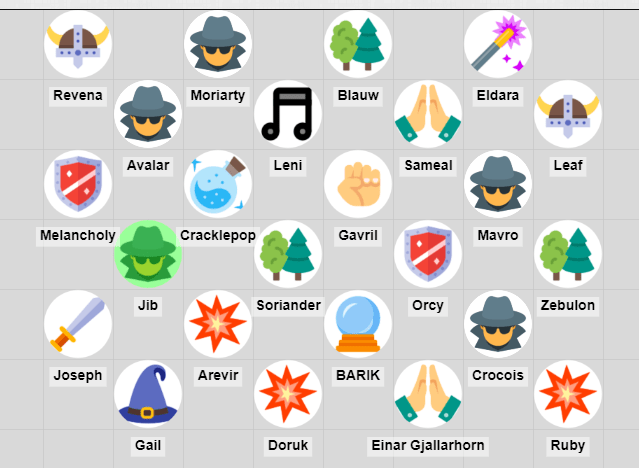
A collection of player tokens on a grid.
From our Extra Life game. I didn’t have time to set up bespoke tokens for everyone, so each class had a generic icon.

Music

  • I keep an eye on Humble Bundle when it comes to music. Every few months, they have bundles of royalty-free music that are made for games. These are great for when I’m going for a specific feel for a game. You’ll find them under the “Software” section, but make sure that you’re not buying a bundle for loops and sound effects (unless that’s what you really want).
  • When I don’t need super specific vibes, the music that comes with Roll20’s jukebox works perfectly well. Rat Battle and Baba Yaga will forever be a vibe.

Maps

  • CzePeku offers amazing maps that can fit so many scenarios. I’ve often come up with scenarios to use a particular map. Also, each map has variants, which can be super helpful in games for showing a change in location. So, the farm can go from day to night or from normal to bloody.
  • 2-Minute Tabletop is the other map-maker I patronize, but for the opposite reason: The maps are more module and generic (but still so pretty!) so I can build what I need.

Note taking

  • Microsoft OneNote – I don’t use this as much anymore, but back when I first started GMing, this was my ride or die. I still break it out when I need flexibility more than structure. In fact, writing this post made me realize it’s perfect for an upcoming project…
  • Cambridge Quad Wirebound Notebook – The absolute gold standard for graph paper for me. The pages are off-white, so they’re easy on the eyes, and the grid is the perfect amount of contrast. I buy these in bulk.
  • Google Docs – Easy to use, if you have a browser you have access to it, and you can share the doc for collaboration. What more do you need?

So, that’s my toolkit. It’s a lot, but I’ve been building it up over 20 years, so the list was always going to be long. If you use something you think I’ve missed, drop it in the comments!

Prepping APs 15 minutes at a time: An obsessive guide

I run a lot of games. Like… a lot. I have a bi-weekly home game where we swap around who’s GMing, a bi-weekly stream, and a whole slew of monthly games. This wouldn’t be possible without three things:

  • Pre-written adventures
  • The ability to do remote games
  • Lots of organization

Because I get asked, I figured there’s no harm in documenting how I prep Adventure Paths. Heck, maybe it’ll inspire someone who wants to GM but says they have no time to pick up an AP.

Caveats

I’ll say this up front: I am an over-prepper. I know my self too well. Improv-heavy games wreck havoc with my anxiety, and I find myself unable to really enjoy the act of GMing if I’m doing too much on the fly. I would much rather prepare for a fight that never happens than have to throw one at the last second. Not everyone needs this level of prep in their life! Take what works for you!

Also, I prefer this to homebrew campaigns. I’ve done several, and while fun, they require a LOT more work on my end to come together the way I want. I still do run homebrew, but the vast majority of what I’ll run is going to be pre-packaged.

Why do all this?

As I said before, I get super stressed if I feel under-prepared. I can generally hide it, but that doesn’t make it any less unpleasant to live through. If I’m prepared, I can chill out during the game, drinking my tea, secure in the knowledge that I’ve planned for most of the zigs and zags.

I also have small chunks of downtime in my day-to-day life, but a lack of large chunks of open time. I can sneak in 15 minute activities with no shuffling around, but one “Oh, by the way”, and my four hours of free-time on a Saturday morning are gone.

Finally, I love maps with walls and doors and lighting and music. I like a pretty VTT experience. You can’t really get that if you’re cramming.

Before prep!

I’m in the market for a new AP. What do I do before I start getting into it?

  1. I read the summaries for the chapters. I want to make sure the vibe matches what my group is looking for.
  2. I check the Paizo forums for that specific AP. They can be a treasure-trove of lessons-learned, suggestions, warnings, and re-drawn assets.
  3. I read the Player’s Guide. It’s tempting to skip this step, but there’s details in the guide that aren’t in the AP.
  4. I brow-beat my players into reading the Player’s Guide. Seriously, players who skip this often end up screwed over later because they selected a class that won’t work, or didn’t invest in a skill that comes up all the time.

Let’s talk prep!

I prep in three cycles: Reading, monsters, maps.

Reading

I don’t read the whole AP at once! I know some people do this, and good for them, but I prefer to work one chapter at a time. I would rather start playing sooner than put it off for a few months while I get through a whole slew of reading. I’ve found that as long as I’m two chapters ahead of the players, I generally have enough buffer to work with.

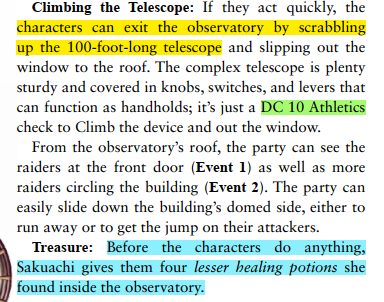
I also highlight a LOT. I use three colors: one for plot bits I don’t want to miss, one for DCs that aren’t already in a monster/hazard block, and one for treasure. My goal is to be able to find important details at a quick glance without turning my whole document yellow.

An example of my highlighting. Yes, my pdfs are very colorful by the time I’m done with them.

Now, if my chosen VTT has my adventure pre-loaded, awesome! I’m mostly done! This is 80% awesome, but it can lead to me being less familiar with the creatures than when I have to craft them by hand. Still, I’m not turning down the time saver.

Creatures and Hazards

After I read a chapter, I’ll go ahead and create all the creatures. How long this takes varies quite a bit. Some books, I can grab almost everything out of a bestiary. Others, nearly every creature is custom for that AP, so I have to create it by hand.

I could just roll everything by hand, but again, I like to actually relax during games. So, I fill out the NPC sheets for pretty much everything in the book. Because I’m working with 15 minute blocks of time, I try to focus on doing the same task over and over. So, I might work on filling out sheets during one session, while another, I work on getting the tokens set up (like I said, I love a pretty token).

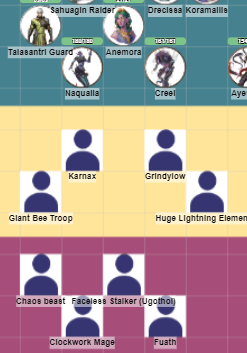
For making tokens, I use Token Stamp. There are other tools, of course, but this one being browser based means it doesn’t matter which computer I’m on when I’m doing prep.

Part of my token creation page. Top/Green: All done! Yellow/Middle: Needs a token. Pink/Bottom: I’ve only made a stub.

Maps!

Maps are the last vital thing I set up. I have a blog post on extracting maps without giving yourself a stomach ache, and I still stand by that method. This is especially true since the automated tools I’ve used don’t seem to like grabbing maps from the interactive PDFs.

To be honest, this part of prep goes the fastest for me. Even with fancy lighting, I can get a map walled up in ten minutes, and since my creatures are made already, it takes only a few more minutes to populate them.

The other stuff

If I have F’s left to give, I’ll pick out some music for ambiance and fights, and maybe make a few handouts. If you like music, I strongly suggest making a few playlists that you can put on randomize and forget about until the situation changes. I like having one for fights, one for general ambience, and one for town.

When running my non-modern games, I use my VTT’s jukebox, which works perfectly fine. For modern games, though, I’m usually leaning on music that isn’t royalty-free, so I used Watch2Gether. And before you ask, no, those games aren’t streamed or uploaded. If they were, they’d get a strike before I had a chance to share a link out.

How long does this take?

I know that “It depends” isn’t a very satisfying answer, but… it depends. A chapter with lots of maps and custom creatures can take way more time than one that’s mostly roleplay and theater of the mind. Also, careful reading takes more time than quick reading.

Looking back over my notes, it looks like two weeks per chapter is a fair average. This seems like a lot of prep, but keep in mind that a chapter is three or four sessions for me, minimum. Since these games are monthly or, at worst, bi-weekly, that level of prep keeps me ahead of the game.

Because this is only 15 minutes at a time, I can generally prep two chapters every day without having to block out huge chunks of time. Because I stop once I’m well-enough ahead, I’ve found I can have around six games going at once without burning out. Really, the hard part is finding time to play!

What am I thinking about changing?

My day job involves coding in Python, so I’ve been diving more deeply about extracting text and images more quickly. I also want to learn more about talking to the Roll20 API (my VTT of choice) so I can create creatures and handouts more quickly. I will always pay for an AP if I’m running it, but Roll20 tends to pick and choose which they’ll import. I know other VTTs keep on top of this, but I’m not interested in switching platforms for reasons that could fill a whole other blog post.

This seems like… a lot.

I mean, it is. And it’s not necessary. I’m describing how I do it, but it’s hardly how everyone preps an AP. It’s not even how I did it when I first started running them.

With my first AP on a VTT, I didn’t use the system’s character sheets. I typed in every roll by hand, as did the players. I have friends who will skim over just enough to get the idea of what the story is and then vibe off of that. I have other friends who won’t put down a map until the players ask, and only toss down a token when it comes time to fight the thing. Heck, I have a GM where all the tokens are circles with letters in them.

While it’s a lot of work, this is the level of effort that lets me have the GMing experience I want to have: Chilling out with my coffee rather than frantically trying to understand what a block of text means, because this is the first time I’ve seen it.

At the end of the day, you do you, boo, as long as it gets us more games.

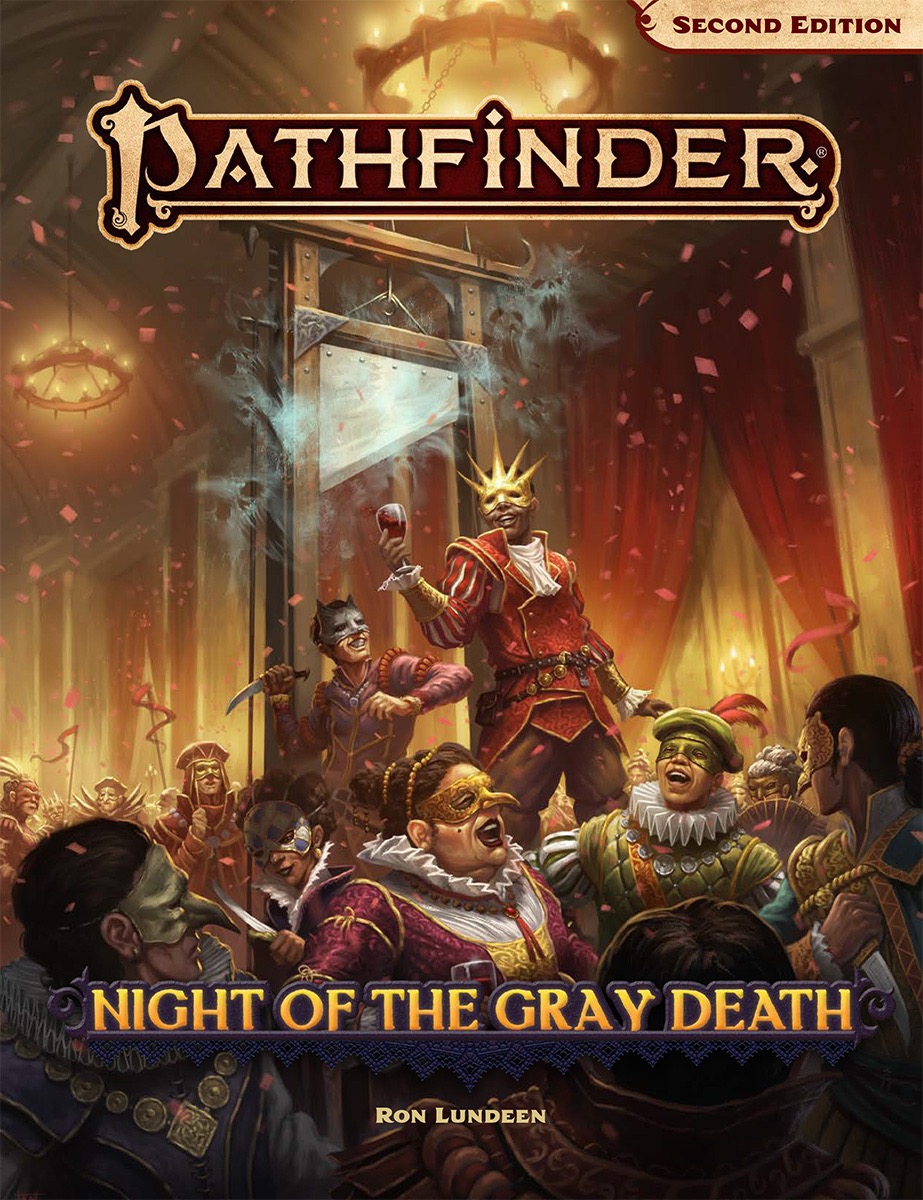
Night of the Gray Death: A Pathfinder 2e Adventure

A while back, Paizo released a new adventure, set in Galt. I knew from the second I saw the promo text that I wanted to run it. I love high-level Pathfinder play, and I love it even more when it’s given a novel backdrop.

From Paizo’s website:

Galt’s executioners are the masked and mysterious Gray Gardeners. Held above the laws of the chaotic nation, these grim killers soak the revolution-wracked land in dread and blood. They behead the guilty and innocent alike with their magical guillotines, but few possess the courage to stand against them. Powerful heroes must infiltrate the Gray Gardeners and put an end to their reign of terror. As the heroes race from haunted crypts to the elegant opulence of an ill-fated masque, the midnight chime will bring salvation or doom to a nation.

For those who don’t know, Galt is basically Golarion’s France, but stuck in a perpetual revolution. This adventure leans into that hard, bringing together the paranoia of a state tearing itself apart and elaborate balls.

It’s also high-level and feels it. The challenges were no joke, but there were still multiple situations where a competent player can short circuit a problem with a well-applied feat. For me, that’s peak high-level play: Either screaming in terror or waltzing past dangers.

Our group

Our group was made of a group of PCs from a West Marches campaign. Initially, it was a polycule who was extremely extra, but eventually they had to call in back-up when it became clear they couldn’t charm or sneak their way past some upcoming challenges. The make-up:

  • Two rogues (one thief, one scoundrel)
  • A swashbuckler
  • A bard (controlled by me)
  • A fighter (called in later, because lord, we were squishy)

We played once a month, during the week, so the sessions were shorter than a weekend one might have been. I recorded every session, which left us with 18 hours of recorded playtime. We’re a fairly focused group when it comes to moving the plot along, so if your group is more chaotic, it might take longer to complete.

Note: After this point, there be spoilers, so if you want to play in this, begone!

Pros

There’s something for everyone! A large part of the game involves gathering information in multiple ways. Maybe the face charms the dress-maker. Maybe the rogue sneaks into the quiet mansion. Maybe the fighter goes and beats the snot out of someone in their way. There’s always a path forward, and there’s always something for everyone to do.

It’s also great to see high-level adventures. So many companies struggle to put out content for characters past the midway point. It can be rough for GMs who lean on pre-packaged content. There’s a reason we do this, after all! This was not only high-level when it came to challenges, but also concerning the stakes at hand. This isn’t about taking out a pesky dragon. This is about saving a nation.

It’s also easy to slot into any existing campaign. Your group (probably already well-known) gets called in. In fact, it works better if none of you are from Galt. You’re neutral parties that aren’t being closely watched by the Revolution.

There’s also so many fun NPCs. It’s honestly a challenge to fit so many of them in, but this just makes it appealing for me to run again.

Cons

There is one fight that can be a game ender: Three Lesser Deaths. It happens in the middle of the second chapter which is run hour-by-hour. Because of this, if the combat knocks out a character, they’re OUT for the rest of the chapter, which could run for several sessions. This one worried me so much, we pulled in a Fighter to boost our very squishy party. Nearly all other fights were fine with a sensible group, but that one could have been rough.

Speaking of, a high-level adventure can be both a boon and a bane. With our players, we shared a high level of mastery and familiarity with our builds. This is not a module for complete beginners. Experienced players with new sheets may also struggle at first, so don’t skip the easier fights in chapter one. They’ll need that practical experience for chapter 2.

There are a number of encounters that never happen, so you may end up prepping maps you never use. If that’s something that bugs you, consider reshaping the first chapter to guide the players a bit more tightly. Each path leads to what they need, so select whichever one seems like it fits with the group’s vibe.

If I were to run it again…

I would probably cut references to NPCs the players never met. This happens in the later chapters, and while it does add to the air of menace, it also confused them, thinking they were clues rather than ambiance. I would also make sure to hint that the Lesser Deaths were a thing somehow, so players could prepare. Otherwise, I would keep it as is! It’s an awesome adventure that had something for everyone.

Gatewalkers: Chapter one done!

Over on D20Saves, I’m running Gatewalkers, one of the latest APs from Paizo! From the official website:

After they walked through that glowing gateway, nothing was ever the same. A band of characters become paranormal investigators in order to figure out the cause of a global amnesic episode. Their quest takes them to lands near, far, and outside of this reality altogether. Along the way, the characters meet fellow “gatewalkers,” defeat alien monsters, and explore strange realms also touched by the so-called Missing Moment. And when it comes time to learn the grim truth of what happened to them on that fated summer night, what then?

Warning: The first part of this blog will cover what happened in the stream, so there's spoilers for Book one. Part two will include my thoughts as a GM, so there's major spoilers for everything. 

If you’d want to watch the previous episodes, check out the playlist here!

Chapter one recap: We meet our heroes (?)

Several months after the missing moment turned their lives upside down, each member of the future party received an invite from a famous researcher in Lepidstadt, a sizable town in the ever-cozy country of Ustalav.

Each of the recipients had been trying to piece their lives together after being removed from the material plane for three months, and this seemed to be as good a direction as any. There are worse things than being research assistants in a field that isn’t yet flooded, right? And they might find what happened to them on the way!

The first mission was to investigate the druid town of Seven Arches in the River Kingdoms. The town had been under a curse, killing all elves who came there… until the Missing Moment happened. Just as the gates lit up all over Golarion, the curse was dispelled. Obviously, the two events are connected, but how?

The crew quickly got embroiled in the politics of the city, agreeing to investigate a rogue druid who had absconded with a relic called the Shadewither Key. Leaving a trail of naked, bound rebel druids behind them (they have an MO, apparently), they eventually captured the head rebel, Bolan. He taunted them, telling them someone named Kaneepo the Slim now had the key, and would use it to “restore the balance” between nature and civilization. Chapter One ended with the party making their way back to town, hoping their work in the town was done.

It was not.

GM thoughts

I said it last time and I’ll say it again: Good lord, this book is a lot. It’s been a while since I had players at level one this long, even in an AP. Looking at my raw recordings, we’re at about 10 hours of play, and this is with the group being fairly focused.

I’m also done prepping book one, and let me tell you, it doesn’t calm down. Each chapter is packed with custom creatures, maps, encounters… So much happens.

The good stuff in Chapter 1

The players had quite a bit of fun in Seven Arches. They enjoyed the NPCs, and honestly, I’m a bit sad that some of them have to be left behind, since the AP is clear that the PCs don’t return to the town.

The plot was also laid-out well enough so that you didn’t get the cursed “Why are we doing this again?” banter. They had a mission (Investigate the curse) and steps to take (Talk to people, check out the rogue druid, find the key) the entire time.

They also loved finding out Bolan (the rebel druid) is another deviant. It gave the boss fight some real X-Men vibes. Make sure to use that deviant power of his! To be honest, it was one of the scariest things he could do.

The less good stuff

This list will be longer, but they’re mostly nitpicks, and extremely manageable.

En medias res. The AP starts with everyone already on their way to Seven Arches, which felt too sudden. I inserted a whole session before this, allowing them to get the letters, make their way to town, meet each other, and finally, meet the good professor. It helped the team gel, which is important since things move quickly once you’re in town.

The big bad. It’s very easy for the players to figure out who the Big Bad is. If you have players who jackrabbit the second they get a sniff of “potential double cross”, play the professor with a light hand. If you REALLY think that the players will run, insert a different NPC and make the professor his boss. Basically, know your players.

The treehouse. This is an awesome dungeon! However, it’s big, and it made my VTT crawl without some major tweaking. I recommend splitting it between two maps, even if one map feels more convenient.

Also, there’s a bit where a druid pulls up a ladder in order to block the way forward for the PCs, forcing them to go through most of the treehouse, looking for a way up. If you want players to explore, YEET THAT LADDER INTO THE SUN. If it’s anywhere close to the edge, they might have an ability that allows them to get the ladder and skip half of the encounters. (On the flip side, if you want to compress the treehouse, leave the ladder dangling).

Night visitations. The PCs were supposed to get dreams that awakened their deviant powers… except the PCs don’t have much need to sleep on the road. This left one PC odd-man-out, and this was with me doubling up one night. I recommend either doing them all at once, or having them start the game with deviant powers awakened, making the dreams spooky, but not attached to any mechanics.

Next chapters!

Having prepped the next two chapters, I’m super excited for the team to start bouncing around the cosmos. Chapter two sends them to the First World, but with a twist. Rather than the neon fever dream of Kingmaker, you’re sent to a place that’s grey and strange. This is probably a good choice, because the next stop is Castrovel, which has a jungle that’s as colorful as it is dangerous.

My only concern right now is a fairly big one: Will the players go through the portal that leads them to the rest of the plot. I’m trying to hammer home that they have to go get that stupid key, so let’s hope they follow the plot thread without me having to kidnap them.

Thinking about the next West Marches

I’m going to start this post out by saying something up front: I am nowhere near ready to start a new West Marches adventure. I love the format, but I’ve really been enjoying having time to run smaller, more focused games. I’ve been chewing my way through some Paizo APs and Adventures, and I wouldn’t have the time to prep for them if I was worried about a sandbox game as well.

That said, I still find myself thinking about the next one… after all, it is a format I deeply enjoy, and surely, I’ll run out of Adventure Paths at some point, right? I might as well jot down some notes on what I’ve been mulling over.

The basics

The system, obviously, would be Pathfinder 2e for any fantasy sandbox. I’ve already written about how PF2 is well-tuned for West Marches, and time hasn’t dulled that opinion.

  • The world is robust, so there’s no need for me to do a ton of worldbuilding.
  • The math works for encounters, making it easy to adjust to pick-up groups.
  • There’s so many heritages / ancestries / classes to pick from.
  • It requires pretty much no GM fiat to run, making it easier to keep track of what house rules you have at a shared table.
  • The rules are all free and online!

Lessons learned and potential improvements

It would be pointless if I co-ran a game for almost three years and didn’t come away with some lessons learned. No attempt is perfect, and there’s always ways to improve.

Levels!

One of the biggest bugbears we had was dealing with level spread. When we started, chat would determine how much XP we got, and everyone had different levels of XP, due to everyone starting at level one when they joined. Level spread became a bigger and bigger problem as time went on, to the point where the GMs started to burn out trying to offer enough games for everyone. In our experience, you couldn’t have more than a three level spread before someone overshadowed the rest or the lower levels were in danger of being one-shot.

We eventually solved this by introducing banding, which worked, but I’ve since grown disillusioned with that as a solution. My other West Marches game (VtM V5) used that, but we eventually abandoned it to make everyone the same level.

Lesson learned: Kill level spread before it kills you.

XP!

In the last server, XP was awarded for chatting in our Discord. This made sense at the time, but also wore down mods and GMs who felt obliged to keep things active. After all, players who don’t get a level get cranky, and might just leave for greener pastures. This is another idea I’ll be swapping out. Some alternative ideas:

  • A flat amount each month. Easy to plan for, but doesn’t motivate players.
  • An amount for each game played, but given to everyone. Great for getting games on the calendars, but might cause some pain if we have low months due to Real Life.
  • A totally random amount between 250 and 1000. I’m including this mostly because it amuses me.

Lesson learned: Link XP to something that’s sustainable for the GMs, since they’re the most limited resource.

Play-by-post!

This one is tricky… Many people love PBP. Hell, I love running and being in text scenes. I’ll also be the first to admit that it can take so much time. Our intention with pushing more PBP in the old game was two-fold:

  • More XP at the end of the month
  • Allow people to roleplay, with the live games being more combat focused.

In the end, it kind of worked, but it also fed the issue with GMs feeling burnt out due to pressure to post. We created a ton of channels so people could post in set “locations” (think #tavern, #bookstore, #market, etc), but newcomers were overwhelmed by so many options. Also, not everyone likes PBP, and would rather roleplay during a game!

While I don’t want to block PBP (the people who like it REALLY REALLY like it), I think I’ll tweak a few things:

  • No creating dozens of channels. Instead, keep it to a single digits number. If channels are busy, players can always RP in DMs and post the result later if they want.
  • Disconnect XP from posts
  • Offer more games where RP is the focus rather than straight combat.

Lesson learned: PBP is great, but isn’t for everyone.

Time zones!

Good lord, this one bit us so hard.

If you have players separated by an ocean, scheduling games can become complicated fast. Most of our players were in the US, so games in those time zones made sense. This left EU or third-shift players without games unless a US GM was willing to run super late or super early. Personally, I didn’t have a problem running the odd early game on the weekend, but I wasn’t willing to do that every weekend.

I never want to tell someone they can’t play… but on the other hand, it’s not like GMs are paid employees who agreed to all-hours shifts. They’re volunteers who have their own lives, games, and need for sleep.

The solution for this one is tough, and one I’m still working through. “Have GMs in every time zone” isn’t feasible, and having GMs run at all times isn’t sustainable. Some ideas I’ve had:

  • Have set timeslots and stick to them. This way, incoming people know if the server will work for them.
  • Don’t set timeslots, but have core hours. For example, if the core hours are weekdays 5-12, games can start no earlier than 5pm, and must end by 12am.
  • Do nothing and hope for the best? Obviously, this one is my least favorite.

Lesson learned: Round Earth is a terrible design. Whoever thought of it should be fired.

Classes and alts!

One awesome thing about PF2? It’s constantly coming out with new classes and ancestries and heritages! One rough thing about PF2? The exact same thing.

Because games blossom when people bond and make connections, I’m not a huge fan of a revolving door of PCs, especially if players expect that they’ll be pulled into the plot quickly. On the old server, we decided to let people have alts, allowing them to have multiple characters (three, to be exact). Some people loved this, and some had trouble keeping up. Also, to be honest, as a GM it became difficult to keep track of all of the personalities. Classes weren’t as much of a problem as bodies. People want to play with their buddies, but if the buddy is a different level / same class, they may not feel like they can ever be in a game with them.

I still love the idea of alts, because they give the server flexibility and let people try out new stuff without dropping an old character. So… is there a way to meld to two?

My potential fix: Let a PC have more than one build.

This would be built into the story via some sort of magic device. Essentially, PCs would be gifted an artifact that has the “impression” of another former adventurer. How this plays out is up to the player. Maybe it’s just one personality and three different classes, or maybe they choose to have different “personalities”, depending on which class is active.

This is one of those ideas that either have people super excited to play, or who immediately aren’t into it. My hope is that it’s a mechanic that can add to the game without taking away from anyone who would rather just have one class. As someone who never got to play her Rogue main in WoW, I 100% get that.

Lesson learned: Not everyone wants to juggle three personalities, and it can start to tax the GMs.

Streaming!

I’ll be real: This was a lot of fun to do. No, we never had a huge audience, but players who couldn’t join a game could watch, and it was fun to clip moments. I got so used to doing this that I started recording (though not streaming) my regular games.

It does require set-up to do, and a machine beefy enough to handle a VTT, Discord, and OBS at once, but this is one of the things I would pitch to the server as an option. The only problem would be if a player didn’t want to stream, which I 100% get. In that case, some options might be:

  • Don’t record the game at all
  • Stream the game through Discord
  • Record it and post a link to the game later

I’m leaning towards the last one, since if you can stream, you can record.

Lesson learned: A record of games is nice to have!

Final thoughts

Okay, decent write-up, but when is the next game happening? A few months ago, I would have said “January 2023” but… I’m writing this in May 2023, so that obviously didn’t happen.

I would say it would be more likely to happen sometime in 2024. The itch for more loose games is growing, and I have a growing number of people I’d love to play with who can’t commit to a full AP. When it does happen, I’m sure I’ll post about it here!

5e to 2e: Player Agency

Right now, we’re seeing 5e GMs checking Pathfinder 2e and asking about what they should know before starting. The advice in the 2e subreddit has been spectacular, like what materials to start with, how to make a sheet easily, and even how to convert beloved characters.

If I had to give just one piece of advice for GMs, it would be this: The balance of power at the table is about to shift. Embrace it.

I don’t mean mechanics, though they do play into it. 5e is considered “cinematic,” which often comes down to bids between players and the GM. Players have an idea, pitch it to the GM, and the GM can set a DC that the player can then try to hit. GM fiat rules the day, encouraged by a ruleset where less is spelled out in favor of a more flexible experience. It can feel like you’re in an action-adventure movie as the scene is played out in the most ” interesting way.”

Pathfinder 2e tends to spell things out more explicitly, meaning GM fiats aren’t as necessary. Nearly every action you can do has been written out in the rules, including DCs and who can attempt them. Of course, GMs have wiggle room, but most tend to roll with what the book says. If a player is given all of the information ahead of time, they can plan their turn without GM input.

Basically, it’s like watching competence porn.

DVD covers for The Martian, Legally Blonde, and Leverage
Elle Woods is peak Competence Porn, I am taking no questions at this time.

I’m not even joking: If you sit down with a group of players who know their sheets and know the system, it’s a thing of beauty, watching them take apart an encounter by breaking out every tool in their toolbox. It hits differently, knowing you took out the mouthy bad guy because the bard drained them and boosted everyone else, the caster made them clumsy and on fire, the fighter scared them and put them on the ground, and the ranger then filled them with arrows. That’s where the magic is.

Don’t mess with the magic

If I’ve seen a 5e GM struggle, it’s because they’re used to molding the surroundings to fit the story they want to tell. The problem is that PF2 gives players a robust toolkit, and many players come to know this toolkit inside and out, and they are relentless in deploying that knowledge.

The bad guy is monologuing?
Ranger: Hunt prey. Draw longbow. Hunted shot. They’re within 200ft of us if we can hear them, right?
GM: Uh, they’re behind a rock. Full cover.
Bard: Quickened heightened Dimension Door. Telekinetic Maneuver to get him from behind the rock.
GM: ON A CLIFF.
Oracle: Moonlight bridge 🙂
Bard: Oh, can I just toss him off the cliff?!
Monk: [cracks knuckles, about to do some monk BS]

There’s a reason why Paizo APs don’t have the bad guy monologue unless they’re okay with them biting it at that particular moment. Even in exceptionally well-laid-out APs, I’ve had plans wrecked by a group of players who saw an opportunity no one had thought of and took it, bypassing weeks of material.

That’s because the balance of power has changed.

The balance of power

The GM holds the most power at a typical 5e/cinematic table since everything comes down to their in-the-moment calls. However, as more rules become explicit and call for fewer fiats, the power shifts to the players. I’ve seen 5e GMs struggle with this as they try to wrest power back by blocking feats and abilities.

Maybe they don’t say that the feat doesn’t work… but they’ll move the baddie to what they think is out of range. Or they give them a power they shouldn’t have because it doesn’t exist (think free-action-uninterruptable-teleport). Or they make up reasons specific spells/skills don’t work against that creature.

This isn’t how you end up with a happy table. Players will feel stymied, the GM will feel like they’re plugging holes in a leaking dam, and the story will feel stilted.

A different perspective on stories

So, if you can’t depend on events falling out a certain way without frustrating your players and yourself, is it even possible to plot ahead in strategic games?!

Absolutely. It just takes a shift in your perspective.

The most significant shift is that you stop seeing your plans as plots to be experienced and more as problems to be solved. You give your players a puzzle, and they have to use their wits and toolkits to figure it out. The story comes from how they do it. You start with the assumption that there’s more than one way to resolve the conflict and that the players will likely surprise you.

One of my favorite scenarios was a murder mystery, where the PCs were tasked to find the body (hidden away), discover who was guilty (probably one of the noble hosts), and find some additional dirt on them (the murder wouldn’t be enough because this was Cheliax). While writing it up, I laid out all that had gone before, who was involved, how, who knew what… but had no idea how they would succeed.

As Matt Colville once said, that wasn’t my problem. That was their problem.

My players were resourceful, using tricks I hadn’t thought of to get information, snoop around, find dirt, and even bring the victim back to life. They even made a few allies along the way! It’s not an outcome I could have predicted, but it’s one that the players still talk about to this day. And, even better, I could just relax and eat cookies while the players planned and poked around, watching them engage with the world without me having to make up anything on the fly.

Gatewalkers: A new stream, and some GM thoughts!

Ever since Paizo announced the wild ride that would prove to be Gatewalkers, I’ve been dying to run it. A group of people pulled together by weird shit and bounced around the universe to completely new locales? Sign me up! Happily, the crew I stream with on D20Saves was also eager to play it, so I had a ready-made crew!

One downside of running a brand-new AP is that you don’t have many lessons learned from the community to help you out. Therefore, I decided to document my thoughts about the AP, which might help GMs considering it but haven’t started it yet. So, the first part of this post will be about the stream, and the second half will be more GM and prep focused. Spoilers will run rampant in the second half.

Stream

The stream will be every other Wednesday (7:30pm EST) on D20Saves and features most of the crew from our sister stream, Fists of the Ruby Phoenix.

The cast (in alphabetical order, by class):

I can say from a wealth of personal experience that this is a great group to run with: Knowledgeable as hell, but not afraid of just relaxing and having fun with how the story plays out.

You can watch the first episode of Gatewalkers here. I’d embed the video, but apparently, we classify as adult content. Maybe one too many f-bombs? At any rate, in Episode one, the PCs receive a letter from an academic asking them to join him in researching mysterious gates that opened across Golarion some six months ago. This disparate crew is especially motivated since they all went through said gates but returned three months later with no memory of what happened while they were gone…

The GM stuff (SPOILERS BEWARE, PLAYERS GO AWAY)

……

….

..

Okay, you’ve had plenty of time to leave. Here there be spoilers.

While prepping this book, I realized this was a packed AP. I’m no stranger to running Adventure Paths, but the content in the first chapter is usually light: The players get to know each other, the GM gets a handle on the world, and you have a few mild encounters to set the mood. In GW? You do a whole investigation, AND you go through a dungeon.

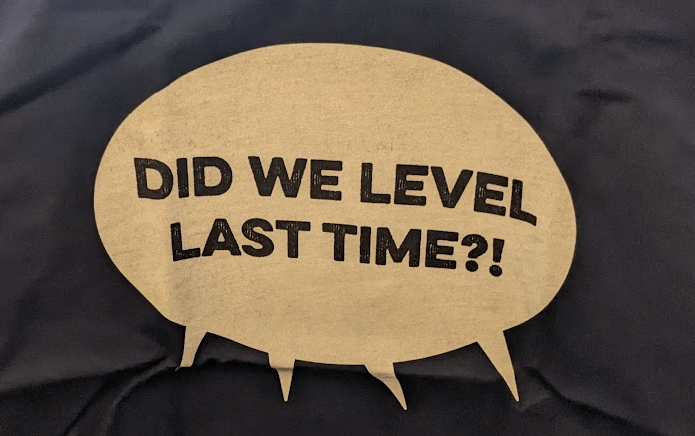
It doesn’t seem to drag, though. There’s always something pushing the players forward, so hopefully, they won’t feel like their level is too delayed. Even so, I got a new shirt to add to my collection.

Shirt with the text 'Did we level last time?!', coming from several speakers.
They say this to me even when I’m not the one GMing.

Another thing that the AP feels like it’s missing is the players meeting each other. To be fair, most APs start with the PCs having minimal reasons to know one another, but in this case, you start on the road, heading toward your first assignment with someone who just hired you. I started the game slightly earlier, giving each player a letter from Dr. Ritalson. The handout:

"My name is Dr. Etward Ritalson, formally of Lepidstadt University. We have more than a few things in common, starting with a particular jaunt through a mysterious portal. While some are content to forget the whole matter, I cannot let such an intriguing (and personal) mystery rest! As such, I have taken a sabbatical from my duties at the University and have dedicated myself full-time to unraveling the missing moment.

"I am reaching out to those who had a similar experience in hopes of putting together a research team. There's too much for one man to do alone, and more minds always make for a better thesis. I have enclosed funds for travel. Any Lodge should be able to teleport you to the Vodavani Lodge or perhaps even the University. The hazard fee is included in the sum reserved for you, so please don't let them upsell you!

"My office is just outside of the University grounds. Anyone should be able to lead you to the office for the Illuminated Consortium of Epopts. I look forward to the work we shall do together!

"Sincerely, ER"

This gave the players a chance to talk about their background, roleplay getting to a lodge (mostly handwaved, but it was amusing to see the differences between all of them), and then give them a chance to meet each other before the Good Doctor (who was out for a few days). Looking ahead to book three, it appears that Dr. Ritalson has a manor in town, complete with staff, so it might be a chance to let the crew get to know some of those NPCs.

The biggest challenge I think the AP will have? Having the players not twig to what’s really going on too early. Already, one jokingly said “X is the behind it all.” I now have book three in hand and… he isn’t wrong.

Anyway, those are my thoughts so far on Gatewalkers. I highly recommend it as an AP, though maybe not if you’re new to Pathfinder, due to deviant abilities and all the jumping around in the world.

Quest for the Frozen Flame: Book 1

When Paizo announced that they were releasing an Adventure Path set in the Crown of the World, my first reaction was to squeal MIMMIFS and immediately recruit a group. Let’s just say I’m super into a campaign where mammoth races could potentially be a thing.

The group

Because people will ask, the group make-up was:

  • Human Gunslinger
  • Orc Monk
  • Human Alchemist
  • Orc Battle Oracle
  • Elf Fighter

We opted for monthly play because everyone involved tends to be busy, and bi-weekly slots are precious. Only one person was new to PF2, and everyone had significant experience with TTRPGs. Hell, a few of them had even played in a wilderness campaign before.

The set-up

I decided to run this game with Automatic Bonus Progression, because it takes the pressure off of me as a GM. It means I don’t have to worry about players getting runes at the right time in order to keep balance, and they can save their cash for more interesting options. 

I didn’t use Free Archetype because the AP didn’t explicitly recommend it, and none of the players were clamoring for it. 

Otherwise, I had no limits, outside of anything tagged Unique. If it’s printed by Paizo, it’s up for grabs. 

And… I decided to try something new.

Speed run!

I love the idea of running APs in non-traditional ways. While I still enjoy (and default to) running them as written, I’m drawn to the idea of mucking around with them. For this game, I pitched an idea to the players: SPEED RUN.

Rather than start at level one, players would start at the max level for that book. So, they start the game at level 3, at the start of book 2, they’ll be level 7, and at the start of the last book, they’ll be level 10. My hypothesis was that the players would blast through the first half of the book, but by the end, will be appropriately challenged. 

I wasn’t doing this just because I could. My biggest concern with the game was that we could only play once a month, and one player was in a drastically different time zone, so would be staying up until WTF o’clock to play with us. I wanted to keep things moving at a decent clip without taking two years to finish one book. I considered streamlining the AP, but this can be tricky: Sometimes, that innocuous encounter comes up again later, so if you skip it, you could end up having to frantically backfill content. 

I already spend enough time prepping. I don’t want to spend even more time re-writing. 

In the end, it played out just how I thought: Players raced through the first two chapters, but by the last chapter, were appropriately challenged. This does mean players don’t get a chance to get used to their classes over time, though, so I’d only recommend it for a group with some experience. 

So, how’d it go?

Warning: After this point, I will be spoiling with unfettered glee. Abandon all hope of a blind run, and that includes my players.

The book

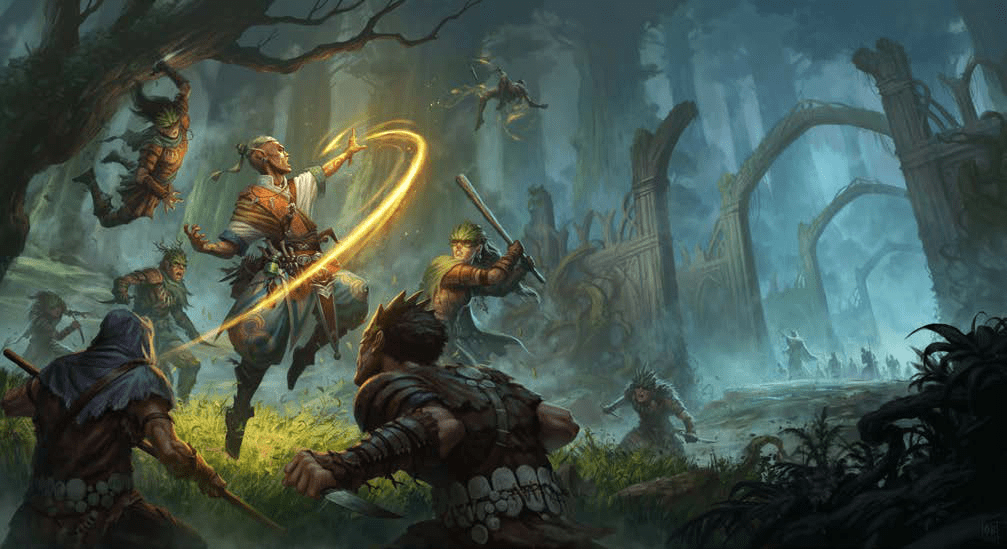
In this AP, you play as members of the Broken Tusk tribe. The players are at the cusp of being accepted as official scouts, whether they’ve been with the tribe their entire life, or only the past few months. The main conflict is facing off with a rival tribe that they were once a part of, who have, quite frankly, lost their god-damn minds. 

When Paizo said that this was a wilderness campaign, they were not joking. There are no towns, encampments, other tribes, magic shops, ANYTHING you can trade with during book one. You do find treasure, but if your group is loot hungry, it won’t be enough to satisfy them. Yes, crafting is a thing, but you spend much of the AP literally on the run. There’s no downtime to speak of, unless you want to risk coming face to face with your rivals.

While there were lots of fights, there were also lots of opportunities to solve conflicts peacefully. Nearly every encounter included a chance to recruit members to your following (something that becomes important later), or to walk away without a fight. If you have players who are always looking to avoid coming to blows, they’ll have lots of chances to stretch their social skills. 

What’d the players think?

The players seemed super engaged with the plot, and quickly caught on that they were going to have to take the wilderness part of the story seriously. They also all agreed that without ABP, they would have been struggling.

Also, they hated, and I mean HATED, the personal antagonist. While the Burning Mammoths are the real danger, the face of them throughout the book is Pakano, a jerk from your tribe who defects to the enemy. Something about this NPC rubbed them the wrong way, and the normally peaceful PCs were thirsting for his blood. In fact, one told me that his eventual death didn’t feel bad enough

My thoughts

Personally, I think this is an awesome AP for anyone who’s up for the challenge of surviving in the wild and living communally. The only issue I had was that there was no motivation to explore, since you were being chased. Okay, the Burning Mammoths are way behind you and quite a bit slower, but the pressure is still on. One encounter was so far out of the way that I couldn’t imagine a group ever going that way, unless they were extremely cocky or obsessive completionists.

Even with ABP, loot is still very low, so if you have a hungry group, I’d recommend planting a traveling merchant somewhere, or establishing a crafter in the following who can provide certain items. You may even want to tweak the rules to make crafting on the run easier to do.

I didn’t push hard to get players to grow the tribe, since in this book, it’s not super important. They passed over a few encounters where they could have recruited someone, but this was mostly because they were focused on the task at hand. Having prepped book 2, though, I know I’m going to have to push them to get more people to join up. In fact, I’m going to put a rough counter on the start page so we can all keep track. 

My recommendations

  • Automatic Bonus Progression, in case you missed that
  • Figure out crafting and/or shopping 
  • Make sure players have their skills covered. There are lots of skill checks in this AP.
  • If no one is playing a healer, plan for that (or let the bodies hit the floor). Maybe a healer in the tribe, or a steady supply of discount healing potions?

Next book!

I just finished prepping Book 2, and I’m stoked. It has a small dungeon crawl (it’s Paizo, there always has to be at least one), and so many more opportunities for exploration and roleplay. If your players were annoyed by being chased, rest easy, because the Burning Mammoths are basically stuck behind an ice wall, giving players a chance to explore at their leisure.

(Image credit: Paizo, from the Player’s Guide)

Dhampir$: Lenore’s Shopping Spree (session five)

Author’s note: I’ve recently started a PF2 stream with a few friends on the Twitch channel Roll the Role. The premise: A crew of dhampirs with the same ‘sire’ have banded together to make coin, a name for themselves, and sort out their complicated past and future. This flashback takes place after session session 5.

[ < The Datoning ] [ Next > ]

Years before…

Absolom seemed to be the place to start. Where else to plan but in the city at the center of the world?

Anna dismissed her driver, sending her off with some coin and a glowing reference. The Kellid woman seemed relieved to go. Ever since taking the position, she’d had nightmares and had been growing ever weaker. Her once ruddy complexion had become sallow and pale. Obviously, traveling in this soft, hot land was taking its toll on her. 

Obviously.

Anna set up in a small apartment her father had set up for ‘business.’ As the business was less than gentlemanly, it wasn’t a part of his holdings that the rest of the family knew about. She could remain there unperturbed… mostly. 

Lucia kept to herself, mostly hovering in corners, watching Anna sort through papers. She sometimes offered a morose comment, but she was hardly one for conversation. Left to her own devices, Anna noticed that the spirit tended towards household tasks. She even took to braiding Anna’s hair, which was just as well: It wasn’t as if Anna could hire a proper staff. 

Still, it was curious, and a clue. Had the spirit been a lady’s maid? 

Whatever she had been, a conversationalist she was not. Anna was never overly social, but her time at The Acadamae had given her a taste for company. She found she regretted not doing more to bring back poor Everett, and missed the uneasy banter between herself and Maizon. She wondered if he had made his way to the Magaambya. Perhaps she could visit… but no, that would be too much of a distraction. Besides that, she had read up on the arcane college’s moral bent. She doubted her research would be welcome there. 

She sighed. It was a pointless train of thought, at any rate. While she hadn’t been explicit, Maizon was no fool. He realized what she was, and had left as soon as humanly possible. Anyone who realized would quit her company out of ignorant fear and, she had to admit, valid concerns. 

She ran her tongue over her sharp cuspid, and an idea came to her. Mortals would flee, but if they were like her

Her father said little about her condition, save that it was an unfortunate side-effect of his attempt to break the family’s curse. He would obliquely mention a visitor, some sort of expert, in unguarded moments, but if she pressed, he would change the subject. She moved to a trunk that she had yet to unpack and opened it. She hadn’t packed much when she left, but she did take what couldn’t be replaced: The LeClerche registry and journals. 

It was the custom amongst the noble class to keep track of who visited the estate, when, and for how long. After all, one never knew when a biographer might see fit to immortalize you, and you would want to prove that you had hosted illustrious individuals. More practically, it allowed the house staff to prepare for a returning guest. 

Anna flipped through the leather bound journal, scanning until she got to her birth. No, she knew all these names… family, clergy, healers. Back further, then. Few visitors during her mother’s confinement. A dinner party with cousins. A visit from some of father’s business associates. And then…

She found it. Her blood turned to ice. 

Julian. A viscount, with a family name she can barely make out. He stayed for a month, so obviously a traveler from far. That month? Nine months before her birth. 

She did some quick mental math. A human pregnancy is 40 weeks, but two of those weeks don’t count. Her mother may have already been with child when he arrived… or Anna may have arrived early. 

She stared at the name. She had her father’s journals, but she’d never seen mention of a Viscount, nor a Julian. She’d read over the events of her birth more times than she could count on the way to Absolom, and outside of family and healers, there were no visitors. Her father had always been a voracious journaler, never leaving out a detail of leading his household. Would he have been able to resist recording such an auspicious visit?

Of course not. Not unless he wanted to hide something…

She found herself looking around the sitting room. The accommodations were lush in a way her home never was: Deep, soft fabrics, overstuffed divans, candleholders placed just so in order to give guests a lovely glow to their skin, suggestive paintings of fruit and scantily clad nymphs. A love nest for a man who, at home, was formal to a fault and never drank more than one glass of wine in an evening. 

If he had kept a secret apartment, then why not a secret journal…?

She was on her feet in a second, tearing apart the desk. Lucia rose from her morose reverie. [Mistress? What do you seek?]

“A journal. One my father kept.” The spirit looked at the trunk Anna had brought with her.  “No, not any of those. One that’s here. It might be hidden, or it might be out…” 

It took an hour. The bookshelves were emptied, the desks and curios gutted, the walls tapped upon. Anna finally found it: A slim green volume, just like the others, with only one difference: The pages were gilded silver rather than gold. A subtle difference, but one that would stand out to one in the know. She opened it, and her father’s words stared back at her.

Met with the most unusual gentleman at Mistress Honeysuckle’s salon. A Viscount… My favorite practitioner had taken ill, so I spent the evening talking with him instead. I find myself envious of how well-traveled he is. I can barely extract myself from my responsibilities long enough to look after our interests here once a month. 

She looked at the date. A year before her mother would have fallen pregnant with her. She scanned forward. It seemed that every time her father made his way to Absolom, he made certain to find time to spend with the mysterious Viscount. ‘Smitten’ was the only word she could use to describe his entries. 

Nine months after their first meeting: He asked if the rumors of the LeClerche curse were true, and I confess, I was too drunk to be a convincing liar. A fortunate folly, though, for it seems he has some ideas on how to break it… He spoke of previous ‘experiments’, but I was too much in my spirits to retain details. Not that it matters. Vincent is terribly clever, and I confess, my training was scant at best. 

She stared at the words for a long time. Experiment.

And she wasn’t the only one.

And her father… not a bad man. Never a bad man. But obviously pulled too easily into someone’s confidence. She suspected his favorite ‘practitioner’ falling ill was no accident. Anna never knew her mother, but by all accounts, she was a lovely and mild woman… And even if she were a shrew, she was Anna’s shrew. 

Carefully, she paged back to their first meeting and started making notes. Where had the Viscount been. How long had he stayed. What names he dropped. It wasn’t much information, but it was enough, for she knew two things: She wasn’t alone, and this man had likely killed her mother and preyed upon her father’s hope. He promised a cure and left behind a monster. Well, so be it. A plan was forming her head:

She was going to find the others. 

They were going to find the Viscount.

And then, they would get their revenge. 

Together.