Caves of Chaos for Pathfinder 2e

One of the challenges of being a GM for a West Marches style of campaign is coming up with content where it’s easy for a large number of players to interact with the plot, while keeping the challenge rating flexible. My husband recommended Keep on the Borderlands, a classic module published in 1979 and written by none other than Gary Gygax.

I bought it from DriveThruRPG, and I’m glad I did. Not only is it an interesting piece of gaming history, but it’s an excellent adventure, even today. Converting it to work in 2e took way less energy than I was expecting, even though the module is old enough to have grown children of its own.

What is it?

Dungeon of Signs: B2 - Keep on the Borderlands - Review

Keep on the Borderlands has two halves to it: A keep that the players liberate and then mold, and the Caves of Chaos, which serve as the main threat. The Caves of Chaos aren’t quite as dramatic as they sound. It’s basically one huge map that features a number of caves, some interconnecting, some not. I ended up not using the “Keep” part of the module (the group already has a functional town), but the Caves of Chaos were well worth the price of the module.

And yes, I recommend grabbing the module. Not only is it a short, interesting read, but it has some tips on how the denizens caves should react to a bunch of adventurers running around and causing trouble for them.

Why use it?

Some of the advantages of using the Caves of Chaos:

  1. Solid maps. The layout of all of the caves are great. There’s plenty of room for a group of PCs to move around, but they have enough corners and doors to make line of sight important.
  2. Great dynamics. While you could, in theory, just use a key you find online for the Caves, I recommend giving the module a read. It recommends actions for various NPCs, and suggests how the caves might change over time as more of them are cleared out.
  3. Diversity of creatures. It’s not just goblins! The caves feature all sorts of enemies, giving players varied challenges that still make sense.
  4. Easy to scale. This might be more PF2 than anything else, but I found the caves to be fairly easy to scale to different levels. This is super important in a West Marches campaign, where you never know what the APL is going to be (though I did cap it at APL 3)
  5. Lots of pretty resources. This module has been out for a while, so the amount of player-created content is high. I found no shortages of maps, keys, and guides. I even found maps that were redrawn to work with Roll20!

What I had to change

Keep on the Borderlands was absolutely written for wargamers. The number of expected mobs was huge, and the playing field was much larger. The squares were ten feet, and it wasn’t unusual to have a room filled 10 to 15 mobs. I ended up switching to five-foot squares, and drastically reduced the number of enemies.

There were also a few creatures I had to change, since they’re either too high level, or they don’t exist yet in Pathfinder 2e (as of this writing, only two of the Bestiaries are out). For example, the medusa was straight out, and stirges haven’t made it over to PF2 yet. I ended up swapping in new creatures, since I didn’t feel like writing my own, and it isn’t like there’s a shortage of options to choose from.

The original maps work off of 10′ squares, which I changed to 5′ squares. It wasn’t like we needed the room, after all, since I wasn’t throwing dozens of goblins at the players.

Getting converted

For each of the maps, I decided that I would keep the general theme, but set up at least three types of encounters: Trivial, Moderate, and Severe, with one Extreme tossed in one of the caves for fun. Because I didn’t know what APL I would be working with, I went ahead and created scaled versions of each encounter. That way, I didn’t have to worry running out of lower level caves, nor did I have to worry about a group of level threes tearing through a bunch of goblins.

Then, I made a table of rough conversions from the module to PF2. This way, I could go back to it as I built out the caves. Most of the creatures were a straight conversion, though it was nice to know what level range I was working with. If a family didn’t go high enough, I’d grab something from another family, or I’d toss a challenge adjustment on one of them. The only creature I had to toss out completely was the medusa, but a hag worked well as a replacement, hidden among the prisoners.

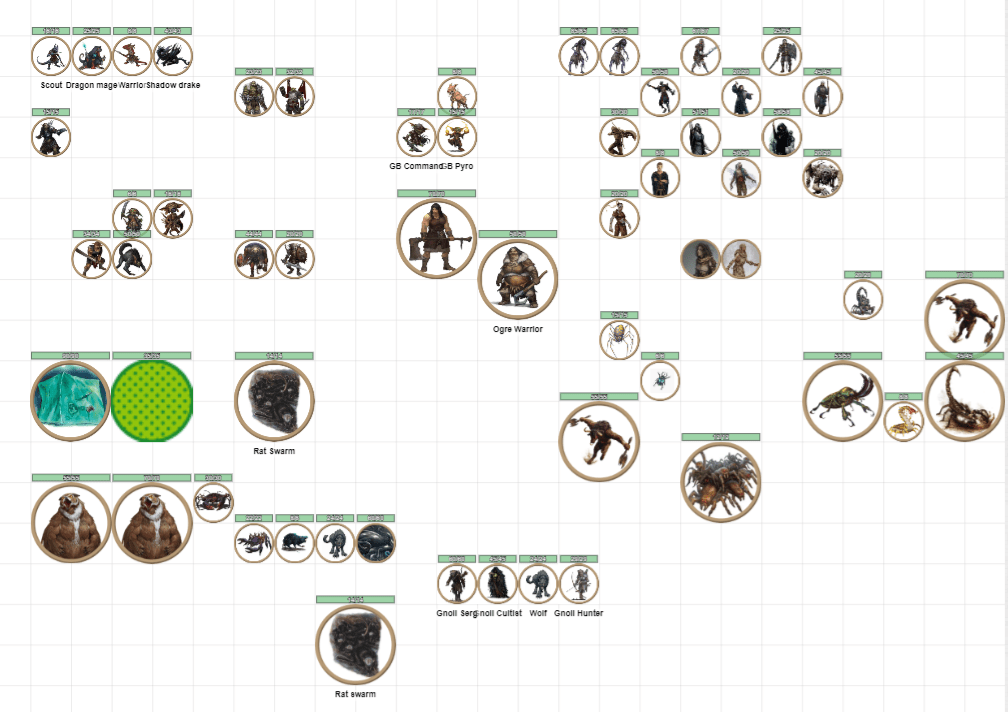
My creature page

Once that was done, I set up the encounters for each cave. I did this for three APLs (one through three), because one of the downsides of a West Marches campaign is that you never know who is going to show up. It was a little more work, but in the end, it was worth it, since it greatly reduced the amount of time it took me to set up a cave.

Setting up the maps

Remember how I said player-created content was a huge benefit to running this AP? I had no shortage of wonderful, detailed, re-imagined maps. I ended up going with the cheekily named “Caverns of Entropy” from Roll20 user Keith Reinig. Even better, right after I bought the set, he added another one with dynamic lighting.

I also grabbed the overland and player maps from Weem as a reference for players between sessions. As they explored, I added their notes and the cave layouts, which cut down on players accidentally keeping vital information to themselves (something none of the players would have done intentionally).

Finally, I added a page in Roll20 for all of my prepped creatures. I ended up using this holding pen so much that I think I’ll keep this around even after I’m done with the caves.

Running the caves!

Now that everything was set up, I was ready to let players make a wreck of my plans. I decided to play it relatively straightforward: The valley appeared near town due to some magical shenanigans and a non-combatant NPC was tasked with getting adventurers to clear it out. This gave the players a hub to work around, since it was presumed that all information was shared with him, and he shared said information with each group. Each session started with players gathering at his shop, where they were shown a map and told details that the previous adventurers had uncovered. From there, they’d decide what they wanted to do, and then set out.

I allowed players to scout one cave entrance per excursion, with a particularly good roll allowing them to also get details about neighboring caves. I’d give a hint as to the kind of creatures inside based on the trash outside the cave (or lack of it). Intelligent creatures might have broken weapons outside their cave, while unintelligent creatures might just have piles of bones. Enemies with military discipline might have neater piles, while a more chaotic group will have stuff strewn everywhere.

Players’ notes

After any scouting, they’d tell me which cave they’d decided on, and I’d put them on mute for ten minutes while I set up. Because this is a mixed level server, I never knew what the APL would be, but having the creatures and encounters set up beforehand saved a ton of time. Once I came back, they’d clear out whichever cave they’d chosen, with a soft-limit of 2.5 hours. Once time was up and they were out of combat, they had to leave, even if there were still creatures roaming around. Since I often run during the week, I can only stay up so late.

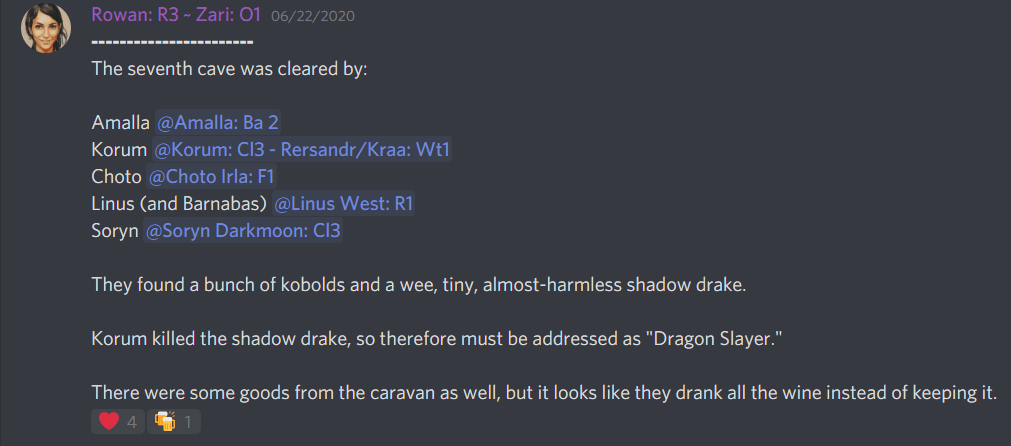
Once the players returned to town, I’d update the map with what was cleared and any notes that were made and post it to the Discord, as well as a synopsis of who went and what the players found.

After-session round-up

How’d it go?

Prepping and converting the Caves of Chaos was no joke, but it was so worth it. I’d guess that I spent around 10 hours converting and scaling encounters, setting up maps, and creating tokens, but this lead to twelve sessions where I had to do minimal prep. To be honest, if I hadn’t obsessed about scaling and instead just scaled everything to APL 2, I could have shaved quite a bit of time off of that prep.

Also, the maps? I wasn’t kidding when I said that they’re truly awesome. Modern map-making tends to focus on a beautiful backdrop to what is essentially an open playing field. The CoC caves have hallways and rooms and dead-ends and secret doors, leading to a more dynamic playing field as activity happens outside the line of sight, PCs get separated, or they get penned in between two different groupings. The maps are also interconnected, which allowed players to sneak into other dungeons and do them in reverse, taking out the boss first, then his minions, and then the scuts at the door.

The players enjoyed the whole quest line. By the time the last cave was cleared, nearly every one of the players on our roster had been to at least one cave, making it a true team effort. I had planned on making the caves disappear at the end of the quest line, but the players started making plans on what they wanted to do with them, so I guess they’ll become a feature of the town. Of course, they are magically created, so who knows what might pop up in the future…

Diving into West Marches

Ever since I saw Matt Colville’s video on running a West Marches campaign, I’d wanted to run one. For those who don’t know, a West Marches campaign turns the idea of a ‘gaming table’ upside down.

  • Instead of one GM and a set number of players, you have a huge pool of players. You may even have a pool of GMs.
  • Instead of a set group of players showing up every week, players self-organize into groups and then figure out a time that works with a GM.
  • Instead of a plot that takes a group around the world, travelling from town to town, the plot centers around a single town that has the Buffy-like habit of drawing problems to it.
  • Instead of a monolith plot, there are multiple threads going on at any time, allowing players to investigate what interests them.

I love the idea of being able to game with a larger group of players, running a plot that was less focused on telling a grand story and more a collection of interesting situations. While I do love a good epic story, it can be exhausting to plot for (especially if you’re an obsessive planner like me). And the allure of having other GMs to fall back on is especially nice. At the time, though, I was already running a campaign, so I put the idea on the back-burner.

Fast-forward to a few months ago, and an interesting opportunity fell in my lap: Becoming a GM for a RP server that hooked into the world of Court of Corvids. I pitched the idea of doing it West Marches style, and Kellandale was born.

The system

One of the biggest hurdles to having a game with handfuls of players and multiple GMs was also the most boring: Record keeping. How do you keep track of XP awarded, gold, purchases, who is playing what, what allowances have been made… After reviewing bots and a moment of madness where I considered writing up an app, we ended up going the route of simplicity.

XP is awarded monthly to everyone on the server. It’s based on the amount of server chatter that month, which we measure by using MEE6. Total server levels * 2 = Total XP for that month. This made keeping track of what level everyone is super easy, since you can find out when someone joined by searching for their username. Does this mean someone could join, say nothing, then roll in a few months later with a level three champion? Sure. But that’s balanced by…

The only way to get gold is to go on missions. When you start on the server, you get 15 gold for your starter gear. After that, if you want to buy gear, runes, potions, spells, or any other adventuring gear, you have to go on a GM-lead mission.

The only thing you get from missions is gold. Now, I love loot as much as the next GM, but I also appreciate the need for balance. Balance is easy at a table with one GM and four players: Just look at their sheets and make sure that they have a similar amount of cool stuff. Is someone behind? Drop something for them in the next encounter. But what do you do on a server where you have multiple GMs and a gaggle of players? How do you make sure everyone has the same access to cool stuff?

The town sells everything you need. The boring solution was you give everyone the same access to cool stuff. Players get a certain amount of gold for every mission. There’s no looting the bodies and selling the gear back at town. Chests don’t hold more than low-level healing potions or items for flavor. Kellandale is a town that’s “big enough” to buy any item you need, as long as you have the gold in hand.

RAW at all times. Aside from a few house-rules that had to be implemented due to the strange nature of the game, we stick to RAW, Paizo-only at all times. This does mean less flavor for players, since they can’t have a cool, GM-bespoke weapon that feeds into their character’s history. Tracking exceptions was too much of a headache, though. We balance that with…

Your rent is paid. Gold earned through missions goes towards adventuring equipment. It’s presumed that the PCs are earning spending money throughout the week using their Lore skills, so rather than roll for it, we assume that they make enough to pay for room and board. Want to go out for a nice dinner? No need to mark down that you spent 5 silver on some Cheesy Chicken at Massimo’s. It’s covered. Want to have a cool looking weapon with no mechanical benefits? Go to town. Heck, want to own a house? As long as it fits your background, go for it.

The GM decides how to run the session. We decided early on that standardizing was going to create a bigger headache than it was worth. So, if a GM is running a session, they decide how they’re going to run it. So far, we’ve run games via voice-only, text, and Roll20, but I wouldn’t be surprised to see a few other options pop up at some point. The only catch is that it has to be free for players to access.

Offer alts. One problem we realized we would have eventually is that eventually we would have wide spread of character levels. Older players might want to play with the newer players, but taking a level one along on an adventure with a crew of level fives is practically impossible to balance.

We decided to balance this by allowing alts. Once your first character hit level three, you could roll up a free level one alt. After this, monthly XP would be split between the player’s characters however they chose. Racing to get to to 20? Don’t put any XP on your alt. Want to play at the lower ranks for a while? Toss them all on there, or split them between the two characters. Get your alt to level three, and you can create a third character.

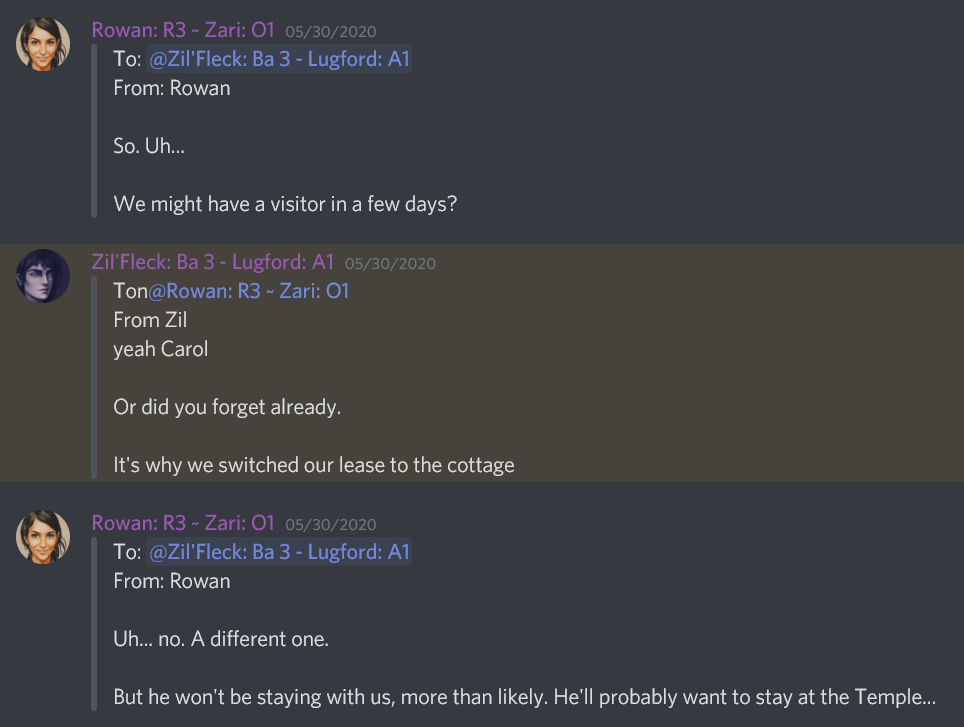
Messaging stones. Several of us came from a modern-setting server where everyone had a smart phone, so everyone could message everyone else. This was super convenient, since it allowed players to communicate without having to ‘happen’ to run into each other or having to run a scene for a quick exchange. Golarian, of course, doesn’t have a data network… but it does have magic! So we created a simple, yet powerful, mechanic: Messaging stones.

That time when my character’s brother came to town…

Every PC is given a free messaging stone when they come to Kellandale. Once they have it, they can send messages to any other PC who has a stone, as long as they’ve met them in game. Yes, they are incredibly powerful, and I would likely ban them at a regular tabletop game, but for a server filled with people in time zones around the world, it’s been the grease that keeps the gears moving.

How’s it going?

We started the server in December, though the first sign-ups didn’t happen until January. Since then, we’ve gone from barely having enough players to keep one GM busy to needing to bring on a fourth GM to make sure all players can be in a session regularly. On the way, we learned some things.

Figuring out sign-ups. One of the suggestions in Colville’s West Marches video was that players would self-organize. It became clear (at least to me) early on that players were not going to self-organize into groups and approach a GM. After all, this was a server where most players barely knew each other. The original West Marches campaign was made of friends. While we’re still feeling our way around the best way to do this, some patterns have emerged.

First, we learned to use the @everyone tag to let people know something is happening. If you’re in one Discord server, you’re probably in a dozen. We couldn’t depend on people checking in every few days.

Second, we started using reactions to figure out what time works best for interested players. For my games, a check meant you were interested and available, an O meant you were interested in being an alt, and an X meant that time absolutely didn’t work for you.

Apparently, no one was interested in fireworks this year.

After a day, I’d look over who was interested and set up the next few sessions. Turnaround time ended up being super important, since waiting too long to get on people’s calendars often lead to people getting booked elsewhere. I could almost always get everyone squeezed in, but if it came down to it, I’d have some people put down as alts with first dibs.

Embracing the meta. Everyone is in a town for the long haul. We’re never leaving, save for a short jaunt. Therefore, if you make a character, they have to have a reason to settle down. And yes, weird things are always going to happen around town, since we can’t travel far, so learn to hang a hat on it.

Building encounters properly is important. This one was a tough lesson to learn. As a GM, you never know who’s showing up to your game. Even if the sign-up was finalized a week before, players shift around, someone decides to bring their alt rather than their main, you get late adds and drops. If there was ever a game where you needed to live by the encounter building rules, it’s a PF2 West Marches campaign.

I learned to be super flexible with planned mobs. As combat got underway, I’d keep an eye on how the group was doing and delete out-of-sight trash mobs if needed. I’d also liberally apply elite or weak adjustments if I felt like the players needed a challenge or a break. I also planned when I could, making sure to calculate a few options so I wouldn’t be sent scrambling if a level 3 didn’t show, and suddenly the APL dropped by one.

Discord data! I love me some data, and since the server was on Discord, I had so much data. Discord has an API you can hit that allows you to download all of the channel data from any Discord you’re a member of. I ended up using said data to create a roster, grab who the new players were, check out which reacts were getting the most use, and see patterns for channel usage.

Future questions

Just because we’ve been doing this for half a year doesn’t mean we know everything. There’s a few issues we’ll have to wrangle with down the road.

Higher level play? The highest level characters on the server right now are level 3. We’ll likely have our first level four characters in August. While we’re not at high-tier play, we are entering into the middle-tier. Do we need to start putting together more complex plots for these higher level characters, or do we just put bigger rats in basements?

The trickiest part about introducing high level play is that there’ll still be lower-level characters running around town. How do we introduce big threats without making it improbable that a level one would stick around?

Level caps? Forced retirement? If a player never puts XP on their alt, they’ll get enough XP to level about every two months. This puts super high-level play off in the future, but mid-tier play is quickly approaching. Do we need to do anything to keep the levels of the characters flatter, or is it okay to have a small group that’s rocketing ahead? And what happens when someone reaches level 20? Do they continue to play, or do they fall into the background, allowing the player to start over again?

Scaling? Right now, we have just over 20 active players (which includes GMs), and four active GMs. This seems to work out fine, as people are able to be in sessions. But will this ratio still work if we hit 40 players? Or 100?

Want to join us?

Kellandale is tied to Queuetime’s Patreon. Anyone who donates once to the $5 tier gets access to the RP Discord and can sign up for sessions as soon as they have an approved character sheet.

[ Sign created with http://apps.pathstoadventure.com/Tavern-Sign-Crafter/craft.asp ]

Larg(ish) combats take two: Off-screen fights

In my Council of Thieves game, the PCs lead a group of lower level rebels. They’ve used them throughout the AP, sending them off on side missions, using them to make up for skill gaps, or bringing them along when the PCs have a large combat.

Recently, the group decided to use them as a distraction. The rebels would keep part of the guard engaged while the main group orchestrated a jailbreak. Due to the layout of the prison, the players wouldn’t be able to directly communicate with the rebels, meaning I would have to simulate what was going on above ground.

True, I could have hand-waved it, but I try to avoid that when it comes to plans like this. Also, the dev in me can’t resist a chance to whip up a script to make things interesting.

The simulation

At first, I thought about writing up something that would take into account hit points, AC, chances of hitting, damage, etc. I decided that was going to be too high effort, especially for a single combat.

Instead, I went with a ‘wound’ system (Note: not the alternative rules from Unchained). I figured a wound would represent a bit of fortitude or luck, like access to healing or a chunk of hit points. Losing a wound point would be akin to getting hit and not having a potion / healer on hand or getting hit especially hard. Running out of wounds would mean your luck had run out.

Combat would work like this:

  • For every two levels an NPC has, they would get one ‘wound’ level. This would be the max number of wounds they can take.
  • Every round, half a wound would be dealt to a random NPC on each side.
  • Once an NPC’s taken their max number of wounds, they are out of the combat and can’t receive more wounds.

For this combat, I decided that being out of wounds didn’t mean the NPC was dead: They’re just unable to fight anymore. Anyone who was at zero wounds would have some sort of injury that would require a heal check and time as well as some magical healing to overcome (like a bone fracture, a bruised rib, a deep wound, etc). While a bit harsh, I wanted to simulate what it was like to be in a combat where you can’t run when it seems dangerous: You have to stick around until you can’t possibly fight anymore.

I also decided that the rebels would scatter as soon as they were down by half. If they waited longer, they may not have enough hands to help the seriously wounded escape with them. In my simulations, this took somewhere between 25 and 30 rounds. I liked that range because it would make things interesting for the jailbreak team. If they took too much time, they might have a second wave of guards descending upon them. If they moved quickly, they might be able to completely take over the prison and guard house.

I decided that the guards wouldn’t retreat as quickly. After all, they’re right by their stronghold, and the ones in the street are working off the assumption that they have back-up coming any second now.

Because it was possible that the main party might come upstairs and clean house, I decided that I’d simplify combat for those left standing. Rather than worrying about hit points, I’d just worry about landing hits. One hit means dealing half a wound (or maybe a full wound if the damage was high enough). When it comes to mopping up, I don’t generally like to split hairs.

The script

In theory, I could have just a rolled a die every turn and kept track of wounds on paper. I wanted to be able to run the simulation a bunch of times, though. This is cumbersome if doing it with pen and die, but trivial when running code. Running the script a bunch of times helped me adjust the numbers so that the fight was interesting without being impossible.

In fact, the multiple simulations are why half a wound is dealt out rather than a full wound: It made the numbers work how I wanted. It also helped me brainstorm how I might interpret the end results.

This script requires Python 3. Also, you need two CSV files, which I included examples of in the repo. Each line is the NPC’s name, how many wound points they have, and how many wounds they start the combat with (generally zero).

[Script] – [CSV file 1] – [CSV file 2]

How’d it go?

When it came time for the combat, I warned the players that I had a script going that would be simulating the battle above, so they should keep that in mind. I felt it was fair to give them a heads up, since I’d been hand-waving much of the off-screen activity of the rebels.

When the combat started, I fired up the script, advancing it at the end of each round. The players mowed through the combat downstairs, and around round 17 ran upstairs and mopped up the guards the rebels had been fighting. By that point, there were two wounded rebels.

Because they knew time was of the essence, I felt like the players pulled out all the stops to end the combat quickly. At the start of the combat, they had no idea if my script was going to hurt people or outright kill them, which seemed fair. They’d never been in this sort of combat with the younger rebels before, so they couldn’t really predict the outcome.

Afterwards, I explained the mechanics of the script. I felt that the PCs could get a rundown from the rebels as to how it went, so a bit of meta-gaming was fine. They didn’t push back on the consequences, and accepted that the rebels that were wounded were going to be down for a day or two. Heck, one even pointed out that one should be out longer!

Future plans for the script

The script was written for a specific combat, so I knew the damage flying back and forth would be somewhat close. In the future, though, I may want to vary the damage output, making one group weaker or stronger.

I also may want the damage dealt to shift as the groups change. Because my simulations showed the groups always being about the same size, I didn’t worry about this, but I could see a future combat where this might vary quite a bit.

Finally, I may have make the script lethal, especially if my players decide to overthrow all of Cheliax…

Council of Thieves: Book Five (as book four)

Fair warning: This post is a long one, since I had to completely rewrite the book twice. Buckle up.

One of the most common suggestions to people who want to run CoT is that they run the books out of order. Since books one, two, and three focus on stopping the shadow beasts, it only makes sense to continue with that thread rather than take a break for a different adventure.

That said, Book Five took quite a bit of reworking before I felt like it was usable. Besides scaling down, some events had to be removed, and a lot of blanks had to be filled in.

Book Five is also like Book Three in that it’s totally possible to take on the end game right after the first session, skipping over the middle part of the AP. If you’re someone who does Just In Time Prep, you’ve been warned.

What I changed (Part One)

Oh, quite a bit. For pretty much the whole book, I figured out what the absolutely vital piece of information / action for each scene was and then re-wrote everything. I knew I had to hit certain beats, so I focused on those:

  • Finding out about House Drovange and the Council of Thieves from an insider
  • Getting some sort of introduction to the Mother of Flies
  • Rescuing the Mother of Flies so the party can learn about Walcourt
  • Taking on Walcourt so the party can kill Ilnerick and create / destroy the Aohl

Re-ordering AP events

Due to swapping books four and five, this meant that the fall of the mayor and Senior Drovange couldn’t have happened yet. Therefore, I had to remove any reference to riots or chaos and save those events until after Ilnerick is take care of. Oddly enough, this wasn’t that hard, since most of the book ignores the events in the Crown Sector.

The Kick-Off

The inciting incident involves dealing with a ‘trusted’ new NPC who the players have never met. My group leans towards paranoia, so the chances of them biting were slim. Instead, I pulled out what absolutely had to be introduced with that scene:

  • Confirmation that Ilnerick is in Westcrown
  • Some information about house Drovage (including their involvement with the Council of Thieves)
  • The involvement of the hags in whatever went down when Eccardian was born
  • The fact that there’s a splinter faction within the CoT

Rather than a new NPC, I used the interlude with the Children of Westcrown to deliver an alchemist to the heroes for questioning. Rugo is a bastard son of Senior Drovage, kept around because he’s utterly loyal, fairly useful, and good to have in case the house is left completely without heirs. With some threatening, he should reveal everything the players need to know in order to move on with the plot.

Mother of Flies

In the book, the players are ambushed while seeking out someone the contact knows, and a follower of the Mother of Flies steps in to help. Instead, I decided to condense things a bit, making the scene where the heroes interrogate Rugo the same scene as the ambush.

To make this work, I moved The Mother of Flies from the Hagwoods to the sewer, reworking her backstory. After her sisters were killed, she fled, but has made her way to the city, hoping to take revenge on the Drovenge family. Unfortunately, her lair was discovered and she’s currently under siege by the Council. At the moment, she’s holding them off, but every day they lose ground.

Some of her agents are still free, and have taken to roaming the sewers, killing reinforcements when they can and looking for a chance to break the siege from the other side.

So, I have two moving parts in the sewers now: Siege reinforcements and Mother allies. As soon as I’m done with the PCs interrogating Rugo, they’re stumbled upon by the reinforcements. As soon as that ruckus is underway, the Mother’s allies come to see what’s going on. After helping out with the combat, the allies can offer some information about the Mother of Flies:

  • She was chased out of the Hagwoods after her counterparts (Sister and Daughter) were killed
  • She came to town to enact her revenge
  • The CoT figured out she was around and have her under siege
  • Rugo was a part of the massacre and was a target for the Mother. The allies that are behind enemy lines are there because they were doing reconnaissance

The main ally is the from the book (Dog’s Tongue), and will give out enough information to hook the players into at least checking out the Mother of Flies.

If the players help end the siege (which is likely, since the siege is also going to make getting around in the sewers harder if they ignore it), they find out where Walcourt is, the history behind Drovage and the Mother of Flies agrees to hole up away from them and leave town once they enact her revenge for her. After that, the players are free to plan an assault on

And then things went to hell

A good plan never survives contact with the players, but I hadn’t expected them to completely wreck them before we even got to the first session.

I was in the middle of planning Book Five when the players finished Book Three. After clearing out Delvehaven, the players decided to resurrect one of the vampires. She was previously a vampire hunter, so likely to be good or neutral, and probably had information they needed. This obliterated the need for half of next book.

I was weirdly delighted with this turn of events. I was losing an interesting NPC (Ailyn, the Pathfinder Bard) soon, so this would give me someone new to introduce the story. Also, it felt a bit more elegant, since even with reworking, the siege felt awkward. Still, it required some scraping of my plans and figuring out if they even needed to deal with the titular Mother of Flies. After all, they’d have the plans for Walcourt and hints about Drovage being involved with the Council of Thieves. They’d be missing some backstory, but that could be inserted later.

What I changed (Part Two)

I decided to create four plots for this book:

  • Reviving Vahnwynne (and dealing with the fallout)
  • Potentially dealing with the Mother of Flies
  • Doing a favor for the temple of Calistria
  • Taking on Walcourt

Reviving a slayer

Reviving Vahnwynne comes with three complications: Finding someone to do the resurrection, acquiring a diamond worth 10k, and dealing with the fallout.

As I wrote before, the Temple of Calistria is the only game in town when it comes to doing a non-evil resurrection. The Temple won’t simply take payment for their services (in fact, they’ll refuse it). Instead, they’ll require a favor. They won’t force the players to carry it out before the resurrection, but when they come calling, they’ll most certainly have a window in which to get it done.

Acquiring a diamond is less of an issue, especially since one of the Children of Westcrown happens to be the daughter of a prominent jewelry merchant. The biggest problem there is finding the cash, since much of the previous spoils have gone into buying property or outfitting the rest of the rebels.

Finally, the fallout. I’ll write about this more in another post, but in short, Vahnwynne comes back with emotional scars. She was a CG person who was forced, via the nature of vampirism, to commit evil acts. Coming back, the memories of such events stay with her, haunting her days and nights. It also doesn’t help that she’s brought back by a group of strangers. If they want her help, the PCs will have to invest some time in getting to know her (and her issues) and helping her recover.

The Mother of Flies

With the resurrection of Vahnwynne, the Mother of Flies becomes unnecessary when it comes to pushing the plot forward. She has some interesting information about the backstory of the Drovage family, but that’s about it.

Rather than use her as an arbitrary stumbling block, I decided to make her optional. I also opted to place her in the sewers of Westcrown (as suggested in a Paizo forum thread) in order to tighten up the plot. She fled from the Hagwoods with a band of followers and has resettled in forgotten part of the sewers, plotting her revenge against Drovage. At the time of the AP, she’s been discovered and is currently under siege.

Vitti, the rebels’ druid, can clue the main PCs in on her existence. In my game, he’s been mapping the sewers, and would note that there’s some strange activity going on. The usual signs of life are disappearing and they’re running into more groups of humans. The players can opt to follow this thread if they want, with the reward being information and a possible alliance, either against Walcourt or for one of their more long-term goals. It also doesn’t hurt that a victory would mean taking out a good chunk of the Council of Thieves standing forces.

I also changed the hook, since the players rarely use the sewers to go anywhere. Instead, two of the CoW (Vitti and Larko, for my game), barely escape an encounter with a band of Council thugs. They tell the PCs what happened and leave it up to them what to do next: Investigate, delay, or ignore the threat.

The Siege

Moving the Mother of Flies underground meant I had to redo the siege. The book lays it out as a rather linear experience involving a lot of enemy fey, which doesn’t make a lot of sense, so I redid it to make it feel more like a group of people being penned in.

The center of the siege is the Mother’s hut, which she placed at a very specific point in order to draw on its power. There are three open areas around her hut, which were originally intended as space for their camp to grown. The Council’s thugs now occupy those spaces, however, blocking her and hers in.

The thugs, at this point, have tried a few pushes, but quickly found that the Mother’s crew can do some serious damage to them. Mother’s side, however, has found that they can’t make a move without the two other sides falling upon their back line. Even if they coordinate with Dog’s Tooth’s group, it still leaves them vulnerable. Both sides are at an impasse.

Each side has about 15 people in it, though several of those people are slaves (something the fey don’t recognize as different than any other enemy). Each group is comprised of one lower level magic caster, one lower level priest, a mix of fighters and rogues, a ranger, and a skald / bard / some other force multiplier. The highest level enemies will be whoever escaped from the fight in the sewers.

Calistria

I’ll be detailing this subplot in another post, but the short version is that the players are tasked with recovering the body of a murdered temple priestess and punishing those responsible in whatever manner seems fit. This will take the crew out of town to a manor, allowing for a nice change in scenery and a chance to use some of their more esoteric skills.

Walcourt

I wasn’t a huge fan of Walcourt as it was in the book. It looks like a fun romp… for any other game. The tone of my game had gotten a bit grim, so I decided to remove some of the goofier elements and play up the corruption of Ilnerick. Rather than being a standard hive, I fashioned it to mimic a Pathfinder lodge, specifically, Delvehaven. The motifs and decor will be familiar to the PCs, and some of the vampires will be former Pathfinders who were tempted too close to his lair.

I ended up using the wonderful Village to Pillage: Murder Mansion as my map. I left most of the levels furnished, only bothering to customize the basement. In game, Walcourt formerly belonged to a noble house that fell during the Chelish civil war. The manor and its lands have never been rehabilitated, in spite of the fact that it sits in the middle Crown Sector. The official reason for this is that the matter of ownership is unclear since many houses could possibly lay claim to the land and the house, but the leaders of Westcrown have made it clear that whoever claims the land must also pay the back taxes on it. Unofficially, Walcourt is kept empty so that the Council of Thieves has a secure location on the island.

Also, you have to keep your pet vampire somewhere, right?

How did it go?

The kick off

Session one was basically set-up for the entire book, What Lies in Dust style. The players got all the hooks during this session and were given no particular order in which to do them. Vahnwynne was raised, they found out about something going on in the sewers, the deal with the temple of Calistria was struck, and they learned the location of Walcourt.

The players immediately accepted that their newly risen party member was traumatized and set about ways to alleviate it. They dug deep into their various tricks to find spells, skills, concoctions, and treasure to figure out ways to help her, which is always nice to see as a GM.

Dropping all the hooks on them at once also seemed to work well, since it gave them freedom to prioritize. The book is very linear, so I’m glad I reworked the plot so that they’re not dependent on each other.

The sewers, the fey, and the siege

The players decided to go into the sewers first, reasoning that if the sewers were now off-limits, the CoW were going to have a harder time getting around.

I set up a crew of Council reinforcements for them to stumble upon. I made it a CR 13 encounter, figuring I’d let the players get into a dangerous situation and then have the red cap Dog’s Tooth step in. He could help turn the tide and get the players moving on the Mother of Flies plot.

One misstep I made: I underestimated my players. They actually did fairly well against the reinforcements, even if the encounter was running long. I had meant to get them to the fey hideout this session, but I ended up having to stop right after introducing Dog’s Tooth.

Meeting the fey

In the third session, the group met Dog’s Tooth and his camp, and it confirmed my suspicions: If the PCs started with common ground with the fey, they’d have no problem making a deal with them. They figured out that many of the fey in the camp were evil, but knowing from the start that they had a common enemy and that the fey intended to leave town after their revenge was had, they decided to play ball.

The PCs got some rough details from Dog’s Tooth about the siege, letting them know that the battlefield had three areas, and that each one held ten to fifteen mortals. This was where I ran into a small problem.

If you give your players some rebels…

…They’ll want to bring the rebels to the fight.

After hearing about the number of potential combatants, the players immediately started planning on bringing all of the Children of Westcrown with them. All of them. I choked at first, since that meant I’d have fourteen friendly NPCs to control.

I almost said no, but then I decided to think about it. After some discussion with my husband (who’s also one of my players), I worked up a solution that would, hopefully, keep combat moving and keep me from having to control an absurd amount of mobs.

The system ended up working quite well. The combat never got bogged down, and while it was still a long fight (around two hours), it never felt slow or drawn out.

The fallout

The players were happy that they were able to clear out a chunk of the Council and got to learn a bit more about the Drovage family. They were also interested in forging an alliance with the fey, though I decided to delay that a bit. The fey informed the players that they had to relocate, and that they would be in contact once that was done.

The players also decided to take a few prisoners from the siege so that they could find out where the other hideouts for the CoT were… which involved maps I totally did not have. Between sessions, I threw together a few possible encounters: A main gathering place for the CoT thugs, a tavern just outside of town (used as a secret entrance to the city), and a warehouse in the docks (mostly for smuggling goods into and out of the city).

Calistria

I had major worried about this side-quest, since there was a chance that the players could seriously foul it up. I decided to heed the advice of Matt Colville, though, and not worry about how the players would get themselves out of a jam.

In the end, the players did perfectly fine: They got out with everything they needed and even made few new allies along the way. It was also a nice break from a combat-heavy book.

The warrens

In the end, the only place that the players ended up hitting up was the Warrens. Once again, I grabbed one of the awesome Village to Pillage maps, tossed in a ton of NPCs, and let the players go nuts. They captured a few guild members, allowing me to toss some more information at them.

The most important discovery was a coded note with instructions to watch certain people. While the players were able to decode the text portions of it, the names of the actual people were left as a mystery. They did manage to get a few names out of the captured thieves, but they didn’t manage to grab the ones who would have been able to tell them that they, the PCs, were on that list.

This was fully intentional, as I wanted to make the players a tiny bit paranoid without sending them into a frenzy of self-defense. Sometimes, a GM needs to be a bit evil, okay?

Delvehaven

Finally, after getting their insider (resurrected Vahnwynne) better and raising some hell, the group descended upon Delvehaven.

Honestly, while this encounter looked super tough on paper, the group breezed through it. They used their insider knowledge, planned the heck out of what they were going to do, and brought all the higher level people with them. Illnerick never stood a chance.

If I could do it again…

Looking back, I’m not sure I’d change a thing. I liked how the book played out, I figured out how to run large-ish combats, and the players seemed to enjoy themselves.

One thing that did bug me: Downtime. With this book, I offered a ton of downtime, spreading out the major events over months. There was nothing especially pressing. Even the request from Calistria didn’t have a due date (as long as they didn’t put it off too long). This lead to the number of sessions doubling, which wasn’t a bad thing, per se, but caused the tension to ease up a bit too much.

I decided that was fine, though. After all, it just made removing all downtime in the next book more distressing…


Population Generator: A script for filling a fantasy town

Hey, I made an online version of this that doesn’t require installing Python! Go check it out!

One of my biggest issues with towns in TTRPGs is that they lack a certain amount of life… literally. I’ve played in huge metropolises and tiny hamlets, and outside of the goods and services available, they’ve felt the same. There’s that one merchant you talk to, that one tavern you know about, and a handful of NPCs that are fairly interchangeable.

As a GM, I’d love to have a town where everyone has a name and a personality. I don’t really have the time to put that together by hand, though. I’m also wary of dumping a huge amount of time into something that my players may simply ignore. I could just make it up as I go along, but I’m terrible about writing down improvised details while in the heat of the moment (this is how a certain shopkeeper in one game ended up with at least four different names).

Ideally, I’d want something to do the work for me, naming my NPCs, giving them personalities and businesses, naming said businesses, and then handing it off to me to use if needed.

Enter the town generator!

Generating random sets of things is something that code is perfect for, so I decided to put together a script that could do it for me. My goals for it:

  • Create a town of N size
  • Populate it with residents
  • Give those residents values to give them some character (age, traits, a wealth level, a job)
  • Give some of the residents a family
  • Pop residents and their family (if any) into a building of some sort
  • Name the taverns and shops
  • Print the whole shebang out to a CSV, so the user can open it in Excel / Google Sheets / whatever

I tinkered with it for a few days, putting in work during coffee breaks and when I had a fit of inspiration. I grabbed a few random data sources, like a list of traits from a researcher at MIT and a bunch of medieval names from an online database. I also spent a bit of a time refreshing random word generators to get some data for my building names.

The results

I ended up with a script that did just what I wanted: Creates and populates a town with residents and businesses! You can see the results of one of the towns I made here.

One of the things I’m enjoying the most are the emergent stories. I considered putting in certain requirements (like a town must always have at least one shop or at least one temple, or can’t be made of only children), but decided against it. For one, it started to feel like a bit of a rabbit hole (why not check the types of temples, or traits that don’t go together, or not having any middle class, or…). But it also created some interesting stories when outlier cases popped up.

For example, in one town I generated, there were a TON of temples. Out of some 300 buildings, 100 of them were a temple of some kind (the normal ratio would have been much lower). What’s going on in a town like this?! Maybe there’s a ton of factions. Maybe the residents follow some of the lesser known gods, or have their own totem spirits. Or heck, maybe they’re all charlatans! And what’s going to happen with that single noble lady who has five sons, all with traits that are at odds with each other…?

The traits also create some fun stories. Each resident is given three random traits. This can lead to a person having traits that are at odds (miserly and generous), or traits that seem at odds with their station (a field hand who’s fancy or a noble who’s rustic). Sometimes, you end up with a marriage where you wonder how in the world they make it work. These just make the people in the city feel a bit more unique and alive. Also, since I’m working with traits and not a block of text, it’s easier to take in during an active session and key off of.

Finally: The business names. I adore the business names. Some of my favorites so far:

  • The Actually Ass tavern
  • The Tripping Chicken
  • The Wishing Wyvern
  • The Half-Elf’s Half-Elf

And the not-safe-for-younger-players:

  • The Wet Wife tavern

Will I use it?

My current campaign takes place in a single city, and my players aren’t in the habit chatting with the locals, so not any time soon. That said, I may go ahead and  run it just in case.

My next planned campaign is a West Marches campaign on Roll20, however, so I’ll likely break it out then. It’s set in a small settlement, but there’s still going to be people bumming around.

What’s planned for it?

Some of the things I’d like to add:

  • Races. Right now, races aren’t a set thing. I’d like to add them in, though I’d like to only do this once I’ve found enough names to add that are actually easy to pronounce
  • A web interface. I’d love for this to not be limited to just people who can run Python.
  • A settings file, so people can tweak the percentages without changing the code.
  • More data!
  • A Python 3 version 😬

Where can I find it?

It’s part of my gamemaster-scripts repo, but if you’re just looking for the files for this script, you can find them here:

https://github.com/kcunning/gamemaster-scripts/tree/master/general/popgen

To run it, you’ll need Python 2.7 installed and the files on your computer, but that’s all. There are no external packages required. If you have an account on Github, feel free to send me a pull request!

Note: Lovely tavern sign created with http://apps.pathstoadventure.com/Tavern-Sign-Crafter/craft.asp

Running a large(ish) combat

In my current Pathfinder game, the players have access to a crew of lower-level rebels. Normally, these rebels are doing their own thing, helping save the world in the background, only coming forward for bits of role play or when one of their areas of expertise are needed. Since they lag quite a bit behind the PCs, they’re rarely taken on missions.

That is, until the latest mission came up.

The PCs were asked to break a siege. They would take one side of the siege, while another group would take another, and those within would take out the last section. They were warned that each side of the siege consisted of somewhere between ten to fifteen people.

As soon as they heard those numbers, they told me that they were going to take the rebels.

“Which ones?”

“All of them.”

I nearly balked, because that would mean controlling not only 15 enemies, but thirteen friendly NPCs. I could see the logic in their demand, though: Of course they would bring more people to the fight. Sheer numbers and a bit of strategy would likely keep the lower level NPCs safe, whereas going on their own, they would be taking a much larger risk.

So, I set about trying to figure out how I would deal with this combat without it becoming a slog, and without it breaking my brain.

A small large combat

Pathfinder does have rules for large scale combats, but those tend towards dealing with actual armies. The scale of this battle was way too small for that to work, so I decided to roll my own.

Organizing the players

I declared all of the “leaders” of the combat: The PCs, my GMPC, and an NPC that they had been fighting alongside recently. Each leader would be commanding a team. If someone wasn’t a leader, then they had to be on a team.

I made my life a bit easier by putting my GMPC in charge of the team of healers and the NPC in charge of just one person, and only so she could get flanking. That minimized the number of decisions I had to make during combat, since one had a set job, and the healers (hopefully) would have actions that were fairly obvious.

Once I had those lower level rebels claimed, I opened up the rest of them to the PCs. I set up a page on Roll20 with all of the tokens for the rebels and let them dole them out among themselves.

This relieved me of having to control a ton of rebels, but I was still worried that combat might take forever as each player looked over an unfamiliar character sheet and tried to sort out what they could do. This can sometimes be a problem in the interludes, when the players have complete control of a rebel (which is why they tend to keep picking the same ones and leaving the unfamiliar ones for me to control). The rebels are level four, so they’ve acquired more than a few tricks.

In the interest of time, I decided that the leaders wouldn’t have absolute control over their team. Instead, at the end of their turn, they could do one of two things: Give a general command to the team (“Take out the cleric!”) or a specific command to one team member (“Cast web over there!”). Otherwise, the characters would either keep on doing what they were last asked to do or do something that made sense to them.

On the last point, I tried to be clear: The rebels may not act in a way that was the most tactically advantageous. They have their own biases, including friendships, romantic leanings, rivalries, personal vendettas, and fears.  They won’t be complete idiots, but they may give up a flanking opportunity in order to protect a friend. They’ll follow orders, but they’re not trained soldiers. They’re used to acting in small groups and watching each others backs.

This simplified things much more for me: I didn’t have to worry about as many decisions, and I could give each rebel some basic strategies that relieved me from looking over their character sheet each turn. I did tell the players that the leaders could communicate freely (“I could use a heal / web over here!”), but at the end of the day, they decided what to do with their people on their turn.

Finally, I grouped the teams to always go after their leader rather than track a bunch of initiatives, because that way lies madness.

Organizing myself

Now that I had the players and rebels sorted, I moved my attention to the enemies.

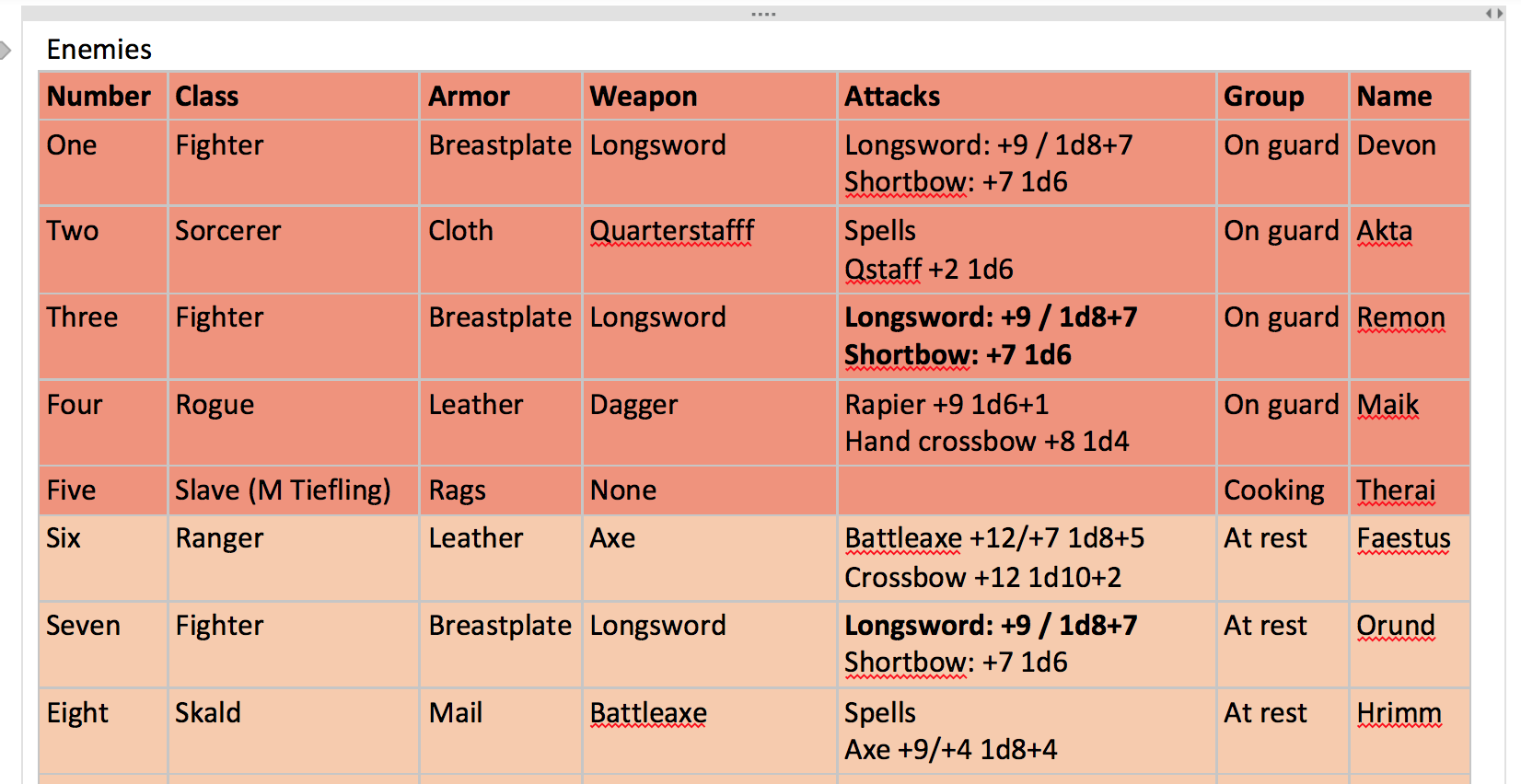
Pulling back the curtain, the actual combatants weren’t as high level as the players probably expected. They consisted of some lower level fighters, rogues, and casters and a higher level skald and ranger, as well as three non-combatants (slaves who were brought with them in order to do basic scut work). Still, I needed to have my ducks in a row.

I decided to split them into three groups: On watch, at rest, and sleeping. Each group would share an initiative, with the on watch group having a +8, the resting group having a +4, and the sleeping group having a +0. On their turn, they’d act however it made sense, because I didn’t feel like keeping track of sub-initiatives.

Screen Shot 2018-10-15 at 9.49.53 AM
The field of battle

I also made a cheat sheet for myself, including their default strategies, gear, and attacks. I wanted to pull up their sheets as little as possible. As much as I love Hero Lab, the interface can be a bit much if you’re juggling more than a few characters.

Screen Shot 2018-10-22 at 11.17.35 AM
My cheat sheet from One Note

Organizing Roll20

Normally, I tracked hit points and conditions through Hero Lab, but for this combat, I decided that going to be too slow. Instead, I used the bar and icon features for tokens, letting me keep track much more easily. I also popped their AC on one of the bars so, once again, I didn’t have to look at sheets.

Rather than trying to remember who was on what team, I used the aura feature of Roll20 to make it clear who was answering to who. I set the aura radius to 0 and square, and gave each team a color that matched their leader. Because my tokens are round, this allowed the aura to show without overtaking any other squares.

I also tracked the initiative openly. Normally, I keep the initiative to myself, but in this case, I felt a bit of meta-gaming would make everything move along a bit faster.

How’d it go?

While I wouldn’t call the encounter short by any means (it ran for at least two hours), it was way more efficient than I’d expected, and there was less fatigue than there normally is in longer combats. The players stayed engaged, and at the end of it gave it a thumbs up.

The players adapted to controlling a team quickly, using them to control the field of battle and give themselves advantage. While the rebels had trouble hitting very hard, they were more than capable when it came to flanking, pinning down, or tossing out spells.

While the combat lasted a while, eventually the group completely wiped the board. They took down most of the enemies and got the last few to surrender once it became clear that they were not only going to lose, but that escape was impossible. None of the rebels were lost, or even significantly hurt. And, best of all, I didn’t feel like my mind was made of mush.

What would I do next time?

While I was largely satisfied with how the combat ran, there were a few tweaks I’d likely make to my prep.

The one thing that had me going back to my sheets were saves. A web was laid down, so I had to keep rolling to see if the mobs were able to free themselves, which meant a ton of going back and forth on their turns.

I’d also make sure players could see all of the health bars. I could see them, but I forgot until too late that the players couldn’t. While some might see this sort of information as meta-gamey, it might have sped up combat a bit rather than have players ask about the health of their team.

I would also have sorted out a macro to deal with bardic songs. Changing a bunch of AC / to hit bonuses at once is a pain and a half. I guess it’s time to do a deep dive into the Roll20 API!


Council of Thieves: Book 3

One of the things that makes book 3 difficult is that the players are technically not fenced off from doing the objectives in any order. It’s even possible to jump straight to the end of the AP. If you’re an obsessive prepper like me, this means getting everything for all sessions (which, for me, is about five sessions worth).

What I changed

Chelish Crux

First, I decided to add to the challenge of the Chelish Crux. A puzzle box that does fire damage is an intriguing concept, but it loses some of the urgency if solving it is merely a series of skill checks.

Instead, I decided to make a lo-fi web-version of the crux (write-up here), forcing the group to choose who would be holding the crux during that attempt. I also changed the rules a bit, having the fire damage occur only on a reset, but doing more damage overall (1d10).

Shadow beasts

Also, I decided to add an encounter for the first session since the players can technically start any of the four objectives, but may want to take some time to consider which direction to go in. The group has been talking about going after a shadow beast for a while, so I decided that Janiven would propose going on a hunt after they figure out the Crux.

The Shadow Beasts are actually shadowgarms (CR 2), which are trivial for a group of optimized level five PCs. I considered switching them to another beast, but a player had previously sussed out what they were with some research. Since the AP has the bodies of the shadowgarms dissolving into a blue gem, I decided to tweak that. Rather than remain inert, when picked up, either physically or by magic, it summons a bearded devil the next round, with the spell causing whoever is in the same square with the gem 2d8 fire damage.

Nasty? A bit. But it’s a good idea not to pick up strange things off the ground, especially if they dropped from a demon’s gut.

The Blue Hood

In book one, The Blue Hood is offered as a side-quest of sorts: The players kill a shadow beast, and the Blue Hood will reward them. Little information beyond that is given, so I filled in some blanks.

I turned the Blue Hood into the head of another Thieves’ Guild, The Grey Ones. Rather than focusing on controlling the laws and politics of the city, The Grey Ones focus on the merchant areas, running rackets, black markets, heists, and the occasional assassination.

The head of The Grey Ones is an older thief named Lupa. Her main concern with the shadow beasts is keeping tabs on any escalation. She strongly supports getting rid of them because it makes running jobs more risky as well as more difficult to pull off. She strongly suspects that the Council of Thieves is behind the shadow beasts, however, so she won’t take any direct action when it comes to them.

In public, Lupo wears a hat of disguise. Rather than trying to be drastically different, she makes subtle changes to herself, like eye color, bone structure, and clothes. She affects a maternal demeanor, moving under the radar of most everyone who interacts with her.

Upon meeting with the heroes at a public house, she’ll note that previous ‘kills’ have lead to blue gems like they saw, but that was it. She muses that someone is ‘escalating quite quickly’ (a hint that things are starting to go awry in the royal sector).

She doesn’t let slip anything about her involvement with The Grey Ones at this point, but if pressed about her interest, she’ll simply say that she’s concerned for her family. A DC 25 perception check from whoever is at this meeting will reveal that there are a number of other patrons around that seem to be keeping an eye on their table.

The Massacre House

First, I leveled up the monks, bringing them to level five. Because the AP was written before all of the splat books, I’ve found that I’ve had to bump up encounter CR in order to challenge the players.

I also thought through the consequences of defeating the Sisters. In my game, I decided that the Sisters were not only responsible for the cremation of the enemies of Thrune, but also of those too poor to afford a regular burial. For health reasons, bodies that can’t be dealt with within three days are taken, cremated, and returned (though often mixed in with the cremains of the other dead). The poor resent the fact that their dead are treated like so much garbage, but don’t push back, since many churches in the city don’t maintain graveyards. Also, at least it’s better than a mass grave that might be plundered by a necromancer and that they couldn’t pay their respects to.

Defeating the Sisters (either by eradicating them or reducing them to one or two survivors) would remove this service from the city. Rather than start up a new crematorium, the leaders of Westcrown would opt to go with mass graves from this point on, even if it means dark mages would have more materials at hand.

The Wave Door

The original encounter for the Wave Door felt like it was a bit light for my group, especially since they’re all playing archetypes from later books and the AP was written with the core classes in mind. I thought about upping the number of creatures, but instead, I opted to make the terrain a bit more interesting.

The AP implies that the encounter takes place on land, but I decided to make the wave door inside a cave completely filled with water. The water is, at the time they get there, ten feet deep, forcing the players to use a small boat (in this case, a rowboat) or spell to allow them to navigate through it.

Once the fight breaks out, players must make an Acrobatics check every time they engage in melee or move.

  • If both hands are being used with a non-ranged weapon (a two-handed sword or someone wielding a sword and a shield), the DC is 20
  • If one hand is being used with a non-ranged weapon or the ranged weapon has kickback (like a gun), the DC is 15
  • If a ranged weapon is being used, the DC is 10
  • Magic has no required check as long as the magic user is sitting down (DC 10 otherwise)
  • Moving around on the boat (which will be limited anyway) has a DC of 10
  • Moving from one boat to the other via jumping will be a DC 20. If they’re next to each other, it’s a DC 15

As for the failures and successes:

  • On a success, the PC can then make an attack roll
  • On a critical success, they don’t have to roll a check the next turn
  • If the roll fails, the PC stumbles and doesn’t connect with the creature
  • If the roll fails by more than five, the PC drops into the water and must spend their next turn getting back into a boat
    • If they make a DC 15 climb check, they only use up their movement
  • If the roll is a critical fail, the boat capsizes, sending both players over the side. The next two turns must be spent getting back into the boat (one to right the boat, the next to climb in). For that first turn, however, they have 75% cover
    • On the second turn, if they make a DC 15 climb check, they only lose their movement

Delvehaven

Honestly, not much needed to be changed with regards to Delvehaven. The only thing I had to do was fill in the blanks where flavor was concerned.

One of the bits of flavor involved a set of potions that were tweaked to be more palatable (think a craft brew that also heals you). The book refers to them and about how clever the labels are… and then doesn’t give you what’s on the labels. I asked the punmasters of Reddit for help and eventually came up with the following names:

  • Good for what ales you (Cure moderate)
  • Hair of the dog (Lesser restoration)
  • Levitate (Kilt Lifter)
  • Milquetoast pale ale (Mage armor)
  • IPA (in small print: Instant Protection from Arrows) (Protection from arrows)
  • Formerly Lager (Reduce person)

Also, I decided to leave a note in a room full of burned scrolls and books. According to the AP, while Delvehaven was under attack, a Pathfinder took everything of importance and escaped the lodge via magic. I opted to leave a note explaining his actions, leaving out his final destination.

To whomever finds this:

Enemies to the Pathfinders are at the gates, and we cannot allow this wealth of knowledge fall into their hands. At Venture-Captain Ghaelfin’s orders, I have taken everything that is of import with me for when we take back Delvehaven. May the gods let me see that day.

Pathfinder Leonito Corvus, Master of Scrolls

While the note doesn’t say where he escaped to, Ailyn will know that he eventually settled in Kintago, where he set up an underground lodge to ready for the day that the Pathfinder Society could return to Cheliax. He died some years later, an old man, never having returned to Westcrown. His two children (Iola and Marto) have continued his work, and have worked with Ailyn during previous missions.

There’s also a room where the AP suggests adding an extra piece of loot from the book’s supplemental content. I ended opting for the Clasp of the Mind Scream because I felt it was the most interesting given the make-up of the party and how they tend to operate.

A parting gift

According to the AP, Ailyn’s parting gift to the PCs is some cash for each Pathfinder found. This felt a bit empty, especially since the party (due to some canny betting) has more than enough money. Instead, I opted to have her gift the party with some ioun stones. This is doubly fitting, since all of the PCs took the trait “The Pathfinder’s Exile,” which gives them all a free wayfinder, and the party finds two more wayfinders in Delvehaven, as well as an ioun stone.

How’d it go?

Session one: The Crux, Shadow Beasts, and the Blue Hood

I was most nervous about using the Crux with my players, since it held the chance of becoming tedious (the solution, after all, is purely random). It ended up working perfectly, though. You can read the whole write-up here.

After solving the Crux, the players decided to track down a Shadow Beast. Due to where the beasts were, they killed one before the second one had shown up. A PC picked up the blue stone, triggering the appearance of the bearded devil just as the second Shadow Beast attacked the back-row PCs. There was a beautiful moment of dawning horror when they realized the easy fight they’d been expecting had suddenly gotten much more difficult.

The players, after discovering that this was a new development, wondered if they had a mole, with a significant amount of the suspicion falling on Ailyn, the visiting Pathfinder.

The next day, the players tracked down the Blue Hood. They picked up on her possibly being the head of a thieves’ guild of some kind. One was frustrated with her, while the other is considering contacting her again, which might lead to some interesting end-game situations.

Session Two: The Devildrome

Though I changed nothing about this encounter leading up to it, I did make a change mid-fight. According to the AP, Thraxx will fight to the death. Our Archanist, though, used the message spell to taunt him, and with a few extremely high rolls, caused Thraxx to abandon his strategy early. He was moved into a position where defeat was obvious, so he surrendered. Thraxx was banned from the Devildrome and is now in the GM stables as a future foe (once he finishes drowning his sorrows).

Session Three: The Massacre House

Leveling up the monks worked perfectly for balancing the encounter. It was a challenge for the heroes, though not so much that it became a death spiral.

Also, the heroes managed to leave all of the Sisters alive and still unaware of who they were. The end result of this is that the Sisters don’t leave the city, but do shut down any access to their monastery. Bodies must be left outside and anyone who lingers is shot. Even supply runs have stopped, instead being delivered by the city guard. They have also sent word to a fellow temple that they are in need of recruits.

Session Four: The Wave Door

After starting the encounter with the Shadows, I ended up chickening out on forcing everyone to roll acrobatics rolls with every swing. In the moment, it felt like it would have slowed down combat and made what was a fairly deadly encounter even more deadly (possibly to a TPK level).

I did stick to requiring an acrobatics roll for movement, which worked quite well, forcing everyone to carefully consider their moves and look through their bag of acquired tricks to come up with new game plans.

Leveling up the mobs to three regular shadows and one plague shadow also worked quite well. They had just enough longevity to be a challenge and hit just hard enough to be a real threat. Pretty much everyone in the group was two strong rolls away from death.

Even with with the planning to get there, this encounter was quite short, with everyone back in town with the loot two hours before our sessions normally ended. They used the time to level up, plan the Delvehaven expedition, and at least start exploring the abandoned lodge.

Session Four through Six: Delvehaven

To my surprise, the players opted to invite Ailyn along, so I was glad that I’d actually written up a character sheet for her. I had decided to make her a Chronicler, since that gives her a cover (being a bard) as well as the background knowledge she’d need to undertake the mission.

The players enjoyed the ‘craft’ potions quite a bit. The investigator of the group (who runs an alchemy shop) voiced an interest in making his own. I had him roll a perception check, and since he blew it out of the water (of course), I let him find some notes left by the brewer to get him started.

A quick aside about the skill checks: If you have a skill monkey in your party, the group truly can bypass 80% of the AP and go straight to Delvehaven. If you don’t want this to happen, make sure to build in a few firm blockers.

If I did it again…

I would go ahead and merge books three and five. The players were a bit put out that Ilnerick, the big bad they’ve been chasing, wasn’t in the basement and that they’re going to have to do a lot more to get to him. Looking back, I can see how this was telegraphed by the AP (you find lots of clues about him as you explore), so I’m sympathetic to their reaction.

Other than that, I was pretty happy with my changes. The encounters were actually challenging for the players, and overall, the book is a pretty fun romp through Westcrown.


Westcrown and Resurrection

As my Council of Thieves game has progressed, I’ve found myself thinking more and more about what it would be like to try to get someone resurrected in the middle of a town full of literal demon worshipers. The players have had a few close calls, and the AP doesn’t get any kinder the further you go, so this will likely come up before the big finale.

I tend to stick to the official rules when it comes to raising the dead: You have to have someone who can cast it, the body in the correct state, and the material component required (no raiding the piggy bank or hand waving). The stickler during CoT is the first item: Finding someone who can cast it.

If you follow the recommended level progression, the players don’t get someone in their party who can cast any of the raise dead spells until book four unless they do a significant amount of side quests or the GM keeps the NPC cleric Areal a few levels ahead of the players. Westcrown is a huge town though, so surely there’s someone around who can cast it for a price, right?

The problem with paying

Paying for healing and disease / curse removal probably isn’t a big deal for most churches. After all, most people would naturally heal on their own, so why not make a bit of cash / spread a bit of good will / possibly covert someone for the cost of a low-level spell slot?

Raising the dead, however, is a completely different matter. First, it’s not a self-rectifying situation. Without intervention, the dead stay dead. Secondly, it’s expensive, and the materials (diamonds worth 5k / 10k) may not be readily available or kept on hand. Finally, what sort of person are you willing to bring back into the world?

A prominent follower is an easy sell. Most churches would want that high level person to come back. But what about someone who isn’t a follower? A ‘good’ church would likely want to make sure that this person they’re bringing back isn’t evil. In fact, they may want to limit their resurrections to those who are actively doing good in the world, or they’d be overrun with the corpses of good-yet-ambitionless people.

And what if the church isn’t good? What if the only church you have available is neutral and doesn’t necessarily care about some do-gooder adventurer challenging the status quo? This is what we run into with Westcrown.

The problem with Westcrown

The funny thing about Chelliax is that they technically haven’t banned other religions (save for Aroden), but they’ve let it be known that this is at their pleasure. They have no problem bringing down the hammer, especially if other churches are growing too powerful. I felt the fallout of this would be that most churches in Chelliax that are ‘good’ tend to be small. They know that appearing to be a threat would only lead to their followers being imperiled, and a powerful cleric is extremely threatening.

So, back to Westcrown during CoT: It’s very likely that Areal and any PC clerics are the most powerful good clerics in town by the end of book two, and that’s with them being around level five. So, who could they go to if they need someone to raise one of their party?

Making deals

Looking over the standard deities, I felt that one church would not only be likely to have a significant presence in Westcrown, but to also be game for talking to a group of do-gooders: Calistria.

Calistria is a Chaotic Neutral deity with a bent towards trickery, deceit, and lust. This slots in perfectly with the powerful people in Westcrown and isn’t completely offensive to the tenets of Asmodeus. They would probably be the only other church who could grow enough to have a high enough level cleric. While the temple wouldn’t be likely to raise the dead out of the goodness of it’s own heart, it would be happy to make a deal.

Some might assume this means becoming a temple prostitute, but it turns out that the temple is adamantly against forced sex work. Not only would they not suggest it, but they would probably turn down the offer since it wouldn’t be a ‘true calling’ for the person in their debt.

The temple is, however, interested in politics, from the collecting and spreading of rumors to the humiliation of those who cross them. While their sacred prostitutes do much of that work for them, there are surely situations where a third-party group work better. For example, if a certain sector didn’t partake of their services, having a few canny insiders could be beneficial. A group of outsiders would also be a good way to take an opponent down a peg or two without publicly implicating themselves.

So, those are my thoughts on Westcrown and raising the dead. I have to admit, I like the potential plot hooks so much I almost want my players to have a reason to use them…


Council of Thieves: A virtual Chelish Crux

At the end of Book Two of The Council of Thieves, the players find a strange artifact called the Chelish Crux. Book three opens with the players trying to open it. From the AP:

This strange and baffling object appears as a wooden and metal dodecahedron that measures about 6 inches in diameter— each face of the crux is carved with a different rune, and when one looks upon the thing, the observer has the unsettling sensation that he can see too many or too few sides at once.

To open the box, the players must trace the symbols on the outside of the crux in the correct order. If the correct symbol is traced, it lights up. If an incorrect symbol is traced, all of the lit symbols go out and the player must start from the beginning. After a certain number of unsuccessful tries, the box erupts into flame, causing fire damage to whoever was holding it and resetting the combination.

Basically, it’s Hell’s Simon.

In the book, the players open the box via a series of skill checks, but being a code monkey, I figured I could do one better: Make a virtual one!

puzzle
The Crux with two correct guesses

Using a bit of Javascript, I created a basic Chelish Crux. How it works:

  • When first loaded up, all squares are black. “The crux’s sides are all dark, save for the occasional flares of red light dancing at the edges.”
  • If a player touches a correct square, it turns red. “When you finish tracing that rune, the metal under your fingers begins to glow red from within, as if being heated in a forge, even though the metal is cool to the touch.”
  • If a player touches an incorrect square, the squares briefly go grey, and all lit squares go out. “For a moment, all lights fade on the crux, even those that appeared at the edges. All of the lit sides go dark once more”
  • If the player runs out of chances, the squares flash madly and then go to black. “As you finish tracing the rune, flames erupt from the edges, bathing the crux in flame and scorching your skin.” The player then takes fire damage. I did 1d8, but this can be adjusted to match the level of the campaign (theoretically, this could be made stronger if someone was willing to pay more).
  • After the explosion of flames, the players are allowed to make a roll to see if they see a pattern in the racing red lights at the edges.
    • A success means the hint level goes up by one. At the end of the URL, I add (or update) “?hl=” and then the number of the new hint level. So, for example, the URL might be https://therealkatie.net/gaming/puzzle-box.html?hl=4 if they’ve gotten four successes.
    • If they don’t make the roll, there’s no penalty. They simply need to go through the process again to trigger another failure
    • If the person holding the crux managed to get at least three more squares correct on that round, then that is considered an assist on the next disable device check.
  • The first time the players go up a hint level, they’ll see that one square is already red. “After studying the lights for a few minutes, you’re positive that this rune is the first rune you should trace. After that, you don’t know.”
  • If they’ve gone up multiple levels, “Studying the lights, you figure out the first few runes to trace, but after that, you’ll have to guess.”
  • If the players manage to get the combination, all of the squares go green, and I describe the box opening. “The box unfolds into a flat square made of metal and wood, about two feet by two feet.”

In game, I described the box as above, but said nothing else, allowing a player to toy around with the web page on my tablet. I only interjected the first time, explaining what it meant when the squares turned grey, red, or flashed. They figured out for themselves that they had to input a combination, and that the combination was twelve runes long, and that it reset. After each attempt, I’d have them make their disable device check, and if successful, I changed the URL to match their hint level and handed it back.

I believe it took about 15 minutes for the players to solve (I don’t think they ever failed a check), and they managed to get it open at the sixth hint level. I feel like it was much more engaging than just a series of skill checks, and making the puzzle physical forced everyone to stay engaged with who was holding the crux (and therefore who was taking the damage).

Feel free to play with the crux yourself, or if you want to, change the code to suit your needs! And apologies in advance for the extremely rough code. Since it was a single use project, the level of love that went into it was rather low.

Council of Thieves: Book 2

The background

After getting back in the GM saddle with Book 1 (pw: council if it’s still protected), I decided to immediately get into book two.

From Paizo:

To banish the monstrous shadows that stalk Westcrown by night, the PCs go undercover, joining the city’s chaotic theatrical community in an elaborate plot to infiltrate the estate of the decadent lord-mayor. Yet theater life turns deadly when they become players in a spectacle no actor has ever survived. Can the PCs endure their debut performance in a city where an actor’s first big hit is often his last?

What I changed

Before the book

Since the PCs were taking an interest in the rebels, I decided to go with the implied suggestion that they should train up the lower level characters. I stuck with what I felt they could reasonably train, so we didn’t end up with a monk, druid, or barbarian. Before the first session, I sent out a list of what everyone had trained as.

My plan is to keep the rebels three levels behind the PCs with the assumption that they’re going out on their own missions. I’ll probably stop them all at some point, since there’s only so much experience you can get running around the city.

I also leveled up Janiven and Areal a bit, with both of them staying a level ahead of the PCs. At level five, however, I’ll probably only continue leveling Janiven (since that’s who they always bring along).

The rehearsals

Because one of my players was part of a theater troop, I ended up moving the rehearsals there. In story, this was because his sister (a bard), disapproved of his auditioning for a murder play and wanted to keep an eye on the production.

I decided to change the benefits for befriending cast members. I felt like the long-term benefits wouldn’t be clear to the players, so I switched some of them to short-term benefits. For befriending one of the actors (and consistently interacting with them), they got a re-roll on a performance check (basically, stealing the Advantage system from 5th Edition) or a bonus on their next perform check.

I also extended the hours that the actors were available by removing curfew for them. In game, the actors were allowed to retire to a bar to relax and socialize, and the mayor made sure they were escorted home afterwards.

As a bit of flavor, I had Yakopulio run a betting pool on who would survive the play. The players ended up betting on themselves, earning them a tidy sum after they all survived.

The play

For the play, I upped the reward amount since it seemed a bit low for such key roles (and because they had been creative about drumming up business for the play). I also played fight music from Oblivion for each scene (when I remembered), which helped set the mood.

Pre-Cornucopia

I ended up modifying the Cornucopia the most. One of the reasons I did this was because one of the PCs scolded Janiven (their fourth actor) for spending too much time dealing with rebel business and not focusing on the play. I had been keeping Janiven in the background in order to keep the spotlight on the PCs, with the excuse being that she was coordinating information gathering on the Mayor’s mansion and the Knot.

So, I had Janiven ‘hand off’ the duties to Yakopulio, meaning that the players now expected something concrete. After the play, Yakopulio came up with a few things:

  1. She could get one person on the inside as staff. Guards positions were already filled, but she could get a servant, groundskeeper, or stablehand in. She also nixed several people right off the bat: Tarvi (since she mingles with nobles, she’d be recognized), Areal (he’s known as a cleric and would stand out as a servant), Sclavo (since he works in court), and herself (since she’s setting up the deal).
  2. She gave them a very rough map of the interior of the mayor’s mansion (below). Because she was getting this information verbally, the map is extremely rough. The attic wasn’t included because her informant (a former servant) wouldn’t have been allowed up there.
  3. She got a list of prominent nobles and dug up some information on each. Tarvi and Sclavo added their own thoughts on them.
  4. She got them a list of courses (which was kind of pointless, but I felt added some flavor).

Yakopulio’s beautiful maps:

firstfloorsecond floor

The players ended up picking Fiosa as their insider (her background as a servant made her more invisible). They also ended up bringing Tarvi as a ‘date.’ Tarvi served as a boost to any social checks, and Fiosa could have been used as a distraction / information gatherer (though they didn’t end up using her). They also would have been fine with going into the Knot, though the party ended up asking them to stay behind and leave at dawn with the other guests.

The Cornucopia

I kept the basic structure of the Cornucopia the same, but I realized quickly that the players were attempting to talk to the same people over and over again, which made sense. Wouldn’t someone have more than one piece of juicy information?

I decided to go ahead and let secrets from other characters come up as long as there was a chance that they would know that secret. I also made up a few other secrets to keep things interesting. I also decided to allude to Chammady’s brother, since it makes sense that the other nobles would know of him, but not know that he’s a tiefling. All they know is that he exists and has been working in another town in Chelliax for some time.

Amusingly enough, the one noble that they all agreed was a good potential ally was… Chammady.

The Asmodean Knot

I ended up not needing to make any mods to the Asmodean Knot. Personally, I think it’s a great dungeon, and I ended up running it as a one-shot at a conference. Since our sessions are only four hours long, it ended up being a two session romp, including the winding up.

I had been worried about the maze, but the players (happily) solved the puzzle via the open/close spell. I truly do pity the group who doesn’t bring a druid or magic user with them…

The Knot also ended up solving a big problem I had with the AP: How Chammady knows that the PCs are members of the Children of Westcrown. Because the PCs don’t advertise the fact that they’re rebels, even with them being in the play, it should be nearly impossible for Chammady to sort out their night-time activities. Westcrown is a big city, and she has quite a few irons in the fire!

Sian escaped her encounter with the PCs and, of course, reported back to Chammady that she ran into the heroes. While she didn’t know exactly who they were (she wasn’t at the play), the description of the foursome was enough for Chammady to draw some conclusions.

How Chammady chooses to use this information will largely depend on what the players decide to do when they encounter her in the next book. She may mark them for extermination… or she may chose to manipulate them to take out other troublesome foes.

Tech I used

Because this book involved lots of maps where there was little fighting, I decided to use Roll20. This wasn’t especially disruptive since everyone was already bringing their laptops to games. The only rooms I drew out on a paper map were ones where combat was highly likely.

I did have to edit the maps to remove secret doorways, but it ended up saving me a lot of time double checking a ton of tiny rooms and some of the trickier puzzles of the Knot.

If I had to do it over again…

I would have put Ailyn’s pitch in a note. Most of the players were so distracted by the play that they kept forgetting why they were doing all of this crazy stuff in the first place. I may have even put it on a ‘secret page’ to set up the idea that they might see one of these later.

I would also try to give them more concrete evidence that there was something in the Mayor’s mansion, and that the play was the only way to get in. While the players went along, the plot thread felt more like marching towards a darling than anything else.

As fun as the dinner was, I probably would either shorten it or do the dinner in one session and the hunt through the house in the second. Things got a bit rushed as I was trying to end the game for the night at a good stopping point.

Final thoughts

This book is probably one of the reasons that some people hate this AP, but my group loved it. They enjoy role playing, and there was no shortage of that with these chapters. Pretty much everything until the end is a long role play session.

I used the Knot as a one shot at a conference, and it was a great hit. It needed only a tiny bit of cleaning up, and with a bit more tightening, I feel like it could be made to fit into a nice four-hour time frame.

In fact, even if you don’t plan on running CoT, I highly recommend picking it up. If you scrub the plot from it (which isn’t hard), you end up with three interesting scenarios that can be dropped into many adventures: A murder play, a fancy dinner party, and an interesting dungeon that’s more than just a series of mobs.