Council of Thieves: Book 3

One of the things that makes book 3 difficult is that the players are technically not fenced off from doing the objectives in any order. It’s even possible to jump straight to the end of the AP. If you’re an obsessive prepper like me, this means getting everything for all sessions (which, for me, is about five sessions worth).

What I changed

Chelish Crux

First, I decided to add to the challenge of the Chelish Crux. A puzzle box that does fire damage is an intriguing concept, but it loses some of the urgency if solving it is merely a series of skill checks.

Instead, I decided to make a lo-fi web-version of the crux (write-up here), forcing the group to choose who would be holding the crux during that attempt. I also changed the rules a bit, having the fire damage occur only on a reset, but doing more damage overall (1d10).

Shadow beasts

Also, I decided to add an encounter for the first session since the players can technically start any of the four objectives, but may want to take some time to consider which direction to go in. The group has been talking about going after a shadow beast for a while, so I decided that Janiven would propose going on a hunt after they figure out the Crux.

The Shadow Beasts are actually shadowgarms (CR 2), which are trivial for a group of optimized level five PCs. I considered switching them to another beast, but a player had previously sussed out what they were with some research. Since the AP has the bodies of the shadowgarms dissolving into a blue gem, I decided to tweak that. Rather than remain inert, when picked up, either physically or by magic, it summons a bearded devil the next round, with the spell causing whoever is in the same square with the gem 2d8 fire damage.

Nasty? A bit. But it’s a good idea not to pick up strange things off the ground, especially if they dropped from a demon’s gut.

The Blue Hood

In book one, The Blue Hood is offered as a side-quest of sorts: The players kill a shadow beast, and the Blue Hood will reward them. Little information beyond that is given, so I filled in some blanks.

I turned the Blue Hood into the head of another Thieves’ Guild, The Grey Ones. Rather than focusing on controlling the laws and politics of the city, The Grey Ones focus on the merchant areas, running rackets, black markets, heists, and the occasional assassination.

The head of The Grey Ones is an older thief named Lupa. Her main concern with the shadow beasts is keeping tabs on any escalation. She strongly supports getting rid of them because it makes running jobs more risky as well as more difficult to pull off. She strongly suspects that the Council of Thieves is behind the shadow beasts, however, so she won’t take any direct action when it comes to them.

In public, Lupo wears a hat of disguise. Rather than trying to be drastically different, she makes subtle changes to herself, like eye color, bone structure, and clothes. She affects a maternal demeanor, moving under the radar of most everyone who interacts with her.

Upon meeting with the heroes at a public house, she’ll note that previous ‘kills’ have lead to blue gems like they saw, but that was it. She muses that someone is ‘escalating quite quickly’ (a hint that things are starting to go awry in the royal sector).

She doesn’t let slip anything about her involvement with The Grey Ones at this point, but if pressed about her interest, she’ll simply say that she’s concerned for her family. A DC 25 perception check from whoever is at this meeting will reveal that there are a number of other patrons around that seem to be keeping an eye on their table.

The Massacre House

First, I leveled up the monks, bringing them to level five. Because the AP was written before all of the splat books, I’ve found that I’ve had to bump up encounter CR in order to challenge the players.

I also thought through the consequences of defeating the Sisters. In my game, I decided that the Sisters were not only responsible for the cremation of the enemies of Thrune, but also of those too poor to afford a regular burial. For health reasons, bodies that can’t be dealt with within three days are taken, cremated, and returned (though often mixed in with the cremains of the other dead). The poor resent the fact that their dead are treated like so much garbage, but don’t push back, since many churches in the city don’t maintain graveyards. Also, at least it’s better than a mass grave that might be plundered by a necromancer and that they couldn’t pay their respects to.

Defeating the Sisters (either by eradicating them or reducing them to one or two survivors) would remove this service from the city. Rather than start up a new crematorium, the leaders of Westcrown would opt to go with mass graves from this point on, even if it means dark mages would have more materials at hand.

The Wave Door

The original encounter for the Wave Door felt like it was a bit light for my group, especially since they’re all playing archetypes from later books and the AP was written with the core classes in mind. I thought about upping the number of creatures, but instead, I opted to make the terrain a bit more interesting.

The AP implies that the encounter takes place on land, but I decided to make the wave door inside a cave completely filled with water. The water is, at the time they get there, ten feet deep, forcing the players to use a small boat (in this case, a rowboat) or spell to allow them to navigate through it.

Once the fight breaks out, players must make an Acrobatics check every time they engage in melee or move.

  • If both hands are being used with a non-ranged weapon (a two-handed sword or someone wielding a sword and a shield), the DC is 20
  • If one hand is being used with a non-ranged weapon or the ranged weapon has kickback (like a gun), the DC is 15
  • If a ranged weapon is being used, the DC is 10
  • Magic has no required check as long as the magic user is sitting down (DC 10 otherwise)
  • Moving around on the boat (which will be limited anyway) has a DC of 10
  • Moving from one boat to the other via jumping will be a DC 20. If they’re next to each other, it’s a DC 15

As for the failures and successes:

  • On a success, the PC can then make an attack roll
  • On a critical success, they don’t have to roll a check the next turn
  • If the roll fails, the PC stumbles and doesn’t connect with the creature
  • If the roll fails by more than five, the PC drops into the water and must spend their next turn getting back into a boat
    • If they make a DC 15 climb check, they only use up their movement
  • If the roll is a critical fail, the boat capsizes, sending both players over the side. The next two turns must be spent getting back into the boat (one to right the boat, the next to climb in). For that first turn, however, they have 75% cover
    • On the second turn, if they make a DC 15 climb check, they only lose their movement

Delvehaven

Honestly, not much needed to be changed with regards to Delvehaven. The only thing I had to do was fill in the blanks where flavor was concerned.

One of the bits of flavor involved a set of potions that were tweaked to be more palatable (think a craft brew that also heals you). The book refers to them and about how clever the labels are… and then doesn’t give you what’s on the labels. I asked the punmasters of Reddit for help and eventually came up with the following names:

  • Good for what ales you (Cure moderate)
  • Hair of the dog (Lesser restoration)
  • Levitate (Kilt Lifter)
  • Milquetoast pale ale (Mage armor)
  • IPA (in small print: Instant Protection from Arrows) (Protection from arrows)
  • Formerly Lager (Reduce person)

Also, I decided to leave a note in a room full of burned scrolls and books. According to the AP, while Delvehaven was under attack, a Pathfinder took everything of importance and escaped the lodge via magic. I opted to leave a note explaining his actions, leaving out his final destination.

To whomever finds this:

Enemies to the Pathfinders are at the gates, and we cannot allow this wealth of knowledge fall into their hands. At Venture-Captain Ghaelfin’s orders, I have taken everything that is of import with me for when we take back Delvehaven. May the gods let me see that day.

Pathfinder Leonito Corvus, Master of Scrolls

While the note doesn’t say where he escaped to, Ailyn will know that he eventually settled in Kintago, where he set up an underground lodge to ready for the day that the Pathfinder Society could return to Cheliax. He died some years later, an old man, never having returned to Westcrown. His two children (Iola and Marto) have continued his work, and have worked with Ailyn during previous missions.

There’s also a room where the AP suggests adding an extra piece of loot from the book’s supplemental content. I ended opting for the Clasp of the Mind Scream because I felt it was the most interesting given the make-up of the party and how they tend to operate.

A parting gift

According to the AP, Ailyn’s parting gift to the PCs is some cash for each Pathfinder found. This felt a bit empty, especially since the party (due to some canny betting) has more than enough money. Instead, I opted to have her gift the party with some ioun stones. This is doubly fitting, since all of the PCs took the trait “The Pathfinder’s Exile,” which gives them all a free wayfinder, and the party finds two more wayfinders in Delvehaven, as well as an ioun stone.

How’d it go?

Session one: The Crux, Shadow Beasts, and the Blue Hood

I was most nervous about using the Crux with my players, since it held the chance of becoming tedious (the solution, after all, is purely random). It ended up working perfectly, though. You can read the whole write-up here.

After solving the Crux, the players decided to track down a Shadow Beast. Due to where the beasts were, they killed one before the second one had shown up. A PC picked up the blue stone, triggering the appearance of the bearded devil just as the second Shadow Beast attacked the back-row PCs. There was a beautiful moment of dawning horror when they realized the easy fight they’d been expecting had suddenly gotten much more difficult.

The players, after discovering that this was a new development, wondered if they had a mole, with a significant amount of the suspicion falling on Ailyn, the visiting Pathfinder.

The next day, the players tracked down the Blue Hood. They picked up on her possibly being the head of a thieves’ guild of some kind. One was frustrated with her, while the other is considering contacting her again, which might lead to some interesting end-game situations.

Session Two: The Devildrome

Though I changed nothing about this encounter leading up to it, I did make a change mid-fight. According to the AP, Thraxx will fight to the death. Our Archanist, though, used the message spell to taunt him, and with a few extremely high rolls, caused Thraxx to abandon his strategy early. He was moved into a position where defeat was obvious, so he surrendered. Thraxx was banned from the Devildrome and is now in the GM stables as a future foe (once he finishes drowning his sorrows).

Session Three: The Massacre House

Leveling up the monks worked perfectly for balancing the encounter. It was a challenge for the heroes, though not so much that it became a death spiral.

Also, the heroes managed to leave all of the Sisters alive and still unaware of who they were. The end result of this is that the Sisters don’t leave the city, but do shut down any access to their monastery. Bodies must be left outside and anyone who lingers is shot. Even supply runs have stopped, instead being delivered by the city guard. They have also sent word to a fellow temple that they are in need of recruits.

Session Four: The Wave Door

After starting the encounter with the Shadows, I ended up chickening out on forcing everyone to roll acrobatics rolls with every swing. In the moment, it felt like it would have slowed down combat and made what was a fairly deadly encounter even more deadly (possibly to a TPK level).

I did stick to requiring an acrobatics roll for movement, which worked quite well, forcing everyone to carefully consider their moves and look through their bag of acquired tricks to come up with new game plans.

Leveling up the mobs to three regular shadows and one plague shadow also worked quite well. They had just enough longevity to be a challenge and hit just hard enough to be a real threat. Pretty much everyone in the group was two strong rolls away from death.

Even with with the planning to get there, this encounter was quite short, with everyone back in town with the loot two hours before our sessions normally ended. They used the time to level up, plan the Delvehaven expedition, and at least start exploring the abandoned lodge.

Session Four through Six: Delvehaven

To my surprise, the players opted to invite Ailyn along, so I was glad that I’d actually written up a character sheet for her. I had decided to make her a Chronicler, since that gives her a cover (being a bard) as well as the background knowledge she’d need to undertake the mission.

The players enjoyed the ‘craft’ potions quite a bit. The investigator of the group (who runs an alchemy shop) voiced an interest in making his own. I had him roll a perception check, and since he blew it out of the water (of course), I let him find some notes left by the brewer to get him started.

A quick aside about the skill checks: If you have a skill monkey in your party, the group truly can bypass 80% of the AP and go straight to Delvehaven. If you don’t want this to happen, make sure to build in a few firm blockers.

If I did it again…

I would go ahead and merge books three and five. The players were a bit put out that Ilnerick, the big bad they’ve been chasing, wasn’t in the basement and that they’re going to have to do a lot more to get to him. Looking back, I can see how this was telegraphed by the AP (you find lots of clues about him as you explore), so I’m sympathetic to their reaction.

Other than that, I was pretty happy with my changes. The encounters were actually challenging for the players, and overall, the book is a pretty fun romp through Westcrown.
 

Westcrown and Resurrection

As my Council of Thieves game has progressed, I’ve found myself thinking more and more about what it would be like to try to get someone resurrected in the middle of a town full of literal demon worshipers. The players have had a few close calls, and the AP doesn’t get any kinder the further you go, so this will likely come up before the big finale.

I tend to stick to the official rules when it comes to raising the dead: You have to have someone who can cast it, the body in the correct state, and the material component required (no raiding the piggy bank or hand waving). The stickler during CoT is the first item: Finding someone who can cast it.

If you follow the recommended level progression, the players don’t get someone in their party who can cast any of the raise dead spells until book four unless they do a significant amount of side quests or the GM keeps the NPC cleric Areal a few levels ahead of the players. Westcrown is a huge town though, so surely there’s someone around who can cast it for a price, right?

The problem with paying

Paying for healing and disease / curse removal probably isn’t a big deal for most churches. After all, most people would naturally heal on their own, so why not make a bit of cash / spread a bit of good will / possibly covert someone for the cost of a low-level spell slot?

Raising the dead, however, is a completely different matter. First, it’s not a self-rectifying situation. Without intervention, the dead stay dead. Secondly, it’s expensive, and the materials (diamonds worth 5k / 10k) may not be readily available or kept on hand. Finally, what sort of person are you willing to bring back into the world?

A prominent follower is an easy sell. Most churches would want that high level person to come back. But what about someone who isn’t a follower? A ‘good’ church would likely want to make sure that this person they’re bringing back isn’t evil. In fact, they may want to limit their resurrections to those who are actively doing good in the world, or they’d be overrun with the corpses of good-yet-ambitionless people.

And what if the church isn’t good? What if the only church you have available is neutral and doesn’t necessarily care about some do-gooder adventurer challenging the status quo? This is what we run into with Westcrown.

The problem with Westcrown

The funny thing about Chelliax is that they technically haven’t banned other religions (save for Aroden), but they’ve let it be known that this is at their pleasure. They have no problem bringing down the hammer, especially if other churches are growing too powerful. I felt the fallout of this would be that most churches in Chelliax that are ‘good’ tend to be small. They know that appearing to be a threat would only lead to their followers being imperiled, and a powerful cleric is extremely threatening.

So, back to Westcrown during CoT: It’s very likely that Areal and any PC clerics are the most powerful good clerics in town by the end of book two, and that’s with them being around level five. So, who could they go to if they need someone to raise one of their party?

Making deals

Looking over the standard deities, I felt that one church would not only be likely to have a significant presence in Westcrown, but to also be game for talking to a group of do-gooders: Calistria.

Calistria is a Chaotic Neutral deity with a bent towards trickery, deceit, and lust. This slots in perfectly with the powerful people in Westcrown and isn’t completely offensive to the tenets of Asmodeus. They would probably be the only other church who could grow enough to have a high enough level cleric. While the temple wouldn’t be likely to raise the dead out of the goodness of it’s own heart, it would be happy to make a deal.

Some might assume this means becoming a temple prostitute, but it turns out that the temple is adamantly against forced sex work. Not only would they not suggest it, but they would probably turn down the offer since it wouldn’t be a ‘true calling’ for the person in their debt.

The temple is, however, interested in politics, from the collecting and spreading of rumors to the humiliation of those who cross them. While their sacred prostitutes do much of that work for them, there are surely situations where a third-party group work better. For example, if a certain sector didn’t partake of their services, having a few canny insiders could be beneficial. A group of outsiders would also be a good way to take an opponent down a peg or two without publicly implicating themselves.

So, those are my thoughts on Westcrown and raising the dead. I have to admit, I like the potential plot hooks so much I almost want my players to have a reason to use them…


Council of Thieves: A virtual Chelish Crux

At the end of Book Two of The Council of Thieves, the players find a strange artifact called the Chelish Crux. Book three opens with the players trying to open it. From the AP:

This strange and baffling object appears as a wooden and metal dodecahedron that measures about 6 inches in diameter— each face of the crux is carved with a different rune, and when one looks upon the thing, the observer has the unsettling sensation that he can see too many or too few sides at once.

To open the box, the players must trace the symbols on the outside of the crux in the correct order. If the correct symbol is traced, it lights up. If an incorrect symbol is traced, all of the lit symbols go out and the player must start from the beginning. After a certain number of unsuccessful tries, the box erupts into flame, causing fire damage to whoever was holding it and resetting the combination.

Basically, it’s Hell’s Simon.

In the book, the players open the box via a series of skill checks, but being a code monkey, I figured I could do one better: Make a virtual one!

puzzle
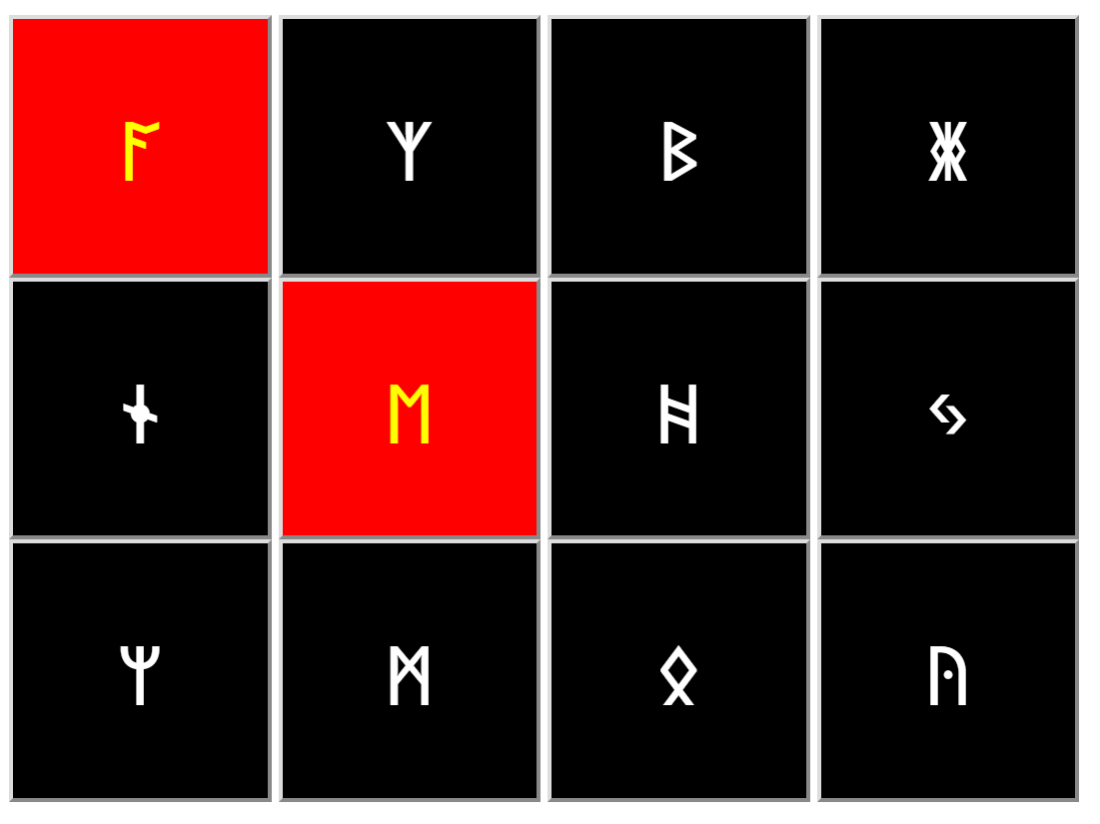
The Crux with two correct guesses

Using a bit of Javascript, I created a basic Chelish Crux. How it works:

  • When first loaded up, all squares are black. “The crux’s sides are all dark, save for the occasional flares of red light dancing at the edges.”
  • If a player touches a correct square, it turns red. “When you finish tracing that rune, the metal under your fingers begins to glow red from within, as if being heated in a forge, even though the metal is cool to the touch.”
  • If a player touches an incorrect square, the squares briefly go grey, and all lit squares go out. “For a moment, all lights fade on the crux, even those that appeared at the edges. All of the lit sides go dark once more”
  • If the player runs out of chances, the squares flash madly and then go to black. “As you finish tracing the rune, flames erupt from the edges, bathing the crux in flame and scorching your skin.” The player then takes fire damage. I did 1d8, but this can be adjusted to match the level of the campaign (theoretically, this could be made stronger if someone was willing to pay more).
  • After the explosion of flames, the players are allowed to make a roll to see if they see a pattern in the racing red lights at the edges.
    • A success means the hint level goes up by one. At the end of the URL, I add (or update) “?hl=” and then the number of the new hint level. So, for example, the URL might be https://therealkatie.net/gaming/puzzle-box.html?hl=4 if they’ve gotten four successes.
    • If they don’t make the roll, there’s no penalty. They simply need to go through the process again to trigger another failure
    • If the person holding the crux managed to get at least three more squares correct on that round, then that is considered an assist on the next disable device check.
  • The first time the players go up a hint level, they’ll see that one square is already red. “After studying the lights for a few minutes, you’re positive that this rune is the first rune you should trace. After that, you don’t know.”
  • If they’ve gone up multiple levels, “Studying the lights, you figure out the first few runes to trace, but after that, you’ll have to guess.”
  • If the players manage to get the combination, all of the squares go green, and I describe the box opening. “The box unfolds into a flat square made of metal and wood, about two feet by two feet.”

In game, I described the box as above, but said nothing else, allowing a player to toy around with the web page on my tablet. I only interjected the first time, explaining what it meant when the squares turned grey, red, or flashed. They figured out for themselves that they had to input a combination, and that the combination was twelve runes long, and that it reset. After each attempt, I’d have them make their disable device check, and if successful, I changed the URL to match their hint level and handed it back.

I believe it took about 15 minutes for the players to solve (I don’t think they ever failed a check), and they managed to get it open at the sixth hint level. I feel like it was much more engaging than just a series of skill checks, and making the puzzle physical forced everyone to stay engaged with who was holding the crux (and therefore who was taking the damage).

Feel free to play with the crux yourself, or if you want to, change the code to suit your needs! And apologies in advance for the extremely rough code. Since it was a single use project, the level of love that went into it was rather low.

Tide of Morning: An interlude for Council of Thieves

One of the things I’ve been wanting to do since I started Council of Thieves is a one-shot with the lower level Children of Westcrown. I wanted something that would fit the plot, but that was still something appropriate for them: Not too central, not too heroic, but still meaningful.

Because I didn’t feel like plunking down cash on a bunch of scenarios, I looked in my library for one that could work. Tide of Morning was about the right level, so I started reworking that.

From Paizo’s site:

Venture-Captain Dennel Hamshanks sends you to convince an Andoren druid named Hemzel to allow the Pathfinder Society to study his recently discovered lorestone, a minor magical item that unlocks some of the mysteries of the ancient Andoren druid circles. When you arrive and find Hemzel murdered and the lorestone missing, you must race against time to recover the lorestone and stop Hemzel’s murderers from using it against the druids of Andoran.

What I changed

The names, premise, and location, of course, had to be changed. Instead of Hamshanks, I had the request come from the visiting Pathfinder, Ailyn.

The new premise:

After returning from the Asmodean Knot, the Children of Westcrown are approached by Ailyn Ghontasavos (a visiting Pathfinder) about a delicate issue regarding a druid and an item of great power.

Years ago, a druid named Hezmel came into possession of a lorestone. Lorestones are vast magical repositories of druidic knowledge embedded in small stones. Studying lorestones provides information on natural phenomena such as weather patterns and seasonal changes, but can also unlock a deeper truth. Those who unlock these truths gain access to the lorestone’s true powers hidden within.

A group of Pathfinders caught wind of the lorestone and overstepped their bounds in trying to acquire it. According to them, they simply had a conversation with Hezmel that went poorly. Whatever actually happened, Hezmel fled to Chelliax, where the Pathfinders would hesitate to follow.

Ailyn has gotten word that Hezmel has settled disturbingly close to Westcrown, and she worries that the powers that be might take an interest in this lorestone. Hezmel has likely assumed that his proximity to the Hagwood will keep the city’s forces at bay, but he is woefully ignorant of what the city will risk for an interesting artifact.

Because the more experienced members of the group are unavailable, she has asked if some of less tried members can attempt to quietly warn Hezmel away. While she wouldn’t turn down a chance to add the lorestone to one of the Pathfinder lodges, all she asks is that the Children of Westcrown convince Hezmel to move his new circle further away from the prying eyes of Westcrown.

I also tweaked the motivations of the main villain, Cyflymder, to work with the AP cannon. Before the Council of Thieves AP begins, the hags of Hagwoods were involved with the Council of Thieves. Two of them were killed in a cover-up, and one fled. While the AP has her going back to the Hagwood, I’m opting to place her elsewhere. Since their murders / disappearance, there have been a number of fights due to the power vacuum, with Cyflymder being the latest pretender.

The ending is also slightly different, with Ailyn giving Vitti a month to study the artifact, allowing him to re-class as a druid. After Book Three is complete, she’ll be taking her leave of Westcrown and (theoretically) taking the lorestone with her.

The mains goal of this session are to get Vitti converted to a druid and to plant the seed that the remaining hag of the Hagwoods may have some information that could benefit the rebels (which will come up in the book, The Mother of Flies).

Getting started

I laid out the premise for this session right after the PCs returned from The Asmodean Knot. Due to their new fame, they’re being watched carefully, so it would be best if they spent a month being as boring as possible (this also allowed the players to use the downtime rules to re-class, start a business, and build a temple). They were asked to pick four of the rebels to go, with Jeniven and Areal suggesting Vitti, Sclavo, and Rizzardo. The PCs chose to send Amaya as a diplomat.

I made sure to suggest Sclavo, since one of the most important puzzles includes using the linguistics skill, and he’s the only rebel who’s trained in that. The puzzle could also be solved with comprehend languages or by someone who can speak Druidic, but that didn’t apply to any of the rebels they were likely to send (one of the PCs already had plans for Tarvi).

I sent the Hero Lab portfolios to the players, telling them that they could change the characters’ archetype, but not their base class. They could also outfit the characters with whatever was in the rebels’ armory, but if they bought something, they’d need to tell me where the cash came from (the rebels, outside of Tarvi and Yakopulio, live pretty much hand-to-mouth).

How’d it go?

It went really well! It offered a nice break from the characters everyone had been playing for so long, and everyone was able to give the character they were controlling their own spin.

One thing I didn’t expect: The characters left through the sewers, and I had zero maps / encounter tables at the ready for that. I ended up hand-waving that portion since the meat of the adventure was to be had outside of the city.

What would I change?

I would absolutely have sewers maps ready! In fact, this is something I’m going to have on hand from now on, just in case. I would also find another way to keep track of time. Most of our sessions take place in areas where time isn’t really an issue, but for this encounter, it could potentially change the final encounter quite a bit.

Overall, I feel like it was a solid scenario that I could see inserting into many a campaign, changing the lorestone as needed.

Council of Thieves: Book 2

The background

After getting back in the GM saddle with Book 1 (pw: council if it’s still protected), I decided to immediately get into book two.

From Paizo:

To banish the monstrous shadows that stalk Westcrown by night, the PCs go undercover, joining the city’s chaotic theatrical community in an elaborate plot to infiltrate the estate of the decadent lord-mayor. Yet theater life turns deadly when they become players in a spectacle no actor has ever survived. Can the PCs endure their debut performance in a city where an actor’s first big hit is often his last?

What I changed

Before the book

Since the PCs were taking an interest in the rebels, I decided to go with the implied suggestion that they should train up the lower level characters. I stuck with what I felt they could reasonably train, so we didn’t end up with a monk, druid, or barbarian. Before the first session, I sent out a list of what everyone had trained as.

My plan is to keep the rebels three levels behind the PCs with the assumption that they’re going out on their own missions. I’ll probably stop them all at some point, since there’s only so much experience you can get running around the city.

I also leveled up Janiven and Areal a bit, with both of them staying a level ahead of the PCs. At level five, however, I’ll probably only continue leveling Janiven (since that’s who they always bring along).

The rehearsals

Because one of my players was part of a theater troop, I ended up moving the rehearsals there. In story, this was because his sister (a bard), disapproved of his auditioning for a murder play and wanted to keep an eye on the production.

I decided to change the benefits for befriending cast members. I felt like the long-term benefits wouldn’t be clear to the players, so I switched some of them to short-term benefits. For befriending one of the actors (and consistently interacting with them), they got a re-roll on a performance check (basically, stealing the Advantage system from 5th Edition) or a bonus on their next perform check.

I also extended the hours that the actors were available by removing curfew for them. In game, the actors were allowed to retire to a bar to relax and socialize, and the mayor made sure they were escorted home afterwards.

As a bit of flavor, I had Yakopulio run a betting pool on who would survive the play. The players ended up betting on themselves, earning them a tidy sum after they all survived.

The play

For the play, I upped the reward amount since it seemed a bit low for such key roles (and because they had been creative about drumming up business for the play). I also played fight music from Oblivion for each scene (when I remembered), which helped set the mood.

Pre-Cornucopia

I ended up modifying the Cornucopia the most. One of the reasons I did this was because one of the PCs scolded Janiven (their fourth actor) for spending too much time dealing with rebel business and not focusing on the play. I had been keeping Janiven in the background in order to keep the spotlight on the PCs, with the excuse being that she was coordinating information gathering on the Mayor’s mansion and the Knot.

So, I had Janiven ‘hand off’ the duties to Yakopulio, meaning that the players now expected something concrete. After the play, Yakopulio came up with a few things:

  1. She could get one person on the inside as staff. Guards positions were already filled, but she could get a servant, groundskeeper, or stablehand in. She also nixed several people right off the bat: Tarvi (since she mingles with nobles, she’d be recognized), Areal (he’s known as a cleric and would stand out as a servant), Sclavo (since he works in court), and herself (since she’s setting up the deal).
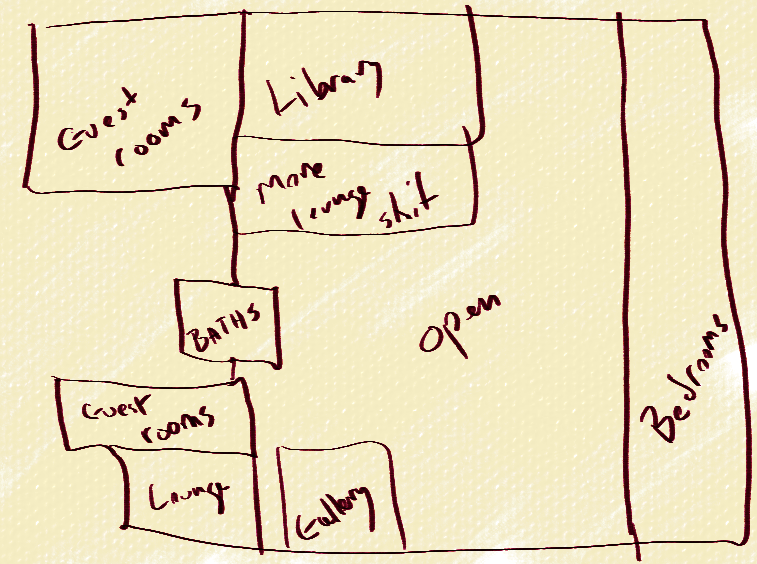
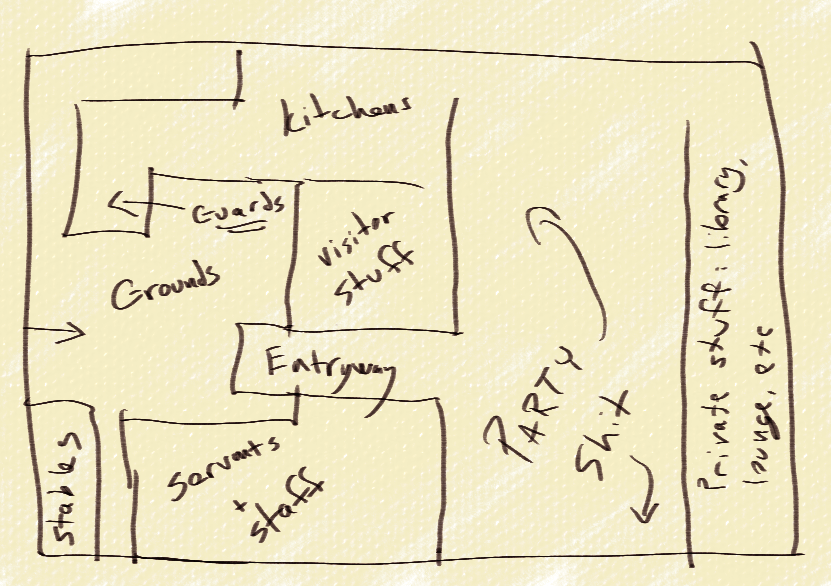
  2. She gave them a very rough map of the interior of the mayor’s mansion (below). Because she was getting this information verbally, the map is extremely rough. The attic wasn’t included because her informant (a former servant) wouldn’t have been allowed up there.
  3. She got a list of prominent nobles and dug up some information on each. Tarvi and Sclavo added their own thoughts on them.
  4. She got them a list of courses (which was kind of pointless, but I felt added some flavor).

Yakopulio’s beautiful maps:

firstfloorsecond floor

The players ended up picking Fiosa as their insider (her background as a servant made her more invisible). They also ended up bringing Tarvi as a ‘date.’ Tarvi served as a boost to any social checks, and Fiosa could have been used as a distraction / information gatherer (though they didn’t end up using her). They also would have been fine with going into the Knot, though the party ended up asking them to stay behind and leave at dawn with the other guests.

The Cornucopia

I kept the basic structure of the Cornucopia the same, but I realized quickly that the players were attempting to talk to the same people over and over again, which made sense. Wouldn’t someone have more than one piece of juicy information?

I decided to go ahead and let secrets from other characters come up as long as there was a chance that they would know that secret. I also made up a few other secrets to keep things interesting. I also decided to allude to Chammady’s brother, since it makes sense that the other nobles would know of him, but not know that he’s a tiefling. All they know is that he exists and has been working in another town in Chelliax for some time.

Amusingly enough, the one noble that they all agreed was a good potential ally was… Chammady.

The Asmodean Knot

I ended up not needing to make any mods to the Asmodean Knot. Personally, I think it’s a great dungeon, and I ended up running it as a one-shot at a conference. Since our sessions are only four hours long, it ended up being a two session romp, including the winding up.

I had been worried about the maze, but the players (happily) solved the puzzle via the open/close spell. I truly do pity the group who doesn’t bring a druid or magic user with them…

The Knot also ended up solving a big problem I had with the AP: How Chammady knows that the PCs are members of the Children of Westcrown. Because the PCs don’t advertise the fact that they’re rebels, even with them being in the play, it should be nearly impossible for Chammady to sort out their night-time activities. Westcrown is a big city, and she has quite a few irons in the fire!

Sian escaped her encounter with the PCs and, of course, reported back to Chammady that she ran into the heroes. While she didn’t know exactly who they were (she wasn’t at the play), the description of the foursome was enough for Chammady to draw some conclusions.

How Chammady chooses to use this information will largely depend on what the players decide to do when they encounter her in the next book. She may mark them for extermination… or she may chose to manipulate them to take out other troublesome foes.

Tech I used

Because this book involved lots of maps where there was little fighting, I decided to use Roll20. This wasn’t especially disruptive since everyone was already bringing their laptops to games. The only rooms I drew out on a paper map were ones where combat was highly likely.

I did have to edit the maps to remove secret doorways, but it ended up saving me a lot of time double checking a ton of tiny rooms and some of the trickier puzzles of the Knot.

If I had to do it over again…

I would have put Ailyn’s pitch in a note. Most of the players were so distracted by the play that they kept forgetting why they were doing all of this crazy stuff in the first place. I may have even put it on a ‘secret page’ to set up the idea that they might see one of these later.

I would also try to give them more concrete evidence that there was something in the Mayor’s mansion, and that the play was the only way to get in. While the players went along, the plot thread felt more like marching towards a darling than anything else.

As fun as the dinner was, I probably would either shorten it or do the dinner in one session and the hunt through the house in the second. Things got a bit rushed as I was trying to end the game for the night at a good stopping point.

Final thoughts

This book is probably one of the reasons that some people hate this AP, but my group loved it. They enjoy role playing, and there was no shortage of that with these chapters. Pretty much everything until the end is a long role play session.

I used the Knot as a one shot at a conference, and it was a great hit. It needed only a tiny bit of cleaning up, and with a bit more tightening, I feel like it could be made to fit into a nice four-hour time frame.

In fact, even if you don’t plan on running CoT, I highly recommend picking it up. If you scrub the plot from it (which isn’t hard), you end up with three interesting scenarios that can be dropped into many adventures: A murder play, a fancy dinner party, and an interesting dungeon that’s more than just a series of mobs.

Running a one-shot at PyCon 2018

Nearly every year, I make the trek out to PyCon US. Most of my time is taken up with running a kids coding class, being an auctioneer, and maybe seeing a talk or two. Some years, I like to bring a special event with me that’s not explicitly about coding or the open source community.

This year, I thought I’d do a one-shot on the first day of sprints. I’d never run a one-shot before (if you discount a few failed starts at campaigns…), but most of my sessions run for a set amount of time and I’m pretty good at ending at a logical point, so I figured I was as ready as I could be to do my first.

So I packed up a kit, made a few tweets, and then met my players at 4.

How’d it go?!

It went amazingly well! In my regular game, we’re in it for the long haul, so the players are more cautious. With the one-shot players, everyone knew that they could just grab a new character if they died, so they were happy to take huge risks (most of which paid off!). It was hectic and crazy and full of players just barrelling through to keep things interesting.

We only got halfway through the dungeon, but I thought that might happen. We found a good stopping point, though, after which I told them about some of the rest rooms and how some of the choices they made would have played out if they’d gone a different direction.

The scenario

Because it was fresh in my mind, I used the end dungeon from Book 2 of The Council of Thieves. You can pretty much use it wholesale without much rewriting. I ended up changing the opening and rewriting the motivations of one NPC (who they never met).

The new opening:

One day, you’re all called to your local Pathfinder lodge. A few days ago, a crowd of new adventurers took on a contract to clear out the long abandoned mansion of a crazed mage, Vheed. The town had been on the verge of taking him out on their own due to rumors of gruesome experiments, but found he was missing. Uncertain as to what to do, they opted to leave the mansion alone, worried burning it down might unleash some magics they were unprepared to deal with.

A band of goblins had taken up residence, so the Lodge was tasked with clearing them out. The adventurers did so easily, but then came upon the entrance to what appears to be a pocket dimension. Stating that they “weren’t being paid nearly enough”, they returned and asked the task be finished by someone else.

I skipped over the trip to the mansion and getting to the dungeon, dropping them in the first room right off the bat.

As for the NPC, the assassin Sian is merely someone who heard of the fleeing adventurers and is determined to find what the dungeon holds before anyone else. Because of this, though, I decided that she could possibly be talked into joining the party, though she would still try to get the drop on them. It would take some fairly high rolls, but I’ve learned to never underestimate the ability of players to sell crazy plans.

Her arrival time means that the first adventurers did not see a body, allowing the players to deduce that they’re not alone in this dungeon.

I also dropped everyone’s level to four since so many people showed up, and spare characters were available if anyone bought it. Also, the sheets I found only had the levels one, four, and seven, and I didn’t want to spend time leveling up on PDFs.

The materials

The kit I ended up taking was an interesting mix of high-tech and no-tech.

Because I’ve taken to printing out my Adventure Paths, I went ahead and took my current game binder. I also took my dice box since I knew most people wouldn’t have their own, and you know there will always be at least one player who refuses to use a dice roller on their phone.

However, I completely forgot to bring character sheets. I had them all collected into a PDF for printing, but in the rush of packing, left it on my personal computer. Fortunately, some kind soul had collected all of the pregens for Pathfinder Society games, so I passed that out to players digitally.

I also used Roll20 since there was no way I was packing maps and markers. Besides, I already had that game set up for my current group, so making a new session was trivial. I made a bunch of throwaway accounts since I wasn’t certain that people would want to create one of their own. Out of a group of ten or so, though, only one got used, so it looks like Roll20 got some new users!

I also set up a ton of tokens ahead of time, which saved time in getting people set up. I used a batch of icons from Icons8 because they’re highly distinct even at low resolutions.

Finally, I brought a portable monitor as a fallback for anyone who couldn’t use their computer. It ended up being pretty useful for showing information to people, though I ended up tweeting out most links that people needed.

What I’d do differently

Well, first off, I’d remember to bring printed character sheets…

I’d also run a shorter scenario. That, or rework the dungeon I used to be shorter. There are a few bits that could be removed without hurting the overall feel, like some acrobatic puzzles and a rather large maze. There’s also a prison area where I feel like everyone would choose to avoid the encounter, it may just be better to leave it out. This would mean moving the glaive to another area of the dungeon, but there’s more than a few places to stash it. Maybe Sian found it, or maybe Jabe could be wielding it.

While my players opted to not get the reward from Livia, I think I’d have to change what she gives them. Instead of six answers (which is of little importance in a one-shot), I’d probably give out some potions of lesser restoration. In The Council of Thieves, the players start out with four, so I feel like that would be a fair swap.

I’d also make a formal sign up page so it would be easier to contact everyone. This one should have been a no-brainer, but I forgot how little time I spend on my laptop at conferences. I would also make the throwaway accounts available to those who signed up so they can claim them right away.

Because I didn’t know how many people would show up, I didn’t gather up tables in advance, which meant we were scrambling a bit to grab enough. Next year, I may just grab a table in a sprint room since most of them emptied out by the time we started. Also, since others may want to join me in running one-shots next year, grabbing a room for the evening may be a good thing to arrange in advance.

By next year I might have a new travel laptop. If that’s the case, I’ll bring Hero Lab with me. While I did okay, there was some fumbling looking things up mid-combat, especially as we ventured into rooms I hadn’t done yet.

We also had some people with no laptops or tablets. I was able to put one of them onto a spare iPad while the other looked on. I’m not sure what I could do about that (they were an attendee’s children didn’t have laptops in the first place), but maybe if I knew ahead of time, I could arrange extra tablets.

Will I do it again?

Absolutely. It was a chaotic, wonderful blast, and a great way to blow off steam after a hectic conference. Even people who hadn’t gamed in decades were able to get up to speed quickly, and everyone who attended (or even watched!) seemed to have a great time.

Next year…

There’s some talk of doing a custom adventure that takes some jabs at Python and its community. Also, some others said they’d like to bring their kits and join in on doing one-shots, which would help if we manage to get a bigger crowd. I have a feeling that’s likely, since even with my lackadaisical organization, we had started with a group of ten.

Though running a table top has little to do with coding, I love events like this that let us just be people around each other, rather than just coders. We all joked, laughed, and egged each other on to do crazier and crazier stunts. It’s a great chance to meet some new people and see people I’ve known for years in a completely different light.

Council of Thieves: Book 1

The background

I was super keen to run a game again, but I knew I didn’t have the time or energy to do a homebrew one. My husband convinced me to run a Pathfinder AP, and looking them over, I actually though Council of Thieves would be similar to an aborted Thieves’ guild game. The opposite was true, but I had free access to the books through a friend, so I figured the most I could lose was a few evenings.

From Paizo’s website:

The city of Westcrown is dying. Since being stripped of its station as the capital of Cheliax, the wealth and prestige of the city has gradually slipped away, leaving the desperate people to fend for themselves in a city beset by criminals, a corrupt nobility, and a shadowy curse. Can the PCs fight back against champions of both the law and the criminal world?

What I changed

For this book, I was getting used to running an AP, so I changed very little. The one thing that did change due to players actions was that they allowed Palaveen to live. As of book two, I haven’t brought him up again and they haven’t sought him out. At the moment, he’s in hiding in the burnt out part of the city, mostly because he doesn’t have the funds or connections to leave town.

I also accidentally left out the Thesing horse drama, but thankfully, one of the PCs belonged to a theater. I simply moved Thesing’s performance there (saying the other theater was closed due to an outbreak of some kind of flu) and made sure that Thesing was embarrassed and blamed the PCs for it.

What I made

For the sewer chase scene, I decided that I didn’t want to roll on a bunch of tables while trying to run my first session in years. Instead, I made a Python script to do it for me.

Script on Github

I drew out each map in advance, then hit enter for each junction. The script would tell me how hard it was to find the waymarker and if there was any event, and if so, what event was it.

I also made a dice roller (because of course the world needs another one!):

Script on Github

It’s function is basically to give me a roll with only one or two key presses. All dice types are rolled at once, and if I enter a number, it automatically adds it to the rolls. I used this script throughout the first book, but stopped using it with book two for most combats. For super secret rolls, however, I still keep it up.

If I had to do it over again…

The book advises you to tell the players before the start that they should have some reason to want to better the city of Westcrown. I trusted that my players would follow whatever plot hook was laid out (since that’s our nature). They didn’t exactly fight me… but there were several sessions where they repeatedly asked each other why they were doing this. So, if I run it again, I would probably lay that out during session zero.

Also, the opening scene didn’t play well with the players, role play-wise. It took them a long time to see Janiven and the rebel organization as competent or, frankly, worth their time. Also, they weren’t exactly happy that they’d been brought together under false pretenses. If I run this sort of thing again, I would probably be more overt about the fact that this is about joining the rebels.

Honestly, what I would probably do instead is let them say yes to joining, then have them found out during a second meeting (maybe they’re setting up the bar that Janiven and Areal bought as a proper safe house).

As for the sewers, I think I would up the encounter rate, up the difficulty of the monsters, and write out the ‘special’ events in advance.

For the final battle, I went easy on the PCs, with battles not alerting anyone else. Looking back, I think they could have taken a bit more pressure.

Final thoughts

I feel like this was a good book with which to start GM’ing again. The plot is pretty straightforward, the scenarios are well laid out, and it has enough room for creativity without forcing the GM to write up huge sections for themselves. I do wish that the background was more explicit about who will be important in the future, since the background has almost nothing to do with what the players are encountering.