
Ever since I saw Matt Colville’s video on running a West Marches campaign, I’d wanted to run one. For those who don’t know, a West Marches campaign turns the idea of a ‘gaming table’ upside down.
- Instead of one GM and a set number of players, you have a huge pool of players. You may even have a pool of GMs.
- Instead of a set group of players showing up every week, players self-organize into groups and then figure out a time that works with a GM.
- Instead of a plot that takes a group around the world, travelling from town to town, the plot centers around a single town that has the Buffy-like habit of drawing problems to it.
- Instead of a monolith plot, there are multiple threads going on at any time, allowing players to investigate what interests them.
I love the idea of being able to game with a larger group of players, running a plot that was less focused on telling a grand story and more a collection of interesting situations. While I do love a good epic story, it can be exhausting to plot for (especially if you’re an obsessive planner like me). And the allure of having other GMs to fall back on is especially nice. At the time, though, I was already running a campaign, so I put the idea on the back-burner.
Fast-forward to a few months ago, and an interesting opportunity fell in my lap: Becoming a GM for a RP server that hooked into the world of Court of Corvids. I pitched the idea of doing it West Marches style, and Kellandale was born.
The system
One of the biggest hurdles to having a game with handfuls of players and multiple GMs was also the most boring: Record keeping. How do you keep track of XP awarded, gold, purchases, who is playing what, what allowances have been made… After reviewing bots and a moment of madness where I considered writing up an app, we ended up going the route of simplicity.
XP is awarded monthly to everyone on the server. It’s based on the amount of server chatter that month, which we measure by using MEE6. Total server levels * 2 = Total XP for that month. This made keeping track of what level everyone is super easy, since you can find out when someone joined by searching for their username. Does this mean someone could join, say nothing, then roll in a few months later with a level three champion? Sure. But that’s balanced by…
The only way to get gold is to go on missions. When you start on the server, you get 15 gold for your starter gear. After that, if you want to buy gear, runes, potions, spells, or any other adventuring gear, you have to go on a GM-lead mission.
The only thing you get from missions is gold. Now, I love loot as much as the next GM, but I also appreciate the need for balance. Balance is easy at a table with one GM and four players: Just look at their sheets and make sure that they have a similar amount of cool stuff. Is someone behind? Drop something for them in the next encounter. But what do you do on a server where you have multiple GMs and a gaggle of players? How do you make sure everyone has the same access to cool stuff?
The town sells everything you need. The boring solution was you give everyone the same access to cool stuff. Players get a certain amount of gold for every mission. There’s no looting the bodies and selling the gear back at town. Chests don’t hold more than low-level healing potions or items for flavor. Kellandale is a town that’s “big enough” to buy any item you need, as long as you have the gold in hand.
RAW at all times. Aside from a few house-rules that had to be implemented due to the strange nature of the game, we stick to RAW, Paizo-only at all times. This does mean less flavor for players, since they can’t have a cool, GM-bespoke weapon that feeds into their character’s history. Tracking exceptions was too much of a headache, though. We balance that with…
Your rent is paid. Gold earned through missions goes towards adventuring equipment. It’s presumed that the PCs are earning spending money throughout the week using their Lore skills, so rather than roll for it, we assume that they make enough to pay for room and board. Want to go out for a nice dinner? No need to mark down that you spent 5 silver on some Cheesy Chicken at Massimo’s. It’s covered. Want to have a cool looking weapon with no mechanical benefits? Go to town. Heck, want to own a house? As long as it fits your background, go for it.
The GM decides how to run the session. We decided early on that standardizing was going to create a bigger headache than it was worth. So, if a GM is running a session, they decide how they’re going to run it. So far, we’ve run games via voice-only, text, and Roll20, but I wouldn’t be surprised to see a few other options pop up at some point. The only catch is that it has to be free for players to access.
Offer alts. One problem we realized we would have eventually is that eventually we would have wide spread of character levels. Older players might want to play with the newer players, but taking a level one along on an adventure with a crew of level fives is practically impossible to balance.
We decided to balance this by allowing alts. Once your first character hit level three, you could roll up a free level one alt. After this, monthly XP would be split between the player’s characters however they chose. Racing to get to to 20? Don’t put any XP on your alt. Want to play at the lower ranks for a while? Toss them all on there, or split them between the two characters. Get your alt to level three, and you can create a third character.
Messaging stones. Several of us came from a modern-setting server where everyone had a smart phone, so everyone could message everyone else. This was super convenient, since it allowed players to communicate without having to ‘happen’ to run into each other or having to run a scene for a quick exchange. Golarian, of course, doesn’t have a data network… but it does have magic! So we created a simple, yet powerful, mechanic: Messaging stones.
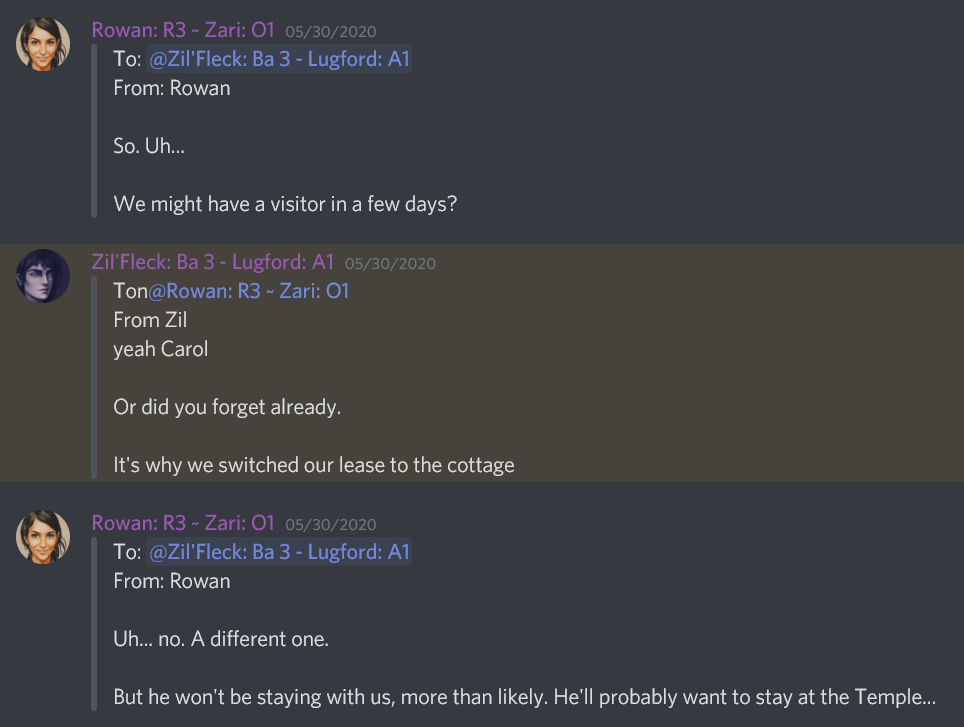
Every PC is given a free messaging stone when they come to Kellandale. Once they have it, they can send messages to any other PC who has a stone, as long as they’ve met them in game. Yes, they are incredibly powerful, and I would likely ban them at a regular tabletop game, but for a server filled with people in time zones around the world, it’s been the grease that keeps the gears moving.
How’s it going?
We started the server in December, though the first sign-ups didn’t happen until January. Since then, we’ve gone from barely having enough players to keep one GM busy to needing to bring on a fourth GM to make sure all players can be in a session regularly. On the way, we learned some things.
Figuring out sign-ups. One of the suggestions in Colville’s West Marches video was that players would self-organize. It became clear (at least to me) early on that players were not going to self-organize into groups and approach a GM. After all, this was a server where most players barely knew each other. The original West Marches campaign was made of friends. While we’re still feeling our way around the best way to do this, some patterns have emerged.
First, we learned to use the @everyone tag to let people know something is happening. If you’re in one Discord server, you’re probably in a dozen. We couldn’t depend on people checking in every few days.
Second, we started using reactions to figure out what time works best for interested players. For my games, a check meant you were interested and available, an O meant you were interested in being an alt, and an X meant that time absolutely didn’t work for you.

After a day, I’d look over who was interested and set up the next few sessions. Turnaround time ended up being super important, since waiting too long to get on people’s calendars often lead to people getting booked elsewhere. I could almost always get everyone squeezed in, but if it came down to it, I’d have some people put down as alts with first dibs.
Embracing the meta. Everyone is in a town for the long haul. We’re never leaving, save for a short jaunt. Therefore, if you make a character, they have to have a reason to settle down. And yes, weird things are always going to happen around town, since we can’t travel far, so learn to hang a hat on it.
Building encounters properly is important. This one was a tough lesson to learn. As a GM, you never know who’s showing up to your game. Even if the sign-up was finalized a week before, players shift around, someone decides to bring their alt rather than their main, you get late adds and drops. If there was ever a game where you needed to live by the encounter building rules, it’s a PF2 West Marches campaign.
I learned to be super flexible with planned mobs. As combat got underway, I’d keep an eye on how the group was doing and delete out-of-sight trash mobs if needed. I’d also liberally apply elite or weak adjustments if I felt like the players needed a challenge or a break. I also planned when I could, making sure to calculate a few options so I wouldn’t be sent scrambling if a level 3 didn’t show, and suddenly the APL dropped by one.
Discord data! I love me some data, and since the server was on Discord, I had so much data. Discord has an API you can hit that allows you to download all of the channel data from any Discord you’re a member of. I ended up using said data to create a roster, grab who the new players were, check out which reacts were getting the most use, and see patterns for channel usage.
Future questions
Just because we’ve been doing this for half a year doesn’t mean we know everything. There’s a few issues we’ll have to wrangle with down the road.
Higher level play? The highest level characters on the server right now are level 3. We’ll likely have our first level four characters in August. While we’re not at high-tier play, we are entering into the middle-tier. Do we need to start putting together more complex plots for these higher level characters, or do we just put bigger rats in basements?
The trickiest part about introducing high level play is that there’ll still be lower-level characters running around town. How do we introduce big threats without making it improbable that a level one would stick around?
Level caps? Forced retirement? If a player never puts XP on their alt, they’ll get enough XP to level about every two months. This puts super high-level play off in the future, but mid-tier play is quickly approaching. Do we need to do anything to keep the levels of the characters flatter, or is it okay to have a small group that’s rocketing ahead? And what happens when someone reaches level 20? Do they continue to play, or do they fall into the background, allowing the player to start over again?
Scaling? Right now, we have just over 20 active players (which includes GMs), and four active GMs. This seems to work out fine, as people are able to be in sessions. But will this ratio still work if we hit 40 players? Or 100?
Want to join us?
Kellandale is tied to Queuetime’s Patreon. Anyone who donates once to the $5 tier gets access to the RP Discord and can sign up for sessions as soon as they have an approved character sheet.
[ Sign created with http://apps.pathstoadventure.com/Tavern-Sign-Crafter/craft.asp ]
 Katie Plays Games