
At the end of Book Two of The Council of Thieves, the players find a strange artifact called the Chelish Crux. Book three opens with the players trying to open it. From the AP:
This strange and baffling object appears as a wooden and metal dodecahedron that measures about 6 inches in diameter— each face of the crux is carved with a different rune, and when one looks upon the thing, the observer has the unsettling sensation that he can see too many or too few sides at once.
To open the box, the players must trace the symbols on the outside of the crux in the correct order. If the correct symbol is traced, it lights up. If an incorrect symbol is traced, all of the lit symbols go out and the player must start from the beginning. After a certain number of unsuccessful tries, the box erupts into flame, causing fire damage to whoever was holding it and resetting the combination.
Basically, it’s Hell’s Simon.
In the book, the players open the box via a series of skill checks, but being a code monkey, I figured I could do one better: Make a virtual one!
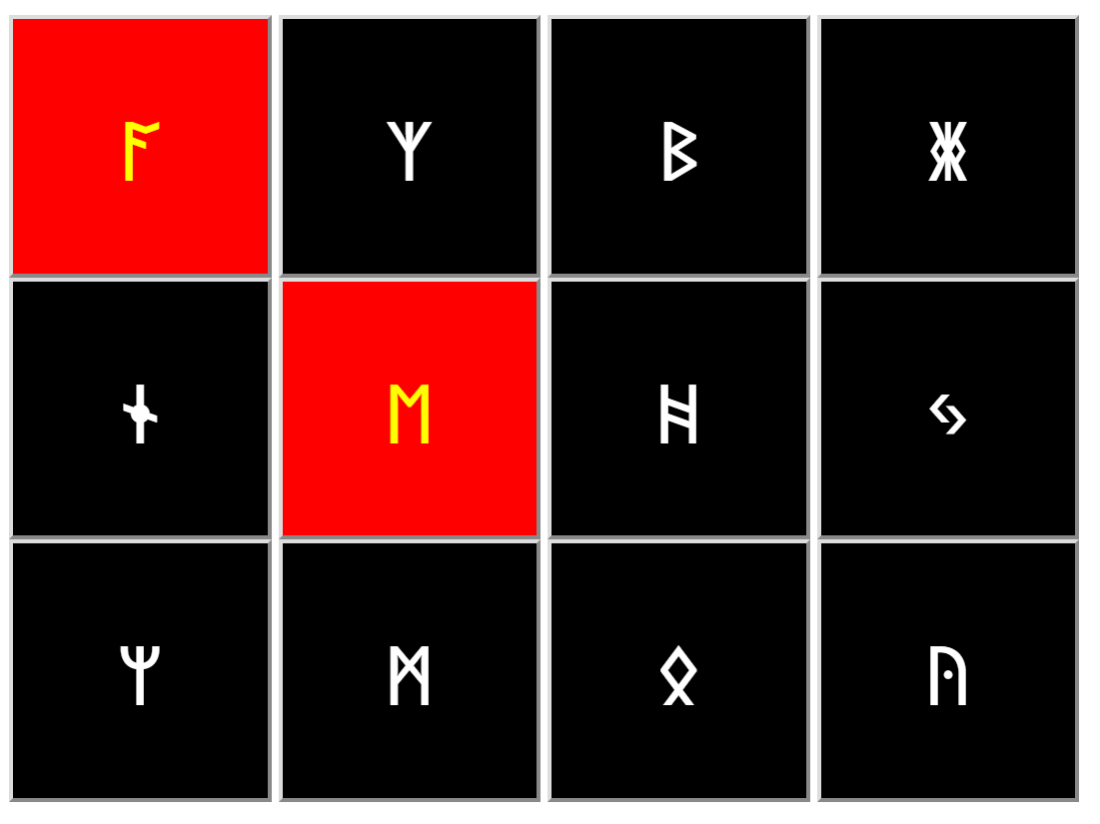
Using a bit of Javascript, I created a basic Chelish Crux. How it works:
- When first loaded up, all squares are black. “The crux’s sides are all dark, save for the occasional flares of red light dancing at the edges.”
- If a player touches a correct square, it turns red. “When you finish tracing that rune, the metal under your fingers begins to glow red from within, as if being heated in a forge, even though the metal is cool to the touch.”
- If a player touches an incorrect square, the squares briefly go grey, and all lit squares go out. “For a moment, all lights fade on the crux, even those that appeared at the edges. All of the lit sides go dark once more”
- If the player runs out of chances, the squares flash madly and then go to black. “As you finish tracing the rune, flames erupt from the edges, bathing the crux in flame and scorching your skin.” The player then takes fire damage. I did 1d8, but this can be adjusted to match the level of the campaign (theoretically, this could be made stronger if someone was willing to pay more).
- After the explosion of flames, the players are allowed to make a roll to see if they see a pattern in the racing red lights at the edges.
- A success means the hint level goes up by one. At the end of the URL, I add (or update) “?hl=” and then the number of the new hint level. So, for example, the URL might be https://therealkatie.net/gaming/puzzle-box.html?hl=4 if they’ve gotten four successes.
- If they don’t make the roll, there’s no penalty. They simply need to go through the process again to trigger another failure
- If the person holding the crux managed to get at least three more squares correct on that round, then that is considered an assist on the next disable device check.
- The first time the players go up a hint level, they’ll see that one square is already red. “After studying the lights for a few minutes, you’re positive that this rune is the first rune you should trace. After that, you don’t know.”
- If they’ve gone up multiple levels, “Studying the lights, you figure out the first few runes to trace, but after that, you’ll have to guess.”
- If the players manage to get the combination, all of the squares go green, and I describe the box opening. “The box unfolds into a flat square made of metal and wood, about two feet by two feet.”
In game, I described the box as above, but said nothing else, allowing a player to toy around with the web page on my tablet. I only interjected the first time, explaining what it meant when the squares turned grey, red, or flashed. They figured out for themselves that they had to input a combination, and that the combination was twelve runes long, and that it reset. After each attempt, I’d have them make their disable device check, and if successful, I changed the URL to match their hint level and handed it back.
I believe it took about 15 minutes for the players to solve (I don’t think they ever failed a check), and they managed to get it open at the sixth hint level. I feel like it was much more engaging than just a series of skill checks, and making the puzzle physical forced everyone to stay engaged with who was holding the crux (and therefore who was taking the damage).
Feel free to play with the crux yourself, or if you want to, change the code to suit your needs! And apologies in advance for the extremely rough code. Since it was a single use project, the level of love that went into it was rather low.
 Katie Plays Games